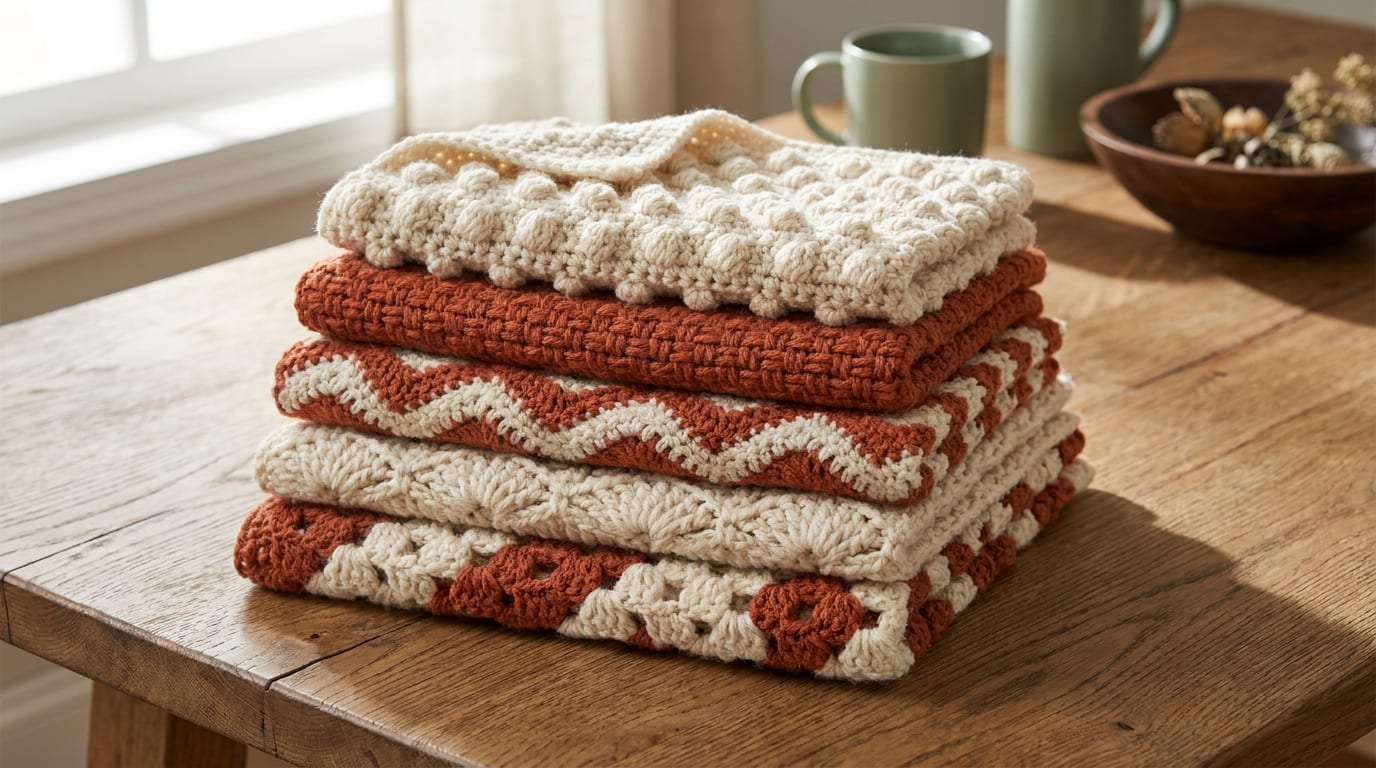
Your crochet blanket stitch decides everything
The crochet blanket stitch you pick matters more than the yarn, the color, or the pattern you saw on Pinterest. The same skein of cream wool becomes a stiff, warm throw in single crochet and a soft, drapey one in double crochet. One stitch traps heat. Another lets a breeze through. One races along at four rows an evening. Another packs so much texture that a small lap blanket eats a whole extra ball of yarn. Before you start a blanket, the single most useful thing you can decide is which stitch carries it.
This guide walks through the stitches crocheters actually reach for when they make blankets and afghans, what each one is good for, and how to match the stitch to the blanket you have in your head. If you already know your foundation stitches and want help choosing between them, you are in the right place. If the stitch names themselves are new, the crochet stitches library defines each one with photos first.
How the stitch changes a blanket
A blanket is mostly fabric, so the stitch that makes the fabric controls how the whole thing feels. Five things shift with your choice, and they trade off against each other.
Drape is how the fabric falls and folds. Short, dense stitches hold their shape and feel firm. Tall, open stitches flow and pool. A blanket you want to wrap around your shoulders wants drape. A blanket you want to stand up to years of being dragged across the floor wants the firmer end.
Density and warmth travel together. Stitches worked close, with little space between them, trap air and hold heat. Stitches with gaps breathe. A dense single crochet throw is genuinely warmer than an airy double crochet one in the same yarn.
Speed is how fast the blanket grows. Taller stitches cover more height per row, so they finish faster. A double crochet blanket can take half the time of the same blanket in single crochet.
Yarn use runs the other way. Taller and textured stitches eat more yarn per square inch, even though they grow faster, because each stitch uses a longer length of yarn. A bobble blanket is hungry. A flat single crochet one is hungry in a different way, since it packs so many short stitches into the space.
Keep those four in mind and every stitch below makes sense as a set of trade-offs rather than a popularity contest.
The foundation stitches for blankets
Three stitches do most of the blanket work in most patterns. They are the plain, reliable choices, and any of them makes a finished blanket you will be happy with.
Single crochet (sc)
Single crochet (UK: double crochet) is short and dense, the most solid of the everyday stitches. You insert the hook, pull up a loop, then yarn over and pull through both loops on the hook. The fabric that results is tight, sturdy, and very warm, with almost no gaps. That makes it the choice for a hard-wearing blanket meant to survive kids, pets, and the washing machine, or for a winter throw where warmth is the whole point.
The catch is speed and yarn. Single crochet is the slowest of the three and the heaviest on yarn per square inch, because you are working a huge number of short stitches to fill the same area. For a full-size single crochet blanket, plan for plenty of time and plenty of skeins. See the full single crochet walkthrough if you want the step-by-step.
Half double crochet (hdc)
Half double crochet (UK: half treble) sits one rung up from single crochet, a touch taller, with a slightly thicker, squishier feel. You yarn over first, insert the hook, pull up a loop, then yarn over once more and pull through all three loops at once. That single pull-through gives the stitch its soft, plush character. It stays warm and cozy, lies fairly flat, and grows noticeably faster than single crochet.
This is the friendly all-rounder, and the one I steer most beginners toward for a first blanket. It forgives uneven tension, it does not curl as stubbornly as single crochet, and it lands in a sweet spot between warmth and speed. The half double crochet guide covers the technique in detail.
Double crochet (dc)
Double crochet (UK: treble) is the tall, fast, classic blanket stitch. You yarn over, insert the hook, pull up a loop, then clear the loops two at a time across two pull-throughs. The taller stitch grows rows quickly and leaves small, regular gaps that give the fabric a soft drape and a little openness.
If you want a blanket finished in a reasonable stretch of evenings, double crochet is the obvious pick. It is drapey rather than stiff, lighter than the dense stitches, and it works beautifully for color stripes since each tall row reads as a clear band. The trade-off is warmth: those little gaps that create the lovely drape also let some heat escape. The double crochet reference has the full method.
Textured and decorative blanket stitches
Once you want more than a plain field of stitches, these add rhythm, pattern, and personality. Almost all of them are built from the foundation stitches you just met, grouped or arranged in a clever way.
Granny stitch
The granny stitch is clusters of double crochet separated by chain spaces, worked in rows or in rounds. It is rhythmic, fast, and forgiving, and the chain spaces make it genuinely easy to see where the next cluster goes, which is why it stays a favorite for relaxed, in-front-of-the-television crochet. It works as a single giant granny square grown outward, as long rows across a throw, or as small squares joined together. The look is open and classic. The granny stitch guide shows the cluster rhythm step by step, and our granny square blanket walkthrough covers building a whole blanket from it.
Shell stitch
The shell stitch fans several stitches, usually double crochets, out of a single point so they spread like a scallop or a seashell. Worked in repeats across a row, the fans line up into a pretty, wavy texture that gives a blanket a soft, slightly lacy, romantic feel. Shells drape well, they are forgiving once you find the repeat, and they make a lovely border even if you work the body in something plainer. The shell stitch reference breaks down the fan.
Ripple and chevron
The ripple stitch, also called chevron, uses regular increases and decreases across each row to push the fabric into a steady zigzag of peaks and valleys. The waves are the whole appeal, and they do something clever with color: because the row is already moving up and down, a change of yarn color follows the zigzag and the join all but disappears. That makes ripple the natural home for striped, multicolor blankets where you would otherwise fuss over hiding color changes. The ripple stitch guide covers the increase and decrease rhythm.
Moss stitch (linen or granite)
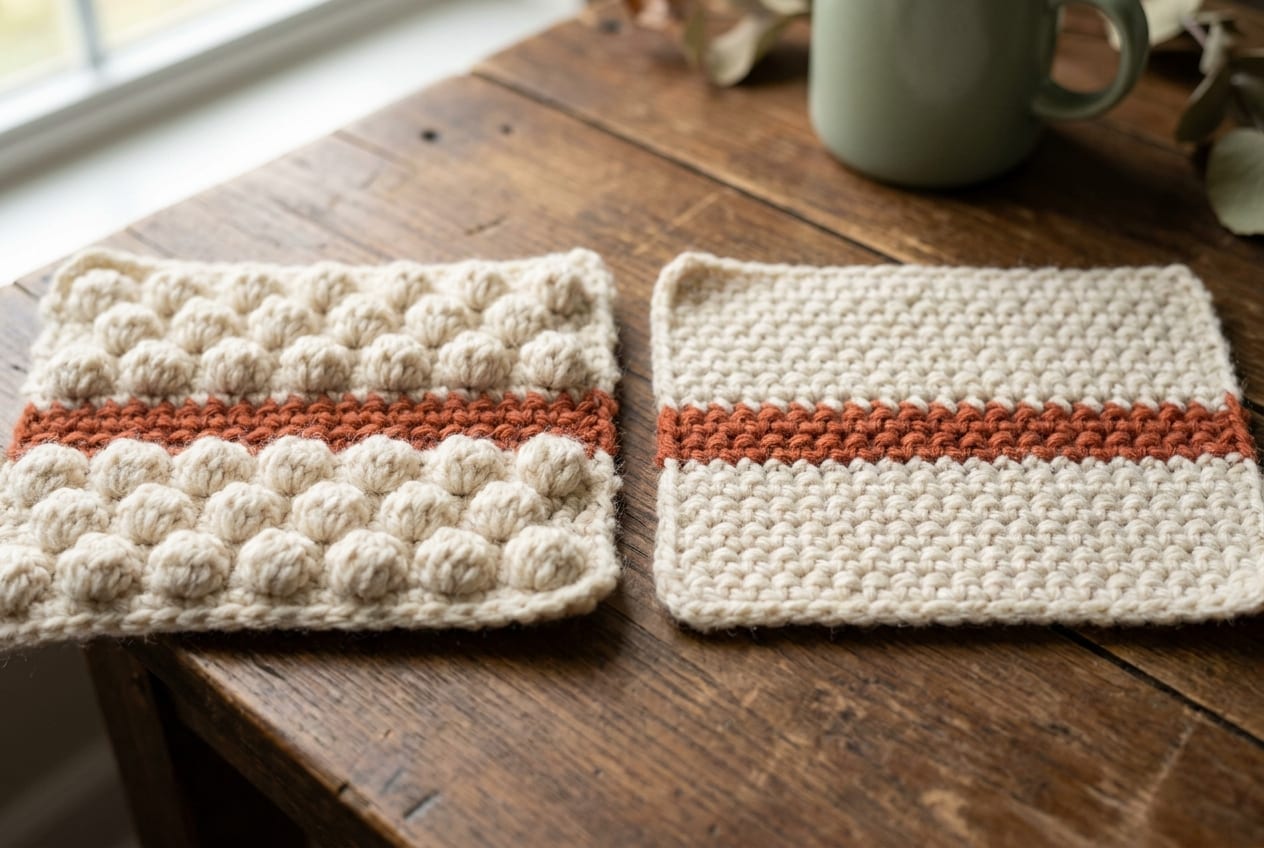
The moss stitch, also sold under the names linen stitch and granite stitch, alternates single crochet and chain-1 across the row, then offsets the pattern so each row's single crochets sit over the previous row's chain spaces. The result is a flat, modern fabric that does not curl, dense enough to feel substantial yet light enough to drape. It reads as a clean, refined weave rather than an obvious crochet texture, which makes it a quiet favorite for a plain, grown-up blanket in a single color. It is also easy to keep straight once the one-row rhythm clicks, since you are always working into a gap. For a calm, understated throw, this is hard to beat.
Bobble and waffle stitches
The bobble stitch and the waffle stitch both push the fabric into raised, plush, three-dimensional texture. A bobble is several stitches worked into one place and gathered at the top into a soft bump, scattered across the blanket like a field of dots. The waffle stitch uses front-post stitches to build a deep grid of raised squares, like the surface of an actual waffle. Both make a blanket that is cozy, weighty, and wonderfully tactile.
The price is speed and yarn. All that raised texture means more stitches packed into the same area, so these are slower to work and the most yarn-hungry options on this list. Budget extra of both. The bobble stitch and waffle stitch guides show how the texture is built.
C2C for picture blankets
Corner to corner, almost always shortened to C2C, is less a single stitch than a way of building the fabric. You work small blocks on the diagonal, starting in one corner, increasing out to the widest point, then decreasing back to the opposite corner. Each little block sits like a pixel, which is the whole point: by changing color block by block from a chart, you can crochet a picture, a monogram, a graph, or a geometric design into the blanket itself.
If your blanket has a picture in it, C2C is usually how it got there. It works up faster than it looks, the diagonal rhythm is satisfying once it clicks, and it carries color changes cleanly. Our C2C blanket pattern walks through the corner-to-corner construction from the first block.
Crochet blanket stitches compared
Here are the stitches above lined up so the trade-offs are easy to scan. None of this is a rule, just the tendencies that hold across most yarns. Read across the row to match a stitch to what you care about most.
| Stitch | Look | Speed | Yarn use | Best for | |---|---|---|---|---| | Single crochet | Tight, solid, flat | Slow | High | Sturdy, warm, hard-wearing blankets | | Half double crochet | Soft, squishy, fairly flat | Medium | Medium | Friendly all-rounder, beginner blankets | | Double crochet | Drapey, slightly open | Fast | Medium | Classic quick blankets and stripes | | Granny stitch | Open clusters, classic | Fast | Medium | Relaxed throws, joined squares | | Shell stitch | Fanned scallops, lacy | Medium | Medium | Pretty, drapey, decorative blankets | | Ripple / chevron | Zigzag waves | Medium | Medium | Color stripes, hidden color changes | | Moss / linen | Flat, woven, modern | Medium | Medium | Plain, refined, no-curl blankets | | Bobble / waffle | Raised, plush, 3D | Slow | High | Cozy, weighty, textured blankets | | C2C | Diagonal pixel blocks | Medium | Medium | Picture and graph blankets |
How to choose the right stitch for your blanket
The trick is to start from the blanket you want, not the stitch. Decide what matters most, then let the table point you.
Want warm and sturdy? Go dense. Single crochet or half double crochet pack the stitches close, trap heat, and hold up to hard use. Single crochet is the warmest and toughest; half double crochet gives you most of that warmth while growing faster and staying softer.
Want fast and drapey? Go tall. Double crochet and the granny stitch cover ground quickly and produce fabric that flows and folds. These are the choices when you want a finished blanket sooner rather than later.
Want flat and modern? Reach for moss stitch. It lies dead flat, never curls, and reads as a clean woven texture, which suits a plain, refined blanket in one color better than almost anything else.
Want texture? Pick bobble or waffle. They turn a blanket into something you want to run your hands over, at the cost of slower going and more yarn.
Want a picture? Use C2C. Diagonal blocks worked from a chart let you build a monogram, a graph, or a full image into the fabric.
Want stripes? Use ripple. The zigzag hides color changes inside its peaks and valleys, so multicolor blankets come out clean.
A blanket can also mix stitches. A common, satisfying recipe is a plain body in half double or double crochet with a shell or granny border to dress up the edge. Once you can name why each stitch behaves the way it does, swapping and combining them gets easy. For more finished ideas worked in these stitches, browse our crochet blanket patterns roundup, and if you are at the very start, the crochet blanket for beginners guide keeps it to one simple stitch.
Frequently asked questions
What is the best crochet stitch for a blanket?
There is no single best crochet stitch for a blanket, only the right fit for what you want. For a warm, sturdy throw, single crochet. For a friendly beginner blanket, half double crochet. For a fast, drapey one, double crochet or the granny stitch. Match the stitch to the drape, warmth, and speed you care about most.
What is the easiest crochet blanket stitch for beginners?
Half double crochet is the easiest crochet blanket stitch for most beginners. It is forgiving of uneven tension, lies fairly flat without curling, and grows faster than single crochet. The granny stitch is a close second, since the chain spaces make it simple to see where each cluster goes.
Which crochet stitch uses the least yarn for a blanket?
Among common blanket stitches, double crochet and the granny stitch tend to use the least yarn for the area they cover, because their small gaps mean fewer stitches fill the space. Dense single crochet and raised bobble or waffle stitches use the most. Always swatch and check yardage before buying.
What are good crochet afghan stitches?
Good crochet afghan stitches include the granny stitch, ripple or chevron, shell stitch, and moss stitch, alongside plain double and half double crochet. Granny and ripple are classic afghan choices because they work up fast and handle color changes cleanly, which suits the striped, multicolor look many afghans have.
Which crochet stitch is warmest for a blanket?
Single crochet (UK: double crochet) makes the warmest blanket, because its short, dense stitches sit close together and trap the most air with the fewest gaps. Bobble and waffle stitches are also very warm and weighty. Open stitches like double crochet drape better but let more heat escape.
Can I mix different stitches in one crochet blanket?
Yes, and it often looks great. A common approach is a plain body in half double or double crochet finished with a shell or granny stitch border. You can also work stripes of different stitches. Just keep your gauge in mind, since switching stitches can change the width if you are not careful.