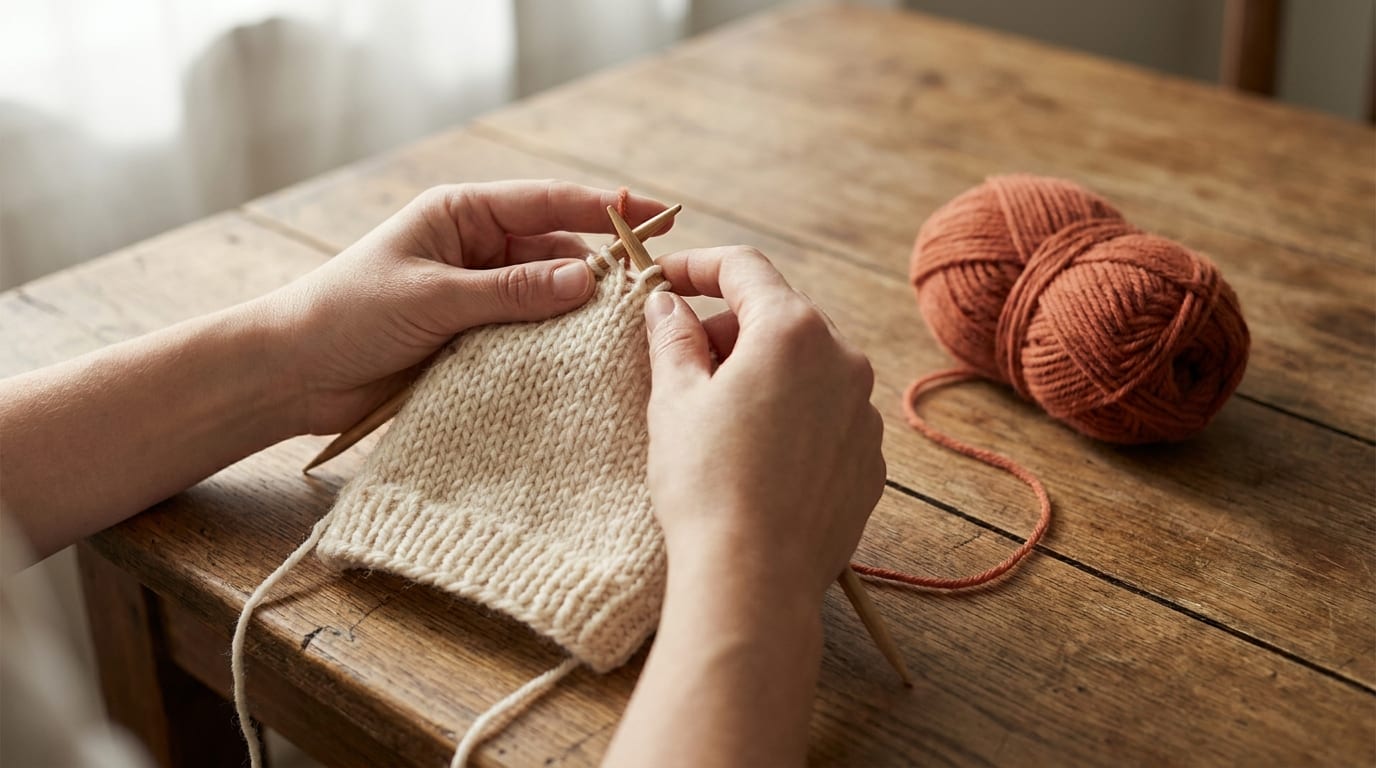
Two sticks, one thread, and a fabric that grows in your lap
The mechanics of knitting look strange until they suddenly do not. You hold two needles, you loop one continuous strand of yarn between them, and a row at a time, a flat stretchy fabric appears. Nobody is feeding it through a machine. It is just your hands, a small repeated motion, and a length of wool.
This is a complete guide to knitting for anyone who has wanted to try and never picked up the needles, or who learned as a kid and lost the thread somewhere along the way. By the end you will know what knitting actually is, how the fabric is built, how it compares to crochet, what you need to start (less than you think), and the four core skills that sit underneath almost every pattern you will ever follow.
We will go slowly. There is no race here. The yarn waits for you.
What is knitting, exactly?
Knitting is the craft of building fabric from interlocking loops of yarn, worked with two needles that hold the live stitches as you go. You pull a new loop through an existing one, slide it onto the working needle, and repeat across the row. Each loop holds the one below it.
That second needle is the whole difference between knitting and crochet. In crochet, a single hook holds one live loop at a time. In knitting, every stitch in the current row sits open on a needle, waiting its turn. A scarf in progress might have forty live loops resting on one needle at once.
Because those loops can shift and stretch, knitted fabric is springy. A knit sweater gives when you move and settles back. That elasticity is why socks, hats, and fitted garments are usually knit rather than crocheted. The trade is that a row of open loops can run if a stitch slips off, so knitting asks for a little more care than crochet when you set it down.
If a friend asks you to explain it in one line over tea: knitting is making stretchy fabric with two needles, one row of loops at a time.
A short history of knitting
Knitting is old, older than crochet by a wide margin. The earliest true knitted pieces that survive are cotton socks from Egypt, worked in the round in fine stranded color, dated to somewhere around the eleventh century. Whoever made them already understood shaping a heel, which means the craft was mature long before that. According to the Wikipedia entry on knitting, the technique likely spread from the Middle East into Europe through Mediterranean trade routes.
By the late Middle Ages, knitting guilds in Europe had turned it into skilled, regulated work. Becoming a master knitter could take years, and the test pieces, things like felted caps and intricate carpets, were demanding by design. Hand knitting was a serious trade, not a pastime.
The knitting frame, invented in England in 1589, began the slow move toward machine production, and over the following centuries factories took over most everyday knitwear. That shift quietly changed what hand knitting was for. It became something people chose rather than something they did out of necessity.
The home knitting we recognize today, the patterns in magazines, the wartime sock drives, the resurgence of recent years, all sit on top of that long history. The motion in your hands is essentially the same one those Egyptian sock makers used a thousand years ago. Few crafts connect you to the past quite so directly.
Knit vs crochet: which should you start with?
Both crafts turn yarn into fabric, and neither is harder than the other. The honest difference is in the feel of the result and the rhythm of the making. The table below lays out the parts that matter on day one.
| Feature | Knitting | Crochet | |---|---|---| | Tool | Two needles | One hook | | Live stitches | A whole row at once | One loop at a time | | Drape | Softer, stretchier | Denser, more structured | | Speed | Faster per stitch | Slower per stitch | | Fixing mistakes | Trickier, a row can run | Easier, undo one stitch | | Yarn used | Less for the same area | About 30 percent more | | Suited to | Sweaters, socks, hats, anything stretchy | Amigurumi, blankets, motifs, lace |
A short way to choose: if you want a soft cardigan or a snug pair of socks, knitting is the gentler road. If you want a little stuffed animal that holds its own shape, crochet wins. Most people who stick with yarn end up doing both.
If the hook calls to you more than the needles, we have a calm introduction to crochet that mirrors this guide. And you do not have to pick a side. CrochetZen supports knitting and crochet inside one app, with a toggle for US and UK notation.
What you need to start (needles, yarn, nothing else)
Most starter kits sell you more than a beginner needs. Here is the short version.
- One pair of straight needles, US 8 (5.0 mm). This mid size is forgiving and pairs cleanly with the most common beginner yarn. Wooden or bamboo needles grip the yarn a little, which slows runaway stitches, so they tend to be kinder for a first project than slick metal ones.
- One ball of worsted weight yarn. Pick a smooth, light, solid color such as cream. Pale yarn makes each loop easy to see, and easy to see means easy to fix. Skip fuzzy yarn and skip variegated yarn until your hands know the motion.
- A pair of scissors and a blunt yarn needle. The yarn needle is for weaving in the loose tail once the piece is done.
That is the entire list. No counter, no fancy case, no set of twelve needle sizes. You can be casting on within five minutes of opening the yarn. If you would rather start with a hook in hand, our roundup of free crochet patterns for 2026 has small projects you can finish in a weekend.
A quick word on yarn names, because they trip people up. US worsted weight is the same thing the UK calls aran. UK double knitting (DK) is a touch thinner and usually wants a slightly smaller needle. Our yarn weight converter lines up US, UK, and EU equivalents in a single chart so a UK pattern never leaves you guessing.
The four core skills
Almost every knitting pattern is built from four moves. Learn these and the door to beginner and easy patterns is open.
Casting on
Casting on puts your first row of stitches onto the needle. It is the knitting equivalent of the foundation chain in crochet. The long-tail cast on is the most common beginner method: you leave a tail roughly three times the width of your project, make a slip knot, and use both the tail and the working yarn to seat each loop. As a rough guide, allow about an inch of tail per stitch in worsted weight, so a 20-stitch swatch wants a tail of roughly 20 inches plus a little extra. Aim for a relaxed, even row. A cast on worked too tight is the single most common reason a first scarf flares out at the bottom.
The knit stitch
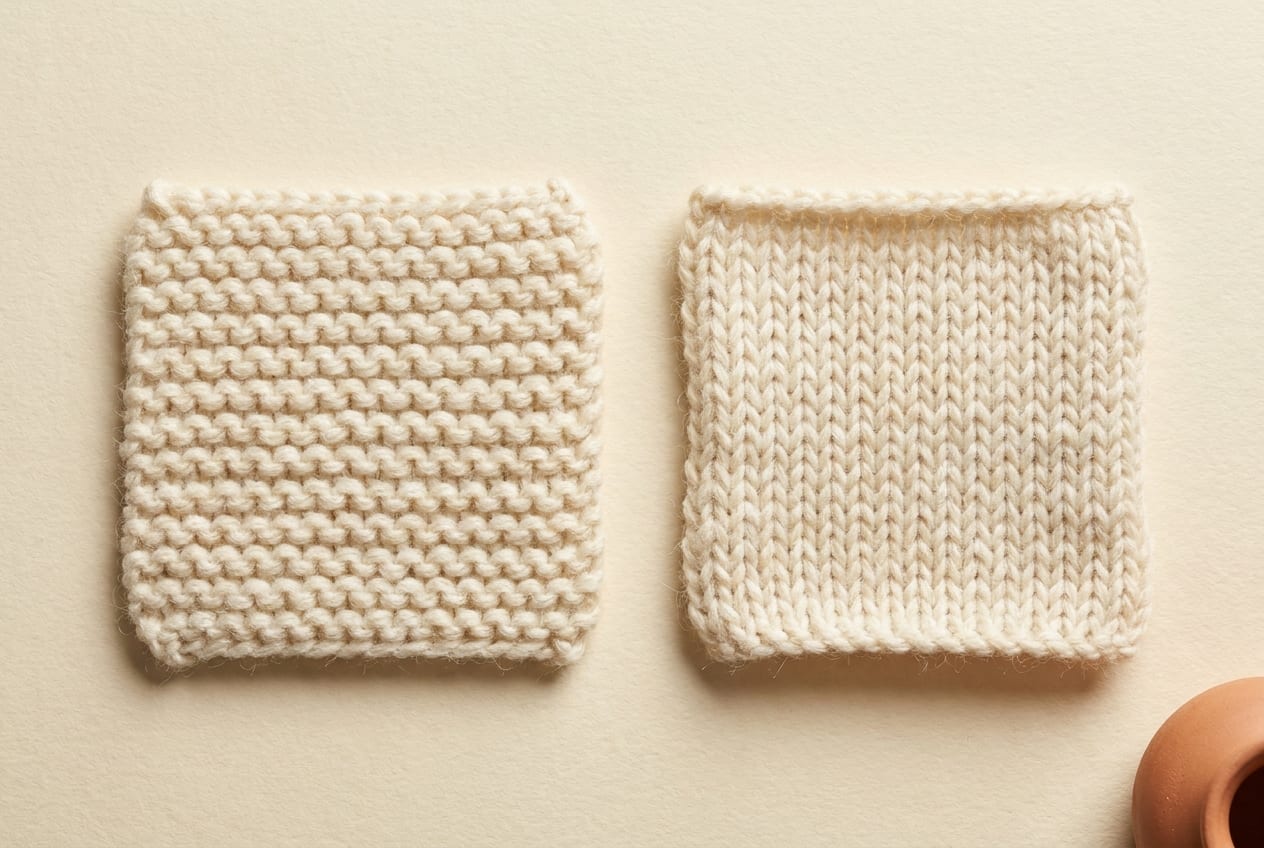
The knit stitch is the heart of it. With the yarn held at the back, you slide the right needle up into the front of a loop, wrap the yarn around, draw a new loop through, and let the old one drop off the left needle. That is one knit stitch. Work it across every row and you get garter stitch, a bumpy, squishy, reversible fabric that lies flat and never curls. It is the friendliest fabric for a first scarf.
The purl stitch
A purl is a knit stitch worked from the other direction. The yarn sits at the front, the needle goes into the loop from a different angle, and the new loop is pushed through toward the back. Purl is not a new skill so much as the mirror of the one you just learned. Alternate one row of knits with one row of purls and you get stockinette (UK: stocking stitch), the smooth V-shaped fabric you see on most sweaters. Stockinette curls at the edges by nature, which is normal and not a mistake.
Binding off
Binding off (UK: casting off) closes the live loops so the fabric cannot unravel when it leaves the needles. The simplest version: knit two stitches, then lift the first one up and over the second and off the tip. Knit one more, lift the previous over it, and keep going to the end. Like the cast on, keep it loose. A tight bind off puckers the top edge of a scarf or chokes the neckline of a sweater.
How to read a knitting pattern
This is the part that makes most beginners freeze. A pattern looks like code, but the vocabulary is short and it repeats. Once you know a handful of abbreviations, most patterns read smoothly.
Here are the ones you meet first:
kis knit.pis purl.k2togmeans knit two stitches together, which removes one stitch (a decrease).yois a yarn over, which adds a stitch and leaves a small deliberate hole, the basis of lace.sskmeans slip, slip, knit, another decrease that leans the opposite way tok2tog.
A typical row might read:
Row 5: k2, yo, ssk, k to end. (32 sts)
In plain words: knit two stitches, make a yarn over, work an ssk decrease, then knit to the end of the row. The number in parentheses is your stitch count when the row is finished. Because the yarn over adds one and the ssk takes one away, the total here stays the same, which is exactly how lace keeps its shape while making holes.
Some patterns give you a chart instead of words. A chart is a grid where each square is a stitch and each symbol is a move, read from the bottom up, usually right to left on the front-facing rows. Charts feel faster than written lines once they click, because you can see the shape of the fabric forming in the symbols. If you want to sketch your own, our stitch chart maker runs right in the browser with no signup.
Two small notes save a lot of confusion. First, patterns talk about the right side (RS) and wrong side (WS). The right side is the face that shows when the piece is finished, and odd-numbered rows are usually the right side. Second, an asterisk marks a repeat. A line like *k2, p2; repeat from * to end means knit two, purl two, over and over across the whole row. Once you see that shorthand, long ribbing instructions stop looking intimidating.
One more thing every pattern leans on: gauge. Gauge is how many stitches and rows fit in a four-inch (10 cm) square at the pattern's recommended needle size. Knit a small swatch, measure it, and compare. If you have more stitches per inch than the pattern, your tension is tight, so go up a needle size. Fewer stitches per inch means loose tension, so go down. It feels like a delay, but skipping the swatch is the single most common way a sweater comes out a full size off.
Common beginner mistakes
Nearly everyone hits these three in the first few projects. Each has a clear fix once you can name it.
A dropped stitch
A dropped stitch happens when a loop slides off the needle and starts working its way down the rows like a ladder in a stocking. It looks alarming and it is genuinely the most common beginner panic. The fix is a crochet hook: catch the loose loop, then pull each rung of the ladder back up through it, one row at a time, until the stitch is back on the needle. Catching it early means one rung to fix instead of ten. This is also where a second pair of eyes helps, and CrochetZen's AI camera spots a dropped stitch in about two seconds, then shows you which loop slipped so you can hook it back before the ladder grows.
Accidental yarn overs that add stitches
If your rectangle keeps getting wider, you are almost certainly adding stitches without meaning to. The usual culprit is the working yarn drifting to the front between stitches, which creates an unplanned yarn over and an extra loop on the next row. Count your stitches at the end of every row. If the number crept up, look for a small hole near the edge, and make sure the yarn sits at the back for knits and the front for purls before each stitch.
A cast on that is too tight
A tight cast on is the quiet cause of a flared hem and a sore first row. If you can barely get the needle tip back into your cast on stitches, it was worked too tight. The simple trick is to cast on over two needles held together, or over a needle one size larger, then slide the stitches onto your working needle and begin. The first row will thank you, and the bottom edge will sit flat instead of splaying out.
Frequently asked questions
How long does it take to learn to knit?
Most people cast on and work a few rows of garter stitch in their first sitting, and finish a simple scarf or a dishcloth within a week or two. The knit stitch feels awkward for the first hundred or so, then your hands take over and the motion turns automatic.
What is the difference between knit and crochet?
Knitting uses two needles that hold a full row of live loops, giving a soft, stretchy fabric. Crochet uses one hook and a single live loop, giving a denser, more structured one. Knitting suits socks and sweaters. Crochet suits amigurumi and motifs. They share the same yarn weight system.
Do I need to learn crochet before knitting?
No. Knitting and crochet are separate crafts with separate techniques, and you can start with either. The one handy overlap is that a small crochet hook is the easiest tool for rescuing a dropped knit stitch, so many knitters keep one in their bag without ever crocheting.
What yarn and needles should a beginner buy?
A pair of wooden US 8 (5.0 mm) needles and one ball of smooth, light-colored worsted weight (UK aran) yarn. Wood grips the yarn slightly so stitches are less likely to slide off, and pale solid yarn makes each loop easy to see, which makes mistakes easy to catch and fix.
Why does my knitting curl at the edges?
Stockinette stitch curls by design, because the front and back of the fabric pull differently. It is not a mistake. To keep edges flat, add a few stitches of garter or ribbing along each side, or block the finished piece by wetting and pinning it flat to dry in natural fibers.
How much yarn do I need for a first project?
A worsted weight dishcloth uses around 50 yards, a simple scarf about 250 to 350 yards, and a baby blanket roughly 600 to 800 yards. One standard skein of worsted holds about 200 yards, so a scarf usually needs two skeins and a dishcloth needs well under one.