A quieter way into a small, ancient craft
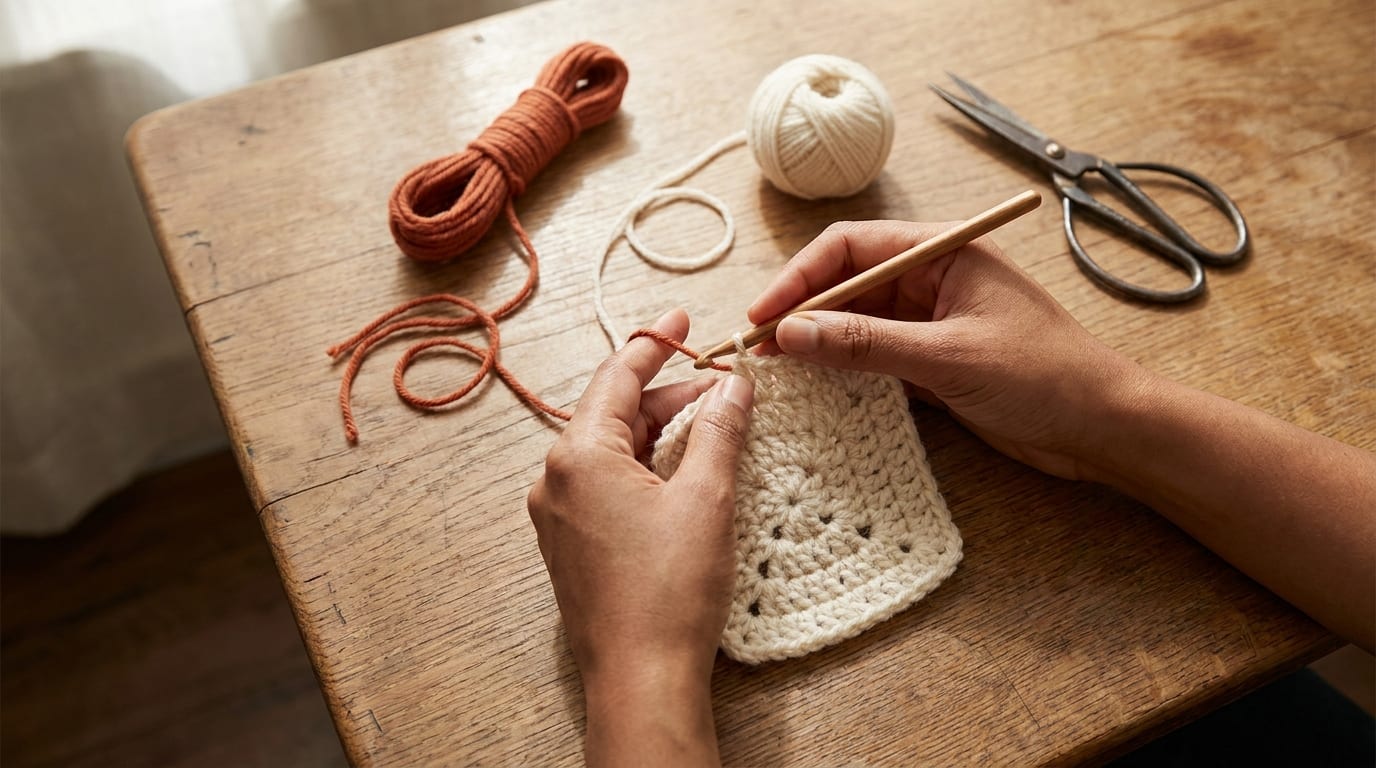
The first time someone shows you how crochet works, it looks improbable. A single hook, one continuous thread of yarn, and somehow you end up with a fabric that holds its shape. No machinery. No needles meeting in the middle. Just a quiet rhythm between hand and hook.
This is a complete introduction to crochet for anyone who has been curious but never tried, or who started years ago and wants to come back to it with fresh eyes. By the end, you will know what crochet actually is, where it comes from, how it differs from knitting, what you need to begin (it is less than most guides will tell you), and the four foundation stitches that carry almost every pattern you will ever pick up.
We will keep it calm. Take your time. The yarn is patient.
What is crochet, exactly?
Crochet is the craft of creating fabric by pulling loops of yarn through other loops, using a single hook. Each loop catches into the previous one, building rows or worked rounds of interconnected stitches.
The word comes from the French croche, meaning hook. That single tool is what separates crochet from every other yarn craft. Knitting uses two needles. Weaving uses a loom. Crochet uses one hook, held in one hand, while the other hand manages the yarn tension.
The fabric that comes out is denser and more textured than most knits. A crochet stitch is structurally closer to a small knot than a knit loop, so crochet pieces hold their shape well and resist unraveling, but they also use roughly thirty percent more yarn for the same square inch.
If you want one short answer for someone who just asked you over coffee: crochet is making fabric with a hook, one stitch at a time.
A short history of crochet
The story of crochet is less neat than knitting's. Knitted socks have survived from the eleventh century, so historians can point to a real object and say with confidence that people were knitting then. Crochet has no such early evidence. No firm artifacts appear before the early nineteenth century, and that gap has fueled a long, friendly argument among textile historians. One side reads the silence plainly: crochet is simply the younger craft. The other side suspects the technique existed long before anyone bothered to write it down, since a hook and a length of thread leave little behind once the fabric wears out.
A popular theory traces crochet back to tambour embroidery, a method that reached Europe in the eighteenth century. In tambour work, fabric is stretched tight on a frame and a fine hooked needle pulls loops of thread up through the cloth to form a chain stitch on the surface. At some point a maker seems to have lifted the hook off the frame and worked the loops into open air, with the chain becoming the fabric itself rather than decoration on top of it. That single move, if the theory holds, is the birth of crochet as we know it.
The craft steps clearly into the record in the 1820s and 1830s, when the first patterns ran in European needlework magazines. The defining chapter came in the 1840s, in Ireland. As the potato famine pushed families toward starvation, women and children across the country took up fine cotton thread and produced an intricate lace, worked in raised motifs of flowers and leaves, that came to be known as Irish crochet. It was not a pastime. The lace sold abroad, and for many households the few coins it earned were the difference between eating and not. Whole communities organized around the work, with experienced makers teaching beginners and merchants carrying the finished pieces to market.
Royal attention sealed its reputation. Queen Victoria openly admired Irish crochet, bought it, and is said to have learned to crochet herself, which turned the lace into a fashionable thing to own and put the whole craft in front of a much wider audience. Through the rest of the Victorian era crochet filled the home with table linens, doilies, and delicate edgings on collars and cuffs.
The twentieth century changed the materials more than the method. Makers gradually moved away from the very fine cotton thread of the lace years and toward thicker, softer yarns, which made stitches faster to work and projects quicker to finish. The 1920s and 1930s saw crochet turn up in fashion, including the flapper-era handbags worked in glass beads. Then came the wave most people picture first. In the 1970s the granny square, a small motif built outward in rounds, landed in living rooms across the United States. Crocheters joined hundreds of them into blankets, vests, and cushion covers, often in oranges, golds, and avocado greens that no one would call subtle.
Today, crochet is in another quiet resurgence. Social platforms have shown the craft to a generation that did not grow up watching grandmothers crochet, and the meditative quality of the work has become a draw of its own.
Crochet vs knitting: which is right for you?
The most useful framing is this: knitting is faster, crochet is more sculptural.
| Feature | Crochet | Knitting | |---|---|---| | Tool | One hook | Two needles | | Speed | Slower per stitch | Faster per stitch | | Drape | Denser, more textured | Softer, more elastic | | Fixing mistakes | Easier, one stitch at a time | Harder, a whole row can run | | Yarn used | About 30 percent more | Less | | Good for | Amigurumi, blankets, motifs, lace | Sweaters, socks, anything stretchy |
Neither one is harder to learn. The early frustration in both crafts comes from tension consistency, not from anything inherent in the technique itself.
If you want to make a soft cardigan that drapes against your body, knitting is the simpler path. If you want to make an amigurumi animal that sits up on its own, crochet is the simpler path. Most people who learn one eventually learn the other.
You do not need to pick. CrochetZen is built for both inside one app, with a notation toggle that switches between US and UK abbreviations.
What you actually need to start
This list is shorter than most starter guides will tell you.
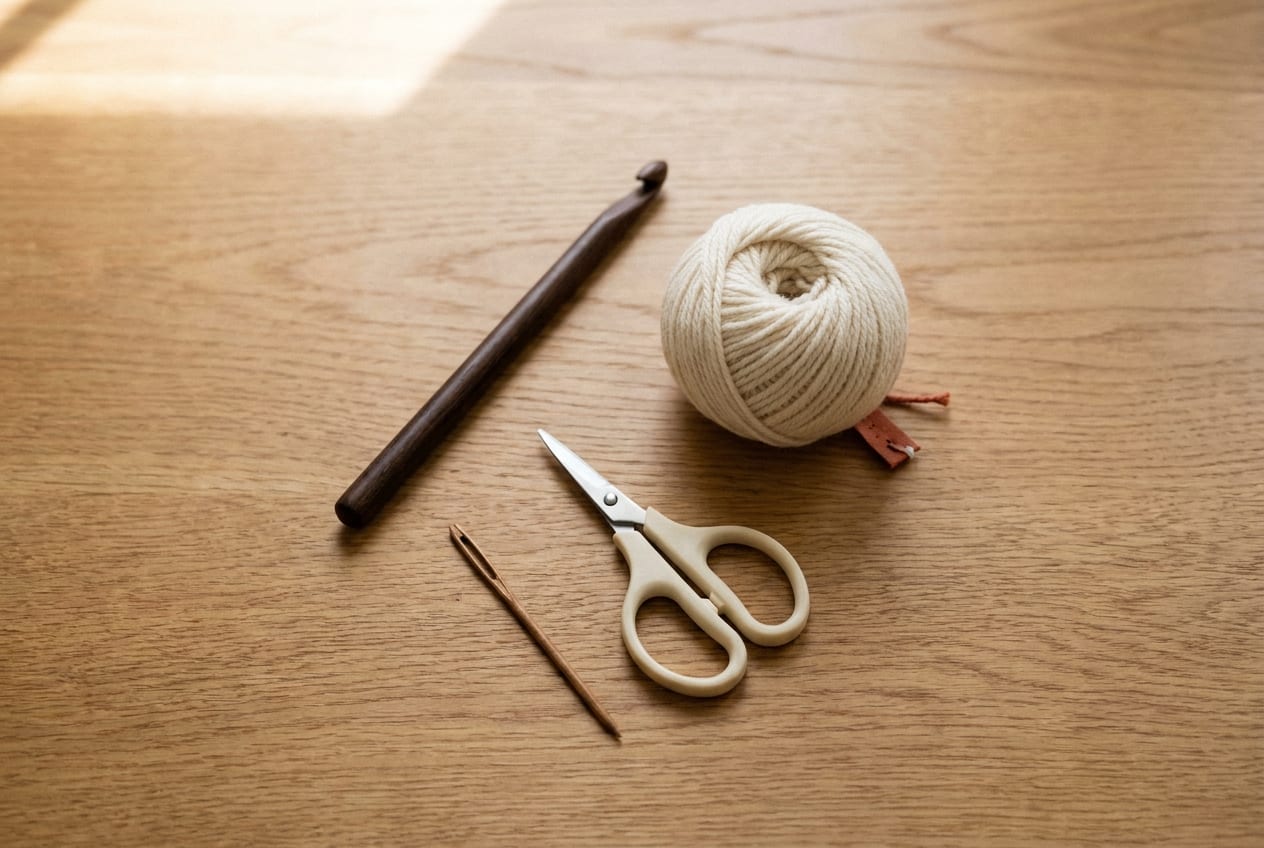
- One hook. A US size H (5.0 mm) is the most forgiving starting size. It pairs cleanly with worsted weight yarn. Wooden and aluminum hooks both work fine for beginners. Pick whichever feels nicer in your hand.
- One ball of worsted weight yarn. Cream or another light color. Light yarn makes your stitches easy to see, which makes mistakes easy to fix. Skip variegated yarn and skip very fluffy yarn for your first project.
- A pair of scissors and a yarn needle. The needle is for sewing in the loose end at the finish.
That is the whole list. You do not need a kit, a stitch marker, a hook organizer, a project bag, or a row counter. You can find a starter project in our 25 free crochet patterns for every skill level collection and have something finished by the weekend.
A small note on yarn weight names. US worsted weight is the same thing as UK Aran. UK double knitting (DK) is slightly thinner. Our yarn weight converter maps US, UK, and EU equivalents in one chart.
The four foundation stitches
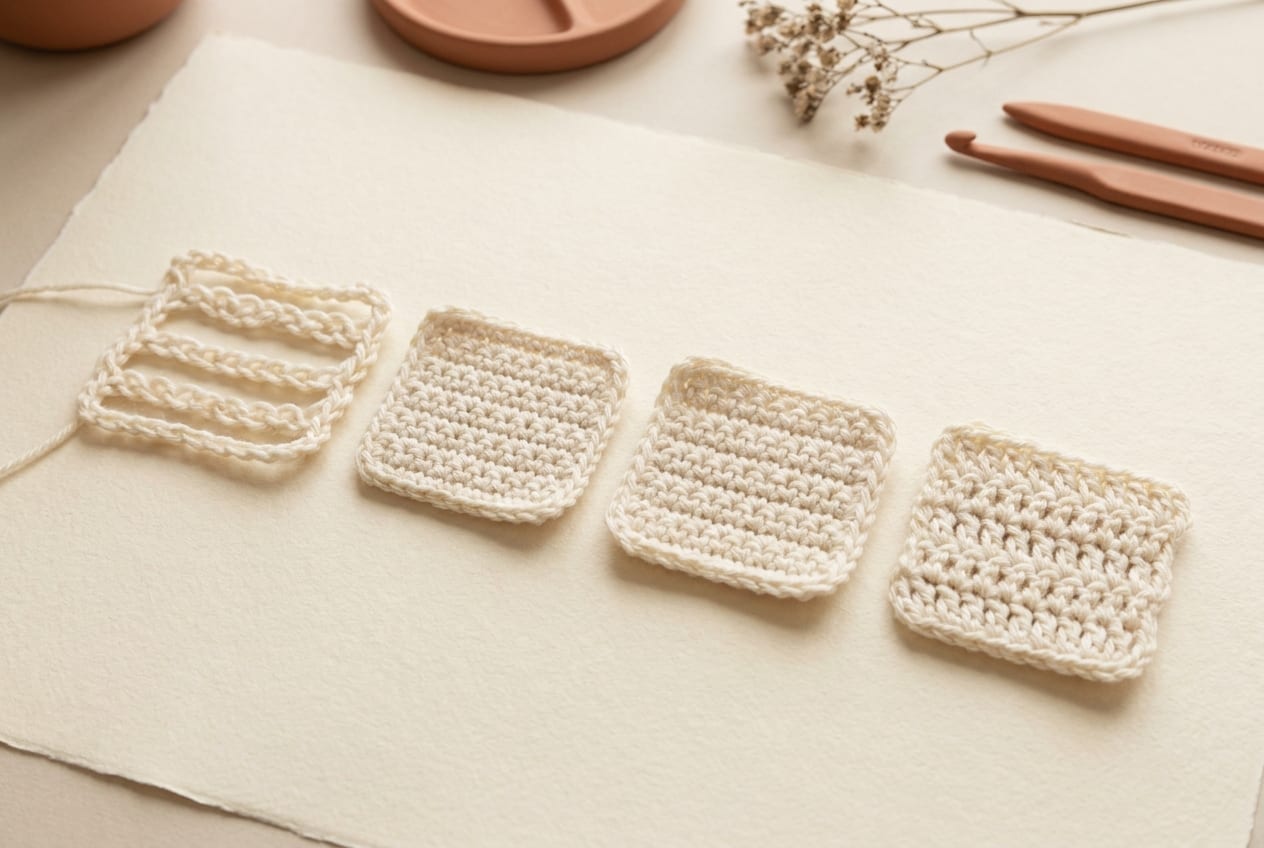
Almost every crochet pattern uses some combination of these four stitches. Learn them, and you can read most patterns labeled beginner or easy.
Chain (ch)
The first stitch and the foundation of every project. You make a slip knot on your hook, wrap yarn over the hook, and pull through. Each chain is one small V-shaped loop. A row of chains becomes the base of a flat project, or you can join chains into a ring for circular projects like granny squares and amigurumi.
Slip stitch (sl st)
The shortest stitch. Insert your hook, yarn over, pull through both loops in one motion. Slip stitches are used for joining rounds, moving across stitches without adding height, or making firm edges. You will rarely build a whole project from slip stitches, but you will use them constantly.
Single crochet (sc)
The shortest stitch with visible height. Insert your hook, yarn over, pull through one loop, yarn over again, pull through both loops. The result is a tight, dense stitch. Single crochet is the workhorse for amigurumi, dishcloths, and any project that needs structure.
Note for UK readers: what Americans call single crochet, the UK calls double crochet. The terminology overlap is a real source of confusion, so always check which notation a pattern uses before you start.
Double crochet (dc)
Twice the height of single crochet. Yarn over before inserting your hook, pull through one loop, then complete the stitch with two more yarn overs and pull-throughs. Double crochet works up faster and creates a more open fabric, which is why most blankets and garments use it.
UK readers: this is treble (tr) in your notation. We promise this is the last time the terminology will be confusing today.
What to make first
The right first project is small, repetitive, and finished before your enthusiasm runs out. You want something that drills one or two stitches until your hands stop thinking about them, and that gives you a real object at the end instead of a practice swatch. These three projects build on each other. Make them in sequence and you will have a quiet, solid foundation.
A dishcloth
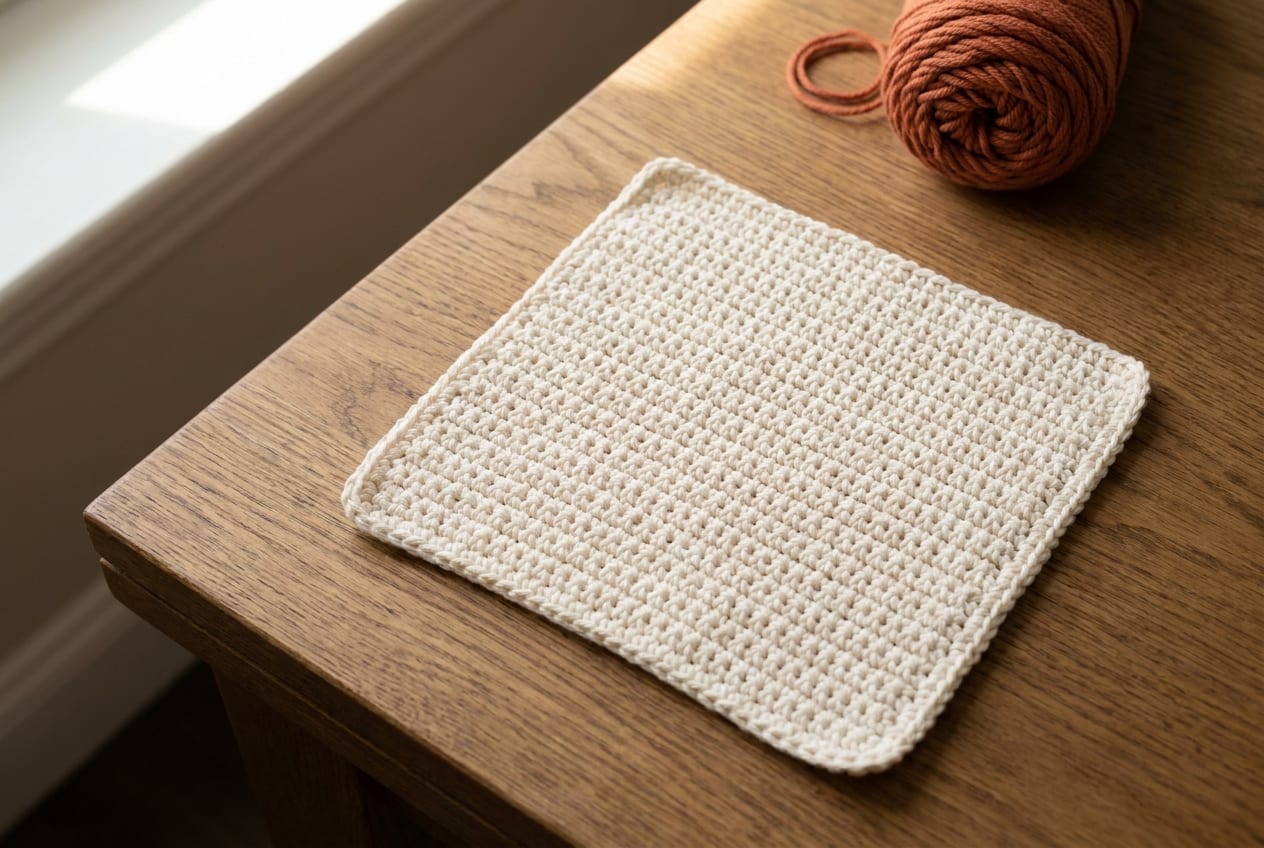
Start here. A cotton dishcloth is the most honest first project in crochet, because it is just single crochet worked back and forth into a square, and it teaches you the two things that trip up every beginner: keeping your edges straight and counting your stitches. Chain about 30 to 35 to set your width, then single crochet across, turn, and repeat until the piece is as tall as it is wide. Worsted weight cotton is the yarn to use, since it shows each stitch clearly and survives the dishwater later. You will need well under one skein, around 50 yards, and most people finish a dishcloth in a single evening. When you bind off and look at it, you will know exactly where your tension wandered, which is the whole point.
A simple scarf
Once a square feels easy, go longer. A scarf is the same back-and-forth idea as the dishcloth, but it introduces a taller stitch and the patience of a project that does not finish in one sitting. Use half double crochet (UK: half treble), which sits between single and double crochet in height and gives a soft, slightly squishy fabric that drapes well around the neck. Aim for roughly 7 to 8 inches wide and 60 inches long, which is a comfortable wrap-once length for an adult. One skein of worsted weight yarn, about 200 yards, covers it with a little to spare. Plan on a few evenings rather than one. By the time you reach the far end, your tension will have evened out on its own, and you will see the difference between the first rows and the last.
A granny square
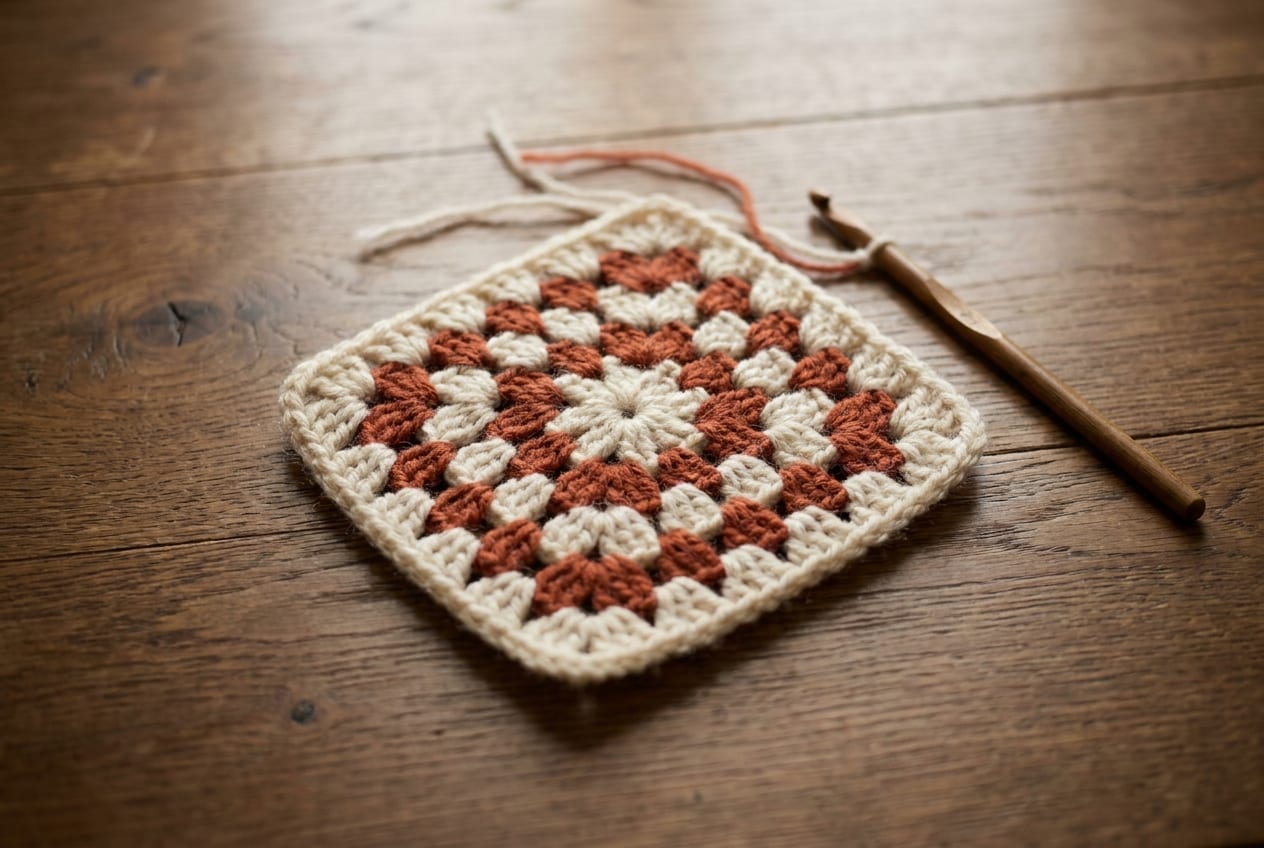
This is the project that opens the door to blankets. The granny square is worked in rounds instead of rows, so it teaches you to join into a ring, work clusters of double crochet into the spaces of the round below, and turn corners. A single square uses only a small amount of yarn, often less than 25 yards, and takes well under an hour once the rhythm clicks. The reason it matters so much is multiplication: a blanket is just many granny squares stitched together, and a single square in cream and terracotta already looks like something you meant to make. Work one in each of two or three colors to see how the rounds stack, then keep going if the mood takes you.
When one of these feels finished and you want a next step, our roundup of free crochet patterns sorts projects by skill level so you can climb at your own pace. If you would rather get comfortable with the building blocks first, the crochet stitches library walks through each stitch with photos.
How to read a crochet pattern
This is the moment most beginners feel lost. Patterns are written in shorthand that looks like a foreign language, but the language is small and consistent.
A typical pattern row might read:
Row 3: ch 1, sc in next 4 sts, 2 sc in next st, sc to end. (15 sts)
In plain English: chain once to lift up to the next row, single crochet into the next four stitches, work two single crochets into the very next stitch (this is an increase), then continue single crocheting until the end of the row. The number in parentheses tells you how many stitches you should have when this row is finished.
Three rules will get you through almost any pattern.
- Always count. Patterns usually give you the stitch count at the end of each row in parentheses. If your count does not match, the mistake is in this row, not three rows back. Catching it now saves the day.
- Know your notation. Before you start, scroll to the first page of the pattern and find the abbreviation key. Confirm whether the pattern uses US or UK terminology. Our planned crochet stitches library will go deeper, but the rule on day one is: check the key.
- Stitches in the round are different from rows. Round patterns often have a starting chain that does or does not count as a stitch. The pattern will tell you. Read that sentence twice before you start a round.
If you prefer visuals to written shorthand, many patterns include a chart with symbols for each stitch. You can also design your own chart with our free stitch chart maker, right in your browser, no signup.
Three common beginner mistakes
Almost every beginner makes these three mistakes at least once. They are easy to fix when you know what to look for.
Starting row too tight
If your foundation chain is hard to insert the hook into for the second row, the chain was worked too tight. Try going up one hook size for just the chain row, then switch back to the pattern-recommended hook for the rest. Some crocheters keep two hooks at the same time for exactly this reason.
Adding or losing stitches at the edges
Most beginners lose one stitch per row because they forget that the turning chain at the start sometimes counts as a stitch. By row twenty, your tidy rectangle has quietly become a sad triangle. The fix is to count at the end of every row, and to confirm whether the pattern says the turning chain counts.
Curling edges on a flat project
If your blanket or scarf curls along the bottom, the foundation chain was probably too tight, or you accidentally switched between right side and wrong side without noticing. Blocking, which means wetting and pinning the finished piece flat to dry, fixes most curling in cotton and wool yarns. Acrylic does not block reliably, so prevention is the only option there.
Frequently asked questions
How long does it take to learn crochet?
Most people make a recognizable swatch in their first sitting and finish a small project, like a coaster or a dishcloth, within their first week. The foundation chain alone often takes an hour to feel natural, and the four basic stitches usually click within a few projects.
What is the difference between US and UK crochet terms?
American and British notation use different names for the same stitches. A US single crochet equals a UK double crochet, and a US double crochet equals a UK treble. Always check the abbreviation key at the start of any pattern before you cast on, so you know which system the designer wrote in.
Can I crochet without knowing how to knit?
Yes. Crochet and knitting are separate crafts with separate techniques. Knowing one is not a requirement for the other. Many crocheters never knit, and many knitters never crochet. They overlap mostly in vocabulary and in the yarn weight system.
Is crochet a good hobby for stress relief?
Repetitive hand crafts like crochet are well documented as calming. The slow rhythm, the focus on one stitch at a time, and the visible progress all reduce anxiety in most people. Just be careful with your posture and take breaks, since long sessions can stiffen the hands.
Why does my crochet curl at the edges?
Edge curl usually comes from a foundation chain that was worked too tight, from inconsistent tension across the rows, or from a stitch that pulls in one direction (single crochet curls more than double crochet). Blocking the finished piece by wetting and pinning it flat will fix most curl in natural fibers.
How much yarn do I need for a beginner project?
A worsted weight dishcloth uses about 50 yards. A small scarf uses around 200 yards. A baby blanket uses 600 to 800 yards. One standard skein of worsted yarn holds about 200 yards, so a single skein is enough for most first projects.