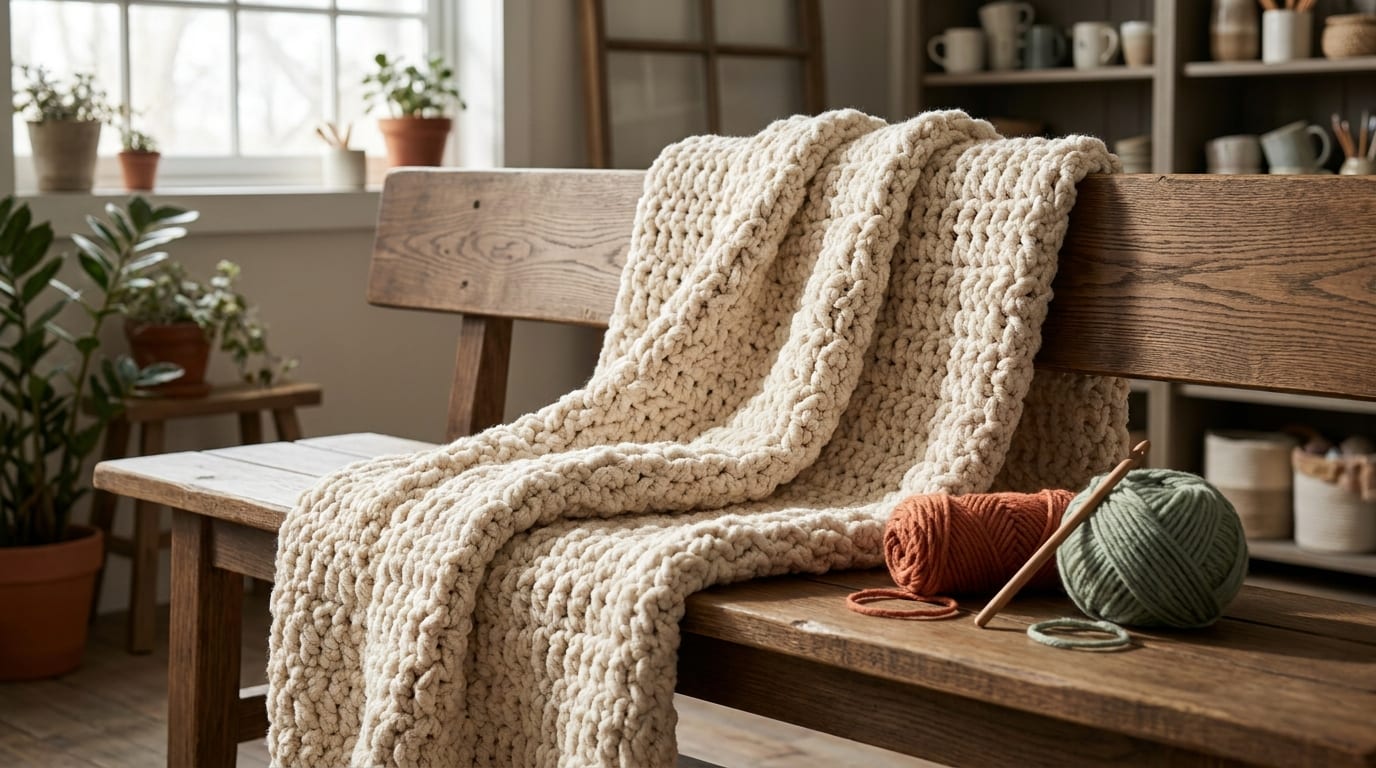
What makes a chunky crochet blanket chunky
A chunky crochet blanket is a blanket worked in very thick yarn on a large hook, so the fabric grows fast and comes out thick, squishy, and warm. The stitches are big enough to see across a room. Because each one covers so much ground, a throw that would take weeks in regular yarn can be finished in a few hours to a weekend. That speed is the whole appeal, and it is what makes a chunky blanket a satisfying first big project even if you have only made a few squares before.
The thickness comes from the yarn, not from any special technique. Most chunky throws use super bulky yarn (Craft Yarn Council weight 6) or jumbo yarn (CYC weight 7), the two thickest categories on the standard scale. For comparison, a regular worsted weight blanket sits at weight 4. Jump to a 6 or a 7 and every stitch is two or three times the size, so you reach blanket dimensions in a fraction of the rows.
Choosing your chunky blanket yarn
The yarn is the heart of this project, so it is worth slowing down here. Four kinds of thick yarn turn up again and again for blankets, and they behave very differently in your hands and over years of use. Pick the one that matches how the blanket will actually live.
Chenille and velvet yarn
This is the soft, plush yarn most people picture when they imagine a chunky blanket, and it is the most popular choice for good reason. Chenille (sold under names like velvet or blanket yarn) is exceptionally soft, usually machine washable, kid-friendly, and it holds its shape well. The finished fabric feels like the inside of a teddy bear. The one quirk to manage is worming: if you work chenille too loosely, the strand can twist back on itself and pop little loops out of the surface. Keep your tension even and snug and it behaves perfectly.
Acrylic super bulky
Plain super bulky acrylic is the affordable, no-drama option. It is washable, durable, and stocked in every craft store in a wide range of colors. It does not feel as plush as chenille, but it wears like iron and survives years of washing, which makes it a strong pick for a blanket that gets dragged onto the couch every night. If you want a thick blanket that just works and does not cost much, start here.
Wool roving and unspun yarn
Roving is the yarn behind those dramatic giant-stitch blankets all over social media, the ones with stitches the size of your fist. It gives an unmatched chunky look. Be honest with yourself about the trade-off, though: roving is fragile, it sheds and pills, and it is not very durable or washable. It is beautiful in a photo and lovely as a decorative throw over the end of a bed, far less practical for a blanket that gets daily handling. Our roving guide covers how to work with it and care for it.
Tube and ribbon yarn
Tube yarn (sometimes called ribbon yarn) is a thin knitted tube rather than a spun strand. It is light for its size, very thick, and soft, which makes for an airy blanket that is warm without much weight. It sits between chenille and roving on the durability scale and is easy on the hands.
For the full picture on these thicker weights, our super bulky yarn and chunky yarn guides break down brands, yardage per skein, and what each weight is good for.
The hook, and going hookless
Chunky yarn needs a big hook. Sizes run roughly from 9 mm up to 25 mm depending on how thick the yarn is, and the yarn band will suggest a starting size for that specific yarn. As a rough guide, super bulky yarn likes a hook around 9 mm to 12 mm, while the giant roving stitches need something in the 15 mm to 25 mm range. These are far larger than the metric or US letter sizes most patterns assume, so if a band lists a size you do not recognize, our crochet hook converter covers these big sizes and lines up the US, UK, and metric equivalents.
A larger hook than the band suggests gives you looser, more open, drapier fabric. A smaller hook gives a denser, firmer, warmer blanket. For a squishy throw, follow the band or go up one size at most.
Hand crochet, with no hook at all
For a hand crochet blanket, you skip the hook completely and crochet with your hands and arms, pulling big loops of yarn through other big loops. This is how you get that giant-loop look without buying a 25 mm hook. It is very fast, often an hour or two for a whole throw, and it needs no tools beyond the yarn itself.
The trade-offs are real. Because your hands make much bigger loops than any hook, the fabric is loose and open, which makes it less durable, and the large loops can catch on rings, drawer handles, and curious cats. Hand crochet shines for a quick statement throw you want done in an afternoon. For something hard-wearing, a hook gives you tighter, sturdier stitches.
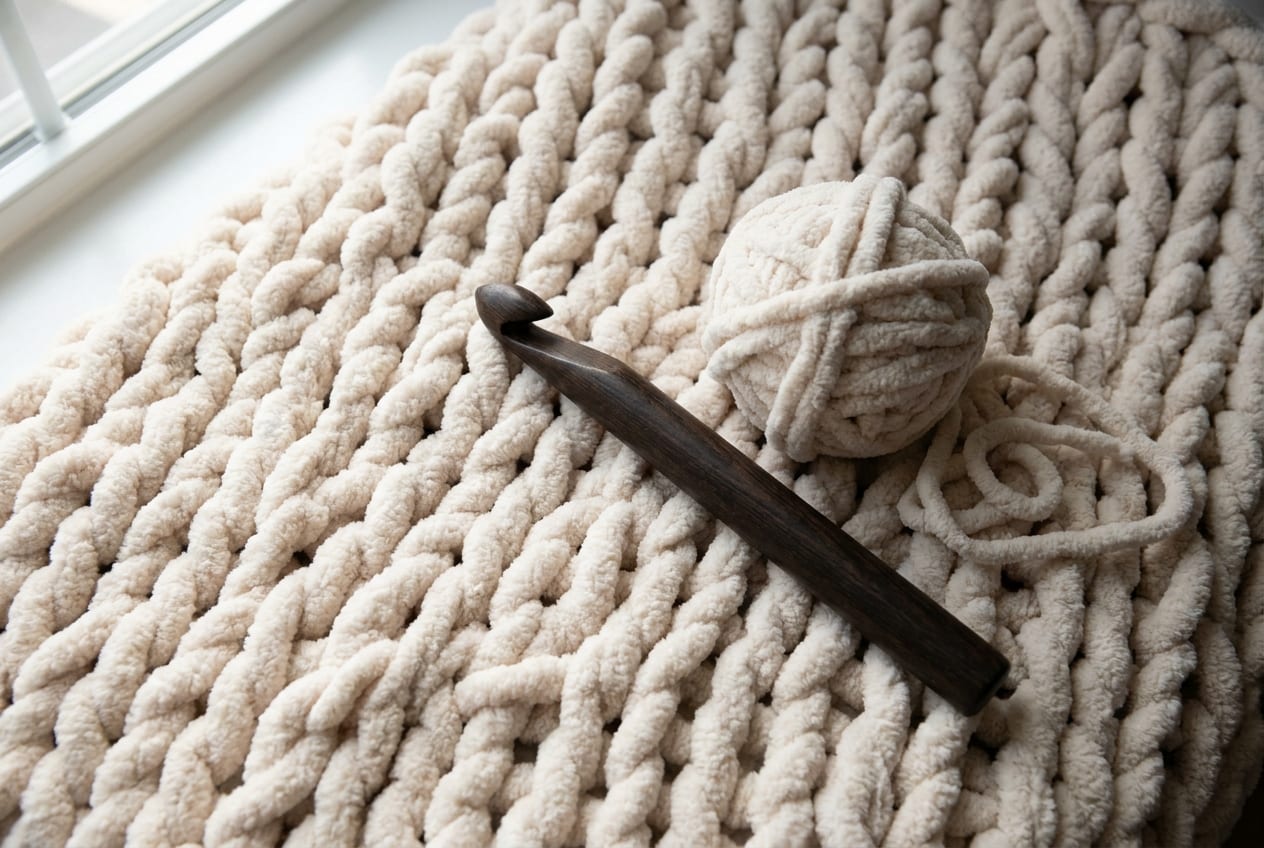
The simplest stitches to use
Keep your stitches plain. In yarn this thick, fancy stitch patterns get swallowed up and disappear, so a complicated cable or shell looks like a lumpy mess rather than a crisp design. The texture of the chunky yarn is the design. Your job is to get out of its way.
Single crochet (sc, UK double crochet) makes the densest, warmest, most solid chunky fabric. It is slower because the stitch is short, but the blanket comes out firm and structured. Half double crochet (hdc, UK half treble) is the sweet spot for most chunky throws: a touch taller than single crochet, so it works up faster, while still giving a dense, squishy fabric with a little drape.
If you want maximum speed, rows of double crochet (dc, UK treble) cover ground fastest of the three, with a slightly more open result. A basic granny square in chunky yarn also works up startlingly fast and gives you a classic look with almost no counting. For a first chunky blanket, pick one stitch and repeat it row after row. That is genuinely all it takes. Our crochet blanket patterns roundup has simple chunky options if you want a written pattern to follow, and the crochet blanket for beginners guide walks through keeping your edges straight on a plain rectangle.
How much chunky yarn you need
Thick yarn is sold by weight as much as by yardage, and it eats skeins fast. A chunky throw might take several skeins of chenille, often somewhere around 6 to 10 depending on the size and the brand, or a few pounds of roving for a giant-stitch blanket. Because the exact amount swings so much between brands, the yardage on the band matters more than the skein count, the same way it does for any yarn.
Buy generously, and buy it all in one dye lot at the same time. Running short two-thirds of the way through a chunky blanket is one of the most common frustrations in this kind of project, precisely because thick yarn disappears so quickly and a single skein does not cover much area. One extra skein is cheap insurance against a visible color jog where a new dye lot starts. If you are new to reading weight and yardage on a label, our guide to what a skein of yarn is explains why total yards beat skein count every time.
| Blanket size | Rough dimensions | Chenille skeins (ballpark) | |---|---|---| | Lap throw | 40 x 50 in | 6 to 8 | | Generous throw | 50 x 60 in | 8 to 10 | | Giant roving throw | 50 x 60 in | A few pounds of roving |
Size and how fast it works up
A lap throw of about 40 by 50 inches is a satisfying, achievable target. It is big enough to cover you on the couch, small enough to finish quickly, and it does not demand a mountain of yarn. That makes it the size most people should start with.
Here is the payoff for all that thick yarn: even a throw is a quick make. Because the stitches are so big, you are not grinding through hundreds of tiny rows. A hand crochet blanket can be done in an afternoon. A hooked chenille throw in half double crochet is realistically a weekend, sometimes a single long evening if you keep at it. Few crochet projects give you a finished, usable object this fast, which is exactly why chunky blankets hook people.
Caring for a chunky blanket
How you wash a chunky blanket depends entirely on the yarn, so always check the ball band first. Chenille and acrylic are usually machine washable on a gentle cycle in cool water, then either tumble dried low or laid flat to dry. They are forgiving, which is a big part of why they are the practical choices.
Wool roving is the exception. It should be spot-cleaned rather than thrown in the machine, and handled gently, since agitation makes unspun wool felt, shed, and pull apart. Tube yarn usually follows its own band instructions and tends to be washable. When in doubt, do not guess. A two-second look at the label tells you exactly what the fiber can take, and it is the difference between a blanket that lasts for years and one you accidentally shrink into a stiff mat on the first wash.
Frequently asked questions
What yarn should I use for a chunky crochet blanket?
Chenille (velvet) yarn is the most popular pick because it is soft, washable, and holds its shape, which makes it ideal for everyday use. Super bulky acrylic is the affordable, durable runner-up. Wool roving gives the dramatic giant-stitch look but is fragile and not very washable.
How much chunky blanket yarn do I need for a throw?
A lap throw around 40 by 50 inches usually takes about 6 to 8 skeins of chenille, and a larger throw 8 to 10, though it varies a lot by brand and stitch. A giant roving blanket needs a few pounds of yarn. Buy a little extra in one dye lot, since thick yarn runs out fast.
What is a hand crochet blanket?
A hand crochet blanket is made by crocheting with your hands and arms instead of a hook, pulling big loops through big loops. It is very fast and needs no tools, giving the giant-loop chunky look in an afternoon. The fabric is loose and less durable, and the big loops can catch on things.
What hook size do I need for a thick crochet blanket?
Big ones. Hooks for chunky yarn run roughly from 9 mm up to 25 mm depending on the yarn, and the ball band suggests a size for that specific yarn. Super bulky likes 9 to 12 mm, while giant roving stitches need 15 to 25 mm. A hook converter chart helps with these oversized sizes.
What stitch should I use for a chunky blanket?
Keep it plain. Single crochet (UK double crochet) gives the densest, warmest fabric, half double crochet (UK half treble) is the popular middle ground, and double crochet (UK treble) is fastest. Fancy stitches get lost in thick yarn, so simple rows or a basic granny look cleanest and work up quickest.
Can you machine wash a chunky crochet blanket?
It depends on the yarn, so always check the ball band. Chenille and acrylic are usually machine washable on a gentle, cool cycle, then dried low or laid flat. Wool roving should be spot-cleaned and handled gently, since machine washing makes unspun wool felt, shed, and fall apart.