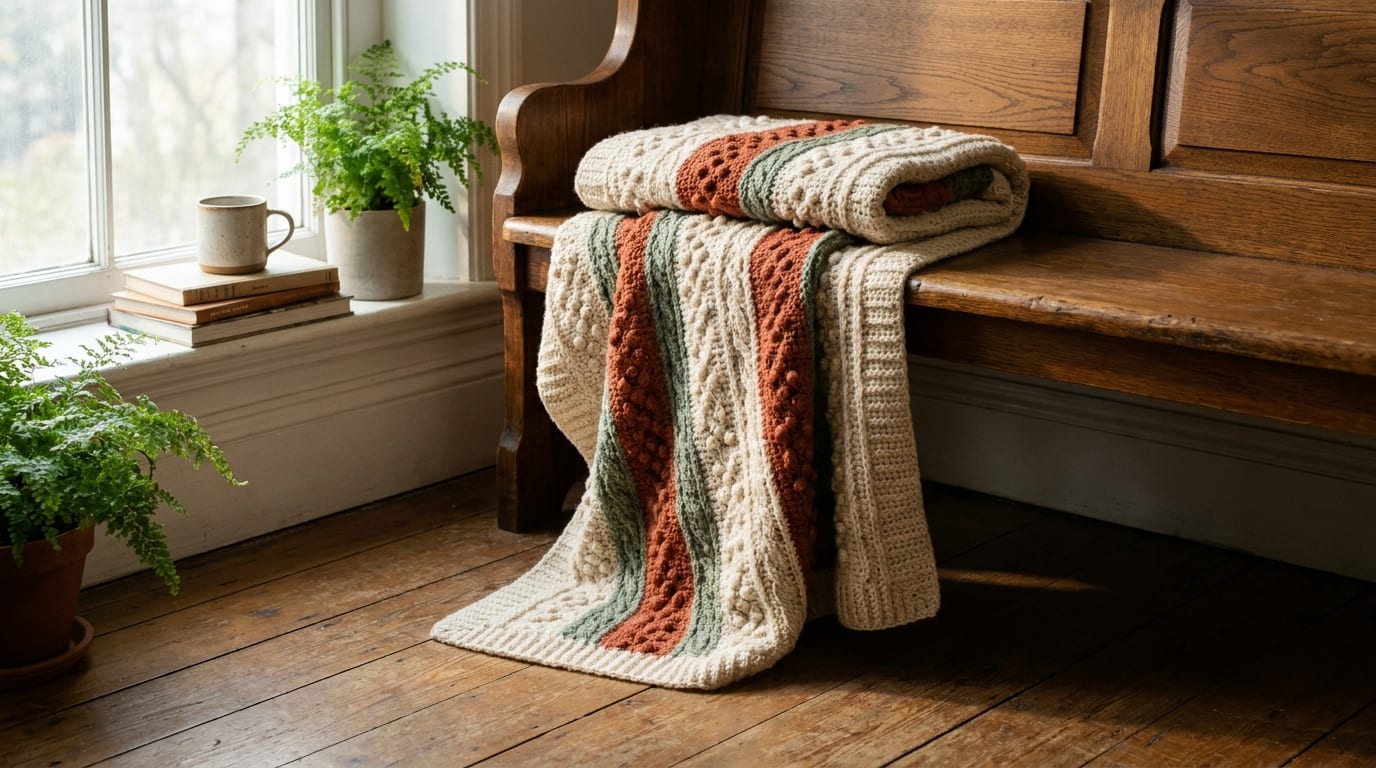
The crochet blanket is the project most people make first
A crochet blanket pattern asks less of you than almost anything else you can make. There is no fit to get right, no gauge that ruins the whole thing if it drifts, and no rule that says you have to stop at a set size. You work rows or rounds until the blanket is as big as you want, then you stop. That is the whole reason a crochet blanket is the first big project for so many people, and the reason experienced makers keep coming back to it on the sofa in the evening.
This guide is the map for the rest of our blanket cluster. It covers the main types of crochet blanket, the finished sizes worth knowing, how to plan the yarn and the yardage, and where to find free crochet blanket patterns that are actually written well. By the end you will know which kind of blanket suits the yarn in your stash and the time you have, and where to click next.
If you have never made one and want a slower, hand-held walk through your very first, start with our crochet blanket for beginners guide and come back here once a few rows feel easy.
Types of crochet blanket
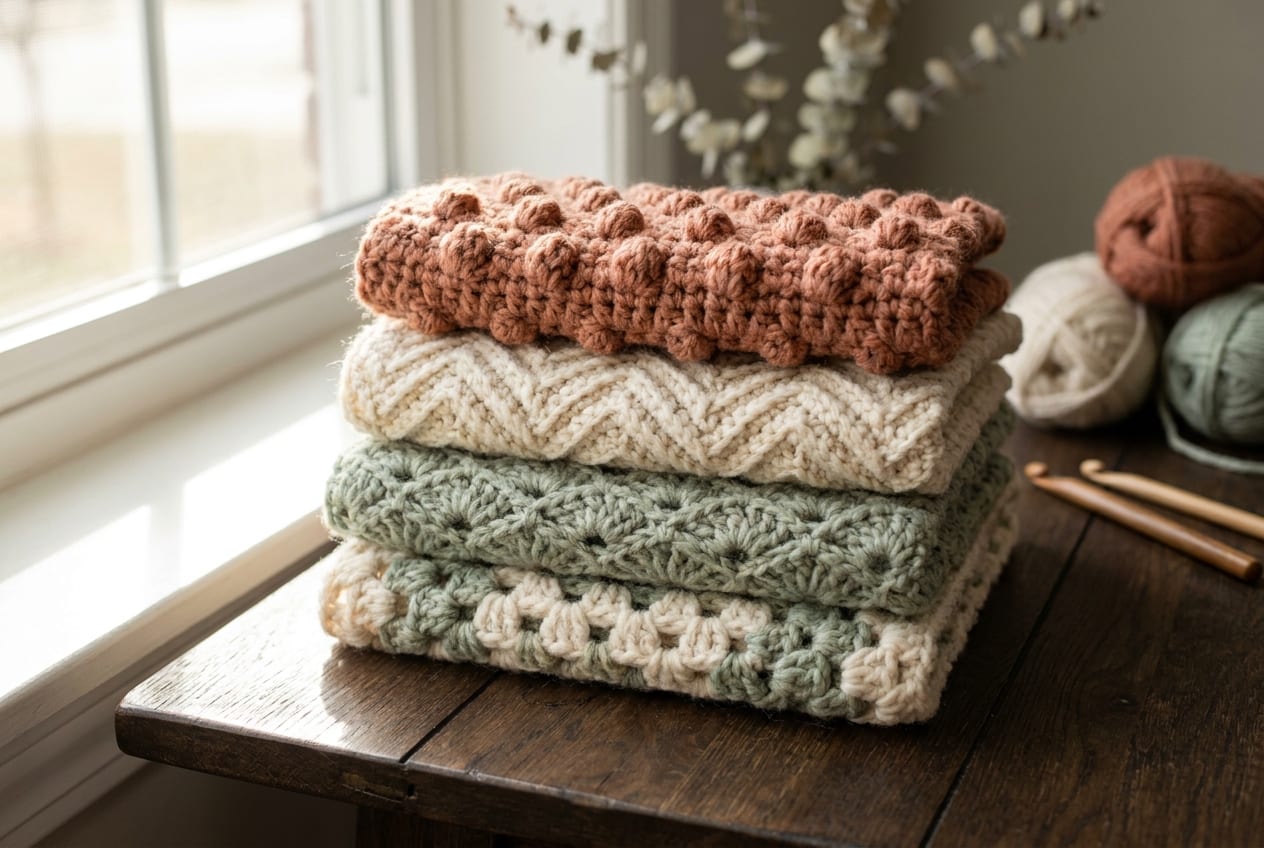
Most crochet blankets fall into a handful of families. The stitch and the construction change how the blanket looks, how fast it grows, and how portable it is along the way. Here are the ones worth knowing before you pick a pattern.
Granny and granny-square blankets
The classic. You either crochet many small granny squares and join them into a grid, or you start one square in the center and keep adding rounds until that single square reaches blanket size. The modular version is the portable one, since a square fits in a pocket. The one-big-square version skips the joining entirely. Both use the same cluster of double crochet (UK: treble crochet) worked in rounds. Browse the blanket pattern hub for both styles, and see our full granny square blanket walkthrough for the methods, the square math, and the joins.
Chevron, ripple, and wave blankets
A chevron blanket gets its zigzag from regular increases and decreases placed at the same points on every row. Work extra stitches at the peaks and skip or combine stitches at the valleys, and the fabric pulls itself into a steady wave. It looks far more advanced than it is, because the whole effect comes from repeating one row. Color changes land beautifully here, since each stripe traces the zigzag. See the chevron blankets for graded patterns.
Corner to corner (C2C)
Corner to corner is worked on the diagonal in little blocks, starting from one corner and growing out to the opposite one. Each block is a tiny cluster, and because the blanket is built block by block, you can map a picture or a word across the grid like pixels. That makes C2C the go-to for graphgan and pixel designs, from a single initial to a full scene. Start with the c2c blankets to see how a chart becomes a blanket.
Temperature blankets
A temperature blanket is a year-long project. You work one row or one small section per day in a color mapped to that day's high temperature, using a palette you set in advance, cool blues for cold days through to reds for hot ones. By December you have a striped record of the whole year in yarn. It asks for patience rather than skill, since each day is only a row or two. The temperature blankets cover how to build your color scale and keep the daily habit going.
Baby blankets
Baby blankets are smaller, which makes them a fast and forgiving way to try a new stitch or finish a gift in a weekend. Reach for soft, washable yarn, since the blanket will be laundered constantly, and keep the texture gentle. The baby blanket patterns collection sorts options by stitch and size.
Striped and solid one-stitch blankets
The simplest blanket of all is a single stitch worked back and forth in rows until the fabric is big enough. Pick single crochet (UK: double crochet) for a dense, sturdy fabric or double crochet for a faster, drapier one, then either keep it one solid color or change colors for stripes. There is no shaping and nothing to count beyond the starting chain, which makes it the calmest possible make and a good reset between fiddlier projects.
Textured and chunky blankets
Bobble, waffle, and shell stitches add a raised, tactile surface that turns a plain rectangle into something with depth. They use more yarn and grow a little slower, but the result feels substantial. If you want a blanket finished fast, go up in yarn weight instead: a chunky crochet blanket worked in super bulky yarn on a large hook can come together in a weekend because every stitch covers so much ground.
How to plan a crochet blanket
Whatever type you choose, four decisions shape the project: the size, the stitch, the yarn, and how much of it to buy. Settle these before you make the first chain and the rest of the blanket runs smoothly.
Pick a size
Decide how big the finished blanket should be, because that number drives everything else. Blanket sizes vary a lot between makers, so treat these as practical starting points rather than fixed rules.
| Blanket type | Approximate finished size | Suits | |---|---|---| | Lovey / security blanket | 14 to 17 in square | A baby to hold and drag around | | Baby blanket | 30 by 40 in | A crib, a stroller, a gift | | Lapghan | 36 by 48 in | A lap in a chair | | Throw | 50 by 60 in | The classic sofa blanket | | Twin | 66 by 90 in | A twin mattress top | | Queen | 90 by 100 in | A long-term commitment |
These measurements are approximate and shift with your tension, your stitch, and your border. When you are unsure, size up a little. A blanket that runs slightly large is easy to live with; one that comes out skimpy is a quiet disappointment every time you reach for it.
Pick a stitch
The stitch sets the texture, the drape, and how quickly the blanket grows. Tall stitches like double crochet cover ground fast and leave an airy, flexible fabric. Short stitches like single crochet make a dense, warm, hard-wearing blanket but take longer. Textured stitches sit in between and add a tactile surface. Our crochet blanket stitches guide walks through the popular ones with the look and feel of each, so you can match the stitch to the blanket you have in mind.
Pick a yarn
Worsted weight acrylic (UK: aran) is the common all-rounder for blankets. It is affordable enough to make a large piece without flinching, it wears well, it washes easily, and it works up at a sensible speed. Reach for cotton when you want more structure and stitch definition, at the cost of a heavier, less stretchy fabric. Reach for a chunky or super bulky yarn when speed matters more than anything, since a thicker yarn on a bigger hook finishes a blanket in a fraction of the rows.
Estimate the yarn
Yardage depends on the size, the stitch, and how dense your tension is, so plan with a margin. As rough guidance for worsted weight, a baby blanket needs about 800 to 1,000 yards, and a throw needs about 1,500 to 2,000 yards. A lapghan sits between the two, and larger blankets scale up from there. Textured stitches eat more yarn than plain ones, so add a skein if you are working bobbles or shells.
Where to find free crochet blanket patterns
A good idea is only half the job. Here is where to find a clean, well-written free crochet blanket pattern, ranked by how much you can trust what you land on.
- Large pattern databases with a free filter. Sites like Ravelry hold an enormous catalog and let you filter for free patterns, by blanket, by yarn weight, and by skill level in a few clicks. It is the fastest way to compare many crochet afghan patterns side by side.
- Yarn brand sites. The major yarn brands publish free blanket patterns designed around their own yarns. Because the pattern names the exact yarn and amount, substitution is easy and the yardage estimate is reliable.
- Independent designer blogs. Many designers release a free crochet throw blanket or afghan pattern on their own site, often with step photos and a video. To find one, search the project plus "free crochet pattern" and click through to the designer's own page rather than a roundup.
- YouTube. For a stitch or a technique you have never tried, a video walks you through it in real time. Pair a written pattern with a video of the same stitch and most blankets stop feeling intimidating.
A word on Pinterest: it is excellent for discovery and useless as a source. Save the images that catch your eye, then always click through to the original site, because the pin often links somewhere other than the pattern it shows. For a wider starting point across every kind of project, our roundup of free crochet patterns sorts options by skill and lists the places worth bookmarking.
Finishing with a border
A border is what turns a panel of fabric into a finished blanket. It frames the work, evens out an edge that always wanders a little, and quietly tidies the sides. Start with one round of single crochet (UK: double crochet) all the way around to settle the edge, working three stitches into each corner so the border lies flat instead of cupping. From there you can stop, or add a few rounds of a decorative edging in a contrast color. Two or three rounds suit a baby blanket; three to five frame a throw nicely. Our crochet blanket edging guide shows several borders from plain to scalloped, with the stitch counts to keep each corner flat.
A beginner starting point
If this is your first blanket, do not start with a temperature project or a detailed graphgan. Pick a striped or solid one-stitch blanket in worsted acrylic on a US H hook (5.0 mm), at a baby size of roughly 30 by 40 inches. You will practice keeping your edges straight and your tension even over a project that finishes in a weekend or two, not a season. Once that one is off the hook, a granny, a chevron, or a textured throw will feel like a natural next step rather than a leap. The crochet blanket for beginners guide has a full first-blanket walkthrough, including the starting chain math and how to count your rows.
Frequently asked questions
What is the easiest crochet blanket pattern for a beginner?
A solid or striped one-stitch blanket is the easiest. You work a single stitch, like single crochet or double crochet, back and forth in rows until it is big enough, with no shaping to count. Start at a baby size in worsted weight yarn so it finishes in a weekend or two.
How much yarn do I need for a crochet blanket?
For worsted weight, a baby blanket needs roughly 800 to 1,000 yards and a throw about 1,500 to 2,000 yards. Amounts vary with the stitch and your tension, and textured stitches use more. Add ten to fifteen percent and buy it all in one dye lot to avoid a visible color shift.
What size should a crochet blanket be?
It depends on use. A lovey is about 14 to 17 inches square, a baby blanket around 30 by 40 inches, a lapghan about 36 by 48, a throw roughly 50 by 60, a twin around 66 by 90, and a queen near 90 by 100. These are approximate and shift with your gauge and border.
Which stitch should I use for a crochet blanket?
There is no single right answer. Double crochet grows fast and drapes well, single crochet makes a dense, warm, hard-wearing fabric, and textured stitches like bobble, waffle, and shell add depth. Match the stitch to the warmth, drape, and speed you want for that particular blanket.
What is the difference between a throw, an afghan, and a blanket?
The terms overlap. Blanket is the general word for any bed or lap covering. A throw is a smaller decorative blanket for a sofa or chair, usually around 50 by 60 inches. Afghan is a common name for a crocheted or knitted blanket, so crochet afghan patterns and crochet blanket patterns mean much the same thing.
Where can I find free crochet blanket patterns?
Large databases like Ravelry let you filter for free blanket patterns by yarn weight and skill. Yarn brand sites publish free patterns built around their own yarns, and many independent designers post free patterns on their blogs. Use Pinterest only to discover, then click through to the original source.