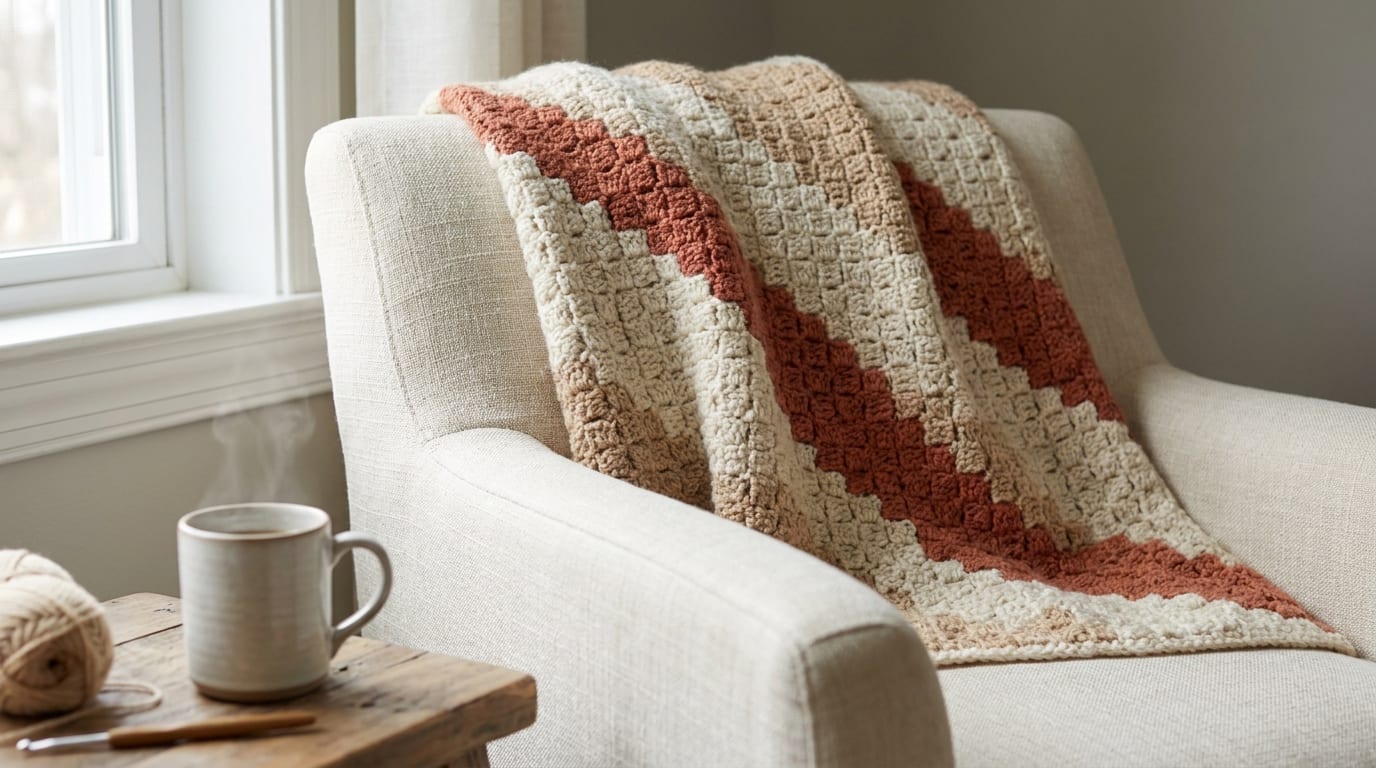
What corner-to-corner crochet is
Most blankets grow one horizontal row at a time, from the cast-on edge upward. Corner-to-corner crochet works differently. You start with a single small block at one corner, add blocks on both sides of every row until you reach the widest diagonal across the center, then remove blocks on both sides until you finish at the opposite corner. The result is a square or rectangle made up of tiny square units arranged on a diagonal grid.
That diagonal grid is the thing that makes C2C special. Each unit in the grid can be a different color, which means every block functions like a pixel. Pixel blankets made this way are called graphghans, and they are one of the most popular uses for the technique. Even without colorwork, the diagonal texture gives a plain blanket more visual interest than a standard single crochet or double crochet fabric.
C2C is also beginner-friendly once you understand the single repeating unit. You only ever learn one stitch sequence and repeat it across every block in the blanket.
The C2C stitch unit
Every block in a corner-to-corner blanket is made the same way. Here is the sequence for one block:
- Chain 6.
- Work a double crochet into the 4th chain from the hook.
- Work a double crochet into each of the next 2 chains (3 double crochets total).
That group of three double crochets sitting on a short chain base is your block. It looks like a small square, roughly 0.75 to 1 inch across in worsted-weight yarn. When you join blocks together, each new block attaches to the corner chain-space of the block before it rather than working into individual stitches. The chain-space creates a natural joining point that keeps the diagonal grid neat.
How to increase
During the first half of your blanket, every row adds one block at the start and one block at the end. This is how the piece grows diagonally from a single block in the corner to the full width at the center.
To add a block at the start of a row: chain 6, work 3 double crochets into the 4th chain from the hook. Slip stitch into the corner space of the first block from the previous row to join, then continue across.
To add a block at the end of a row: after working the last block in the row, slip stitch into the corner chain-space of that block, then chain 6 and work 3 double crochets into the 4th chain to create the extra end block.
Each increase row is one block wider than the row before it. Row 1 has 1 block. Row 2 has 2 blocks. Row 3 has 3 blocks, and so on until you reach your target width.
How to decrease
Once you reach the center diagonal, you begin removing one block from each end of every row. This is the decrease section, and it mirrors the increase exactly in reverse.
At the start of a decrease row, slip stitch across the top of the first block, then chain 3 to step down into position. The slip stitches do not create a new block -- they just move you to the correct height for the next block over. You then work across the row as usual and stop without adding an extra block at the end.
The chain-3 at the start of each decrease row replaces the chain-6 you used during increases. It keeps your hook at the right height without adding length to the piece.
How many blocks for a throw
The block count you need depends on your gauge. A typical worsted-weight block with a 5 mm hook measures about 0.8 inches per side. Use that number to calculate your target:
- Lap blanket (approximately 48 x 48 inches): aim for 60 x 60 blocks
- Generous throw (approximately 54 x 54 inches): aim for 68 x 68 blocks
- Baby blanket (approximately 30 x 30 inches): aim for 38 x 38 blocks
Make a test block before you calculate. Measure it, then divide your target width in inches by the block size in inches to get the block count. A 60-block blanket has 60 blocks across the widest diagonal row, which means the increase section runs for 60 rows and the decrease section runs for another 60 rows -- 120 rows total.
That sounds like a lot, but C2C rows are short at the start and only reach full length at the center. The average row length across the whole blanket is half the maximum, so the project moves faster than the row count suggests.
C2C for graphghan pixel art
A graphghan is a blanket where each block is a different color, creating a pixelated image when you view the finished blanket from a distance. C2C is the most popular technique for graphghans because the square blocks map perfectly onto a grid, and you can use any pixel art or cross-stitch chart as your pattern.
To plan a graphghan, choose your image and decide on a block grid size. A 60 x 60 block blanket gives you a 60 x 60 pixel canvas. Pixel-art tools like Pixilator or even a basic spreadsheet with colored cells can serve as your chart.
Color changes in C2C happen at the block level. You finish one block in the old color, join the new yarn, and start the next block. Carry unused colors along the back of the work only if you will use them again within 3 or 4 blocks. For longer gaps between colors, cut the yarn and weave in the ends. A complex graphghan will have many ends to weave, so plan for that finishing time.
Yarn amounts for a C2C blanket
A solid-color lap throw in worsted-weight yarn uses around 1,000 to 1,200 yards. A 60 x 60 block blanket in a two-color stripe uses roughly 500 to 600 yards per color. A graphghan with many colors needs less of each individual color but more yarn overall -- budget 1,200 to 1,500 yards total and distribute among your colors based on how much of the image each one covers.
A useful rough method: make 10 blocks with a measured length of yarn and note how many yards you used. Divide by 10 to get yards per block, then multiply by the total number of blocks in your blanket. A 60 x 60 grid has 3,600 total blocks, but remember you only work each diagonal position once, so the effective count is lower -- the actual number of blocks in a 60 x 60 C2C blanket is about 3,600 individual blocks across all rows combined.
Buy at least 15% more than your estimate to account for tension variations and the inevitable extra weaving.
Tips for keeping tension even across a large project
Long diagonal rows in the center of a C2C blanket can pull differently than short rows near the corners. A few habits help keep the fabric flat and even.
Work at the same time of day when possible. Your grip on the hook tends to be looser when you are tired, which changes the block size over long evening sessions compared to daytime work.
Do not pull the joining slip stitches tight. The slip stitch between blocks should sit relaxed in the chain-space. A tight slip stitch puckers the corner and distorts the grid.
Block the finished blanket by misting it with water and pinning it flat. Even a well-tensioned C2C blanket benefits from a light blocking session to even out the diagonal edges and open up the texture.
For more blanket options beyond C2C, the crochet blanket patterns guide covers the full range of blanket types from granny squares to chevrons. If you want to add colorwork beyond basic C2C, tapestry crochet is a related technique worth exploring for carrying colors in a single row without cutting.