What a skein of yarn actually is
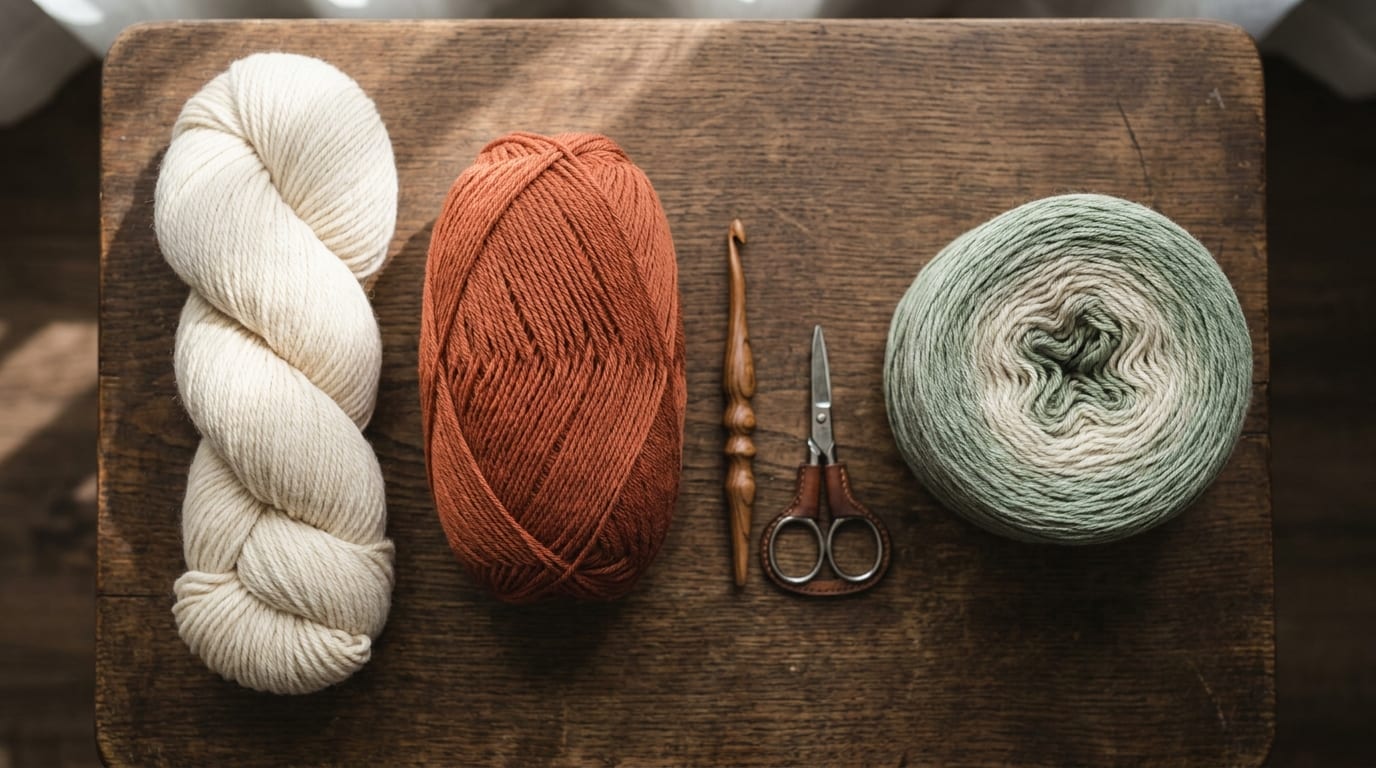
A skein of yarn is one unit of yarn, sold the way the mill chose to package it. In everyday shop talk, "a skein of yarn" usually means a single put-up you can buy off the shelf and bring home, the same way you would say a loaf of bread or a roll of tape. The word does double duty, though. It is both the loose, general name for any single bundle of yarn and the specific name for one particular shape, the oval center-pull skein you see hanging on pegs in a craft store.
That double meaning is where a lot of beginner confusion starts. Someone tells you a pattern needs "three skeins" and you stand in the aisle holding three very different-looking bundles, unsure if you have the right amount. This guide clears it up. By the end you will know the three common put-ups by sight, why the number on a pattern matters far less than the yardage, how to read every line on a yarn label, roughly how much yarn each kind of project eats, what a dye lot is, and how to wind a hank so it does not turn into a knotted mess on your floor.
Skein vs ball vs hank vs cake
Yarn comes wound in a handful of standard shapes, and each one behaves differently in your hands. Knowing them by sight saves you from buying a hank when you wanted something ready to crochet, and from fighting a tangle you could have avoided.
Ball
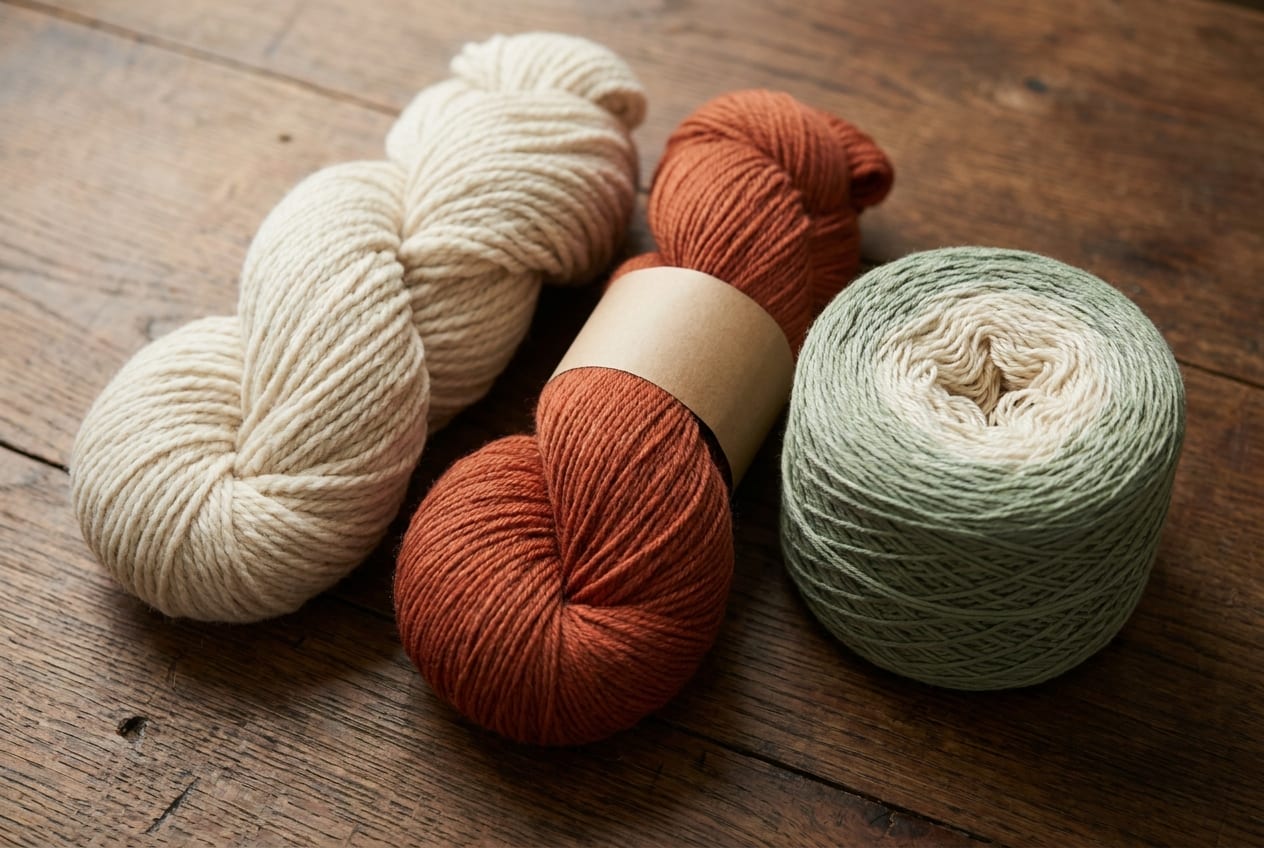
A ball is yarn wound into a round or roughly egg-shaped bundle. Most balls are made to pull from the outside, so the working end sits on the surface and you roll the ball as you go. Some smaller balls also have a center-pull end tucked inside. Balls are common for cotton, sock yarn, and many budget acrylics. They are ready to use straight away, with no winding needed.
Center-pull skein
This is the classic shape most people picture, and the one the word "skein" points to in a craft store. It is an oval, slightly flattened cylinder with a paper band (the label) wrapped around the middle. You find the end buried in the center and pull from the inside, which lets the skein sit still and feed yarn smoothly without rolling off the table. Worsted weight acrylics like the big-brand workhorses almost always come this way. Ready to use, no winding needed.
Hank
A hank is yarn wound into one large loose loop, then twisted on itself into a tidy figure-eight bundle for the shelf. It looks beautiful, which is why nicer wools, hand-dyed yarns, and many indie-dyer skeins are sold this way. Here is the catch: you cannot crochet straight from a hank. The moment you untwist it and pull, the loop collapses into a knotted heap. A hank has to be wound into a ball or a cake first. More on how to do that below.
Cake
A cake is yarn wound on a yarn winder into a flat-bottomed cylinder that sits upright like a small cake on a plate. It pulls from the center, stays put while you work, and shows off color order neatly, which is why gradient and self-striping yarns are so often sold as cakes. You can buy yarn pre-wound as a cake, or wind your own from a hank. Ready to use as sold.
Why yardage matters more than skein count
Here is the single most useful thing to take from this whole guide: buy yarn by total yards, not by the number of skeins.
Yarn is sold by two measurements at once. Weight, in grams or ounces, tells you how much fiber is in the bundle. Length, in yards or metres, tells you how far that fiber will go. Those two numbers are not locked together across different yarns. Two skeins that both weigh 100 grams can hold wildly different lengths, because a fine, dense fiber packs more length into the same weight than a thick, lofty one. A 100 gram skein of thin fingering wool might hold 400 yards, while a 100 gram skein of chunky acrylic might hold only 120.
So "three skeins" means nothing on its own. Three skeins of what? If a pattern was written for skeins that hold 220 yards each, it needs roughly 660 yards. If the yarn you grabbed holds only 170 yards per skein, three of them leave you about 150 yards short, which is a missing sleeve discovered at the worst possible moment.
The fix is simple. Find the total yardage your pattern calls for, then add up the yardage on the labels of whatever yarn you actually buy until you reach that number, plus a little spare. Always round up. A pattern that needs 640 yards and a yarn that comes in 200 yard skeins means four skeins (800 yards), not three. The extra is cheap insurance against running short or hitting a different dye lot later.
If you are substituting one yarn for another, our yarn weight converter lines up the US, UK, and EU weight names so you can match thickness first, then do the yardage math with confidence. Our full yarn substitution guide walks through matching weight, gauge, and fiber in order. And if your project has to fit a body or a cushion, work a swatch and run the numbers through the gauge calculator before you commit, because the right yardage in the wrong gauge still gives you the wrong size.
How to read a yarn label
The paper band around a skein is small but it carries everything you need to choose, substitute, and care for the yarn. Here is what each part tells you, roughly in the order you will use it.
- Weight category. The Craft Yarn Council (CYC) standard runs from 0 (lace) up to 7 (jumbo), often shown as a little yarn-skein icon with a number inside. 0 is lace, 1 is fingering (UK 4 ply), 2 is sport, 3 is DK (US light worsted), 4 is worsted (UK aran), 5 is bulky (UK chunky), 6 is super bulky, 7 is jumbo. This is the first thing to match when you substitute yarn.
- Fiber content. What the yarn is made of, by percentage, such as 100% cotton or 80% acrylic and 20% wool. Fiber drives warmth, stretch, drape, and how the piece washes.
- Yardage and grams per skein. The two numbers from the section above, usually printed together, for example 100 g / 220 yds (200 m). This is the number you add up to hit your pattern total.
- Recommended hook and needle size. A starting hook size, often shown with a crochet symbol, plus a knitting needle size. Treat it as a suggestion, not a rule. Your own tension may want a size up or down.
- Gauge. A small grid or note telling you how many stitches and rows fit in a 4 inch (10 cm) square at the recommended hook. Useful as a sanity check when you swatch.
- Care symbols. The little laundry icons for washing, drying, bleaching, and ironing. Superwash wool and acrylic are usually machine friendly. Untreated wool often is not, and will felt in a hot wash.
- Dye lot. A code, usually a number, identifying the exact batch this skein was dyed in. This one matters enough to get its own section next.
If a weight name on the label is one you do not recognize, the yarn weight converter maps it across the US, UK, and EU systems in one chart. Worsted, for instance, is the US name for what the UK calls aran, and our worsted weight yarn page walks through what that everyday middle-of-the-road weight is good for. There are matching guides for DK and cotton if those are what you are holding.
How much yarn does a project need?
Yardage needs depend on the project size, the stitch you use, and the yarn weight. The table below gives rough yardage for common projects worked in worsted weight (UK aran), which is the most common beginner weight. Treat these as ballpark figures and always check your actual pattern, since a dense stitch like single crochet (UK double crochet) eats more yarn than an open one, and crochet in general uses about a third more yarn than knitting for the same area.
| Project | Rough yardage (worsted) | Notes | |---|---|---| | Dishcloth | ~50 yds | Often under one skein. A good first make. | | Hat / beanie | ~120 to 200 yds | Adult size; ribbing adds yardage. | | Scarf | ~300 yds | A simple wrap-once length. | | Baby blanket | ~700 to 900 yds | Depends on size and stitch density. | | Adult sweater | ~1000 to 1500 yds | Varies a lot with size and length. | | Throw / large blanket | ~1500 to 2000 yds | Bump it up for chunky borders. |
A worked example makes the table easier to use. Say you want a worsted scarf and the yarn you like comes in 170 yard skeins. The scarf needs about 300 yards, so two skeins (340 yards) covers it with a margin. One skein would leave you well short. For a baby blanket at the larger end, 900 yards in those same 170 yard skeins means six skeins (1020 yards), again with sensible spare.
Two adjustments to keep in mind. Going up in yarn weight uses fewer yards for the same finished size, because each stitch is bigger. Going down uses more. And lacy, open stitch patterns sip yarn while tight, textured ones gulp it, so a cabled or bobbled piece can need noticeably more than a plain one of the same dimensions.
Dye lots, and why you buy enough at once
A dye lot is the specific batch of yarn that went through the dye bath together. Yarn from the same lot is as close to identical in color as the maker can manage. Yarn from two different lots of the same shade can differ just enough to show.
The difference is often invisible while the skeins sit side by side on the shelf, then becomes obvious once both are worked into the same piece, where a faint line appears at the row you switched lots. Natural fibers and hand-dyed yarns vary the most. Solid acrylics vary the least, though even they are not immune.
The rule that saves you: buy all the yarn for one project at the same time, from the same dye lot, and buy a little extra. Check the lot number on every label before you leave, since two skeins of the same color on the same peg can still come from different lots. If you do end up needing to bridge two lots in one project, do it where a seam or a color change already hides the join, never in the middle of a smooth panel. For self-striping and gradient yarns sold as cakes, the dye lot still applies, so grab matching cakes for anything where the color flow needs to line up.
How to wind a hank into a ball
A hank is the one put-up you must prepare before you crochet. Skip this step and the loop collapses into a tangle the instant you pull the end. Here is the calm way through it.
The fast method uses two tools made for the job. A swift holds the open loop under gentle tension and spins as yarn comes off it, while a ball winder turns that yarn into a tidy center-pull cake. You clip the swift to a table, drape the opened hank around it, snip the little ties holding the bundle, thread the end into the winder, and crank. A 100 gram hank winds into a cake in a couple of minutes.
No swift and winder? You can wind by hand. Untwist the hank back into its big single loop and find something to hold it open, the back of a dining chair, a pair of upturned chair legs, or a willing friend's two outstretched hands. Snip the ties, find one end, and wind it around your fingers or a cardboard tube into a ball, letting the loop feed off the holder a little at a time. It is slower and a bit meditative, and it works perfectly well.
A few things to keep you out of trouble. Cut the ties, do not pull the hank apart before it is held open, or you will start with a knot. Wind loosely; a tight ball stretches the yarn and can dull the color. And to say it one final time: never try to crochet straight from a hank. Wind first, then stitch.
New to all of this and wondering where the yarn even goes? Our calm introduction to crochet covers the hook, the four foundation stitches, and how to read a pattern. When you are ready for a first project to use that skein on, the roundup of free crochet patterns sorts makes by skill level, each one listing the yarn and rough yardage it needs.
Frequently asked questions
Is a skein the same as a ball of yarn?
Not exactly. Skein is the general word for any single unit of yarn, and also the specific name for the oval center-pull shape sold in craft stores. A ball is a different put-up, wound round and usually pulled from the outside. Both are ready to crochet as sold.
What is the difference between a hank and a skein?
In the hank vs skein question, the key difference is readiness. A center-pull skein is ready to use straight away. A hank is one large twisted loop that must be wound into a ball or cake first, because pulling the end while it is still twisted collapses it into a tangle.
How many yards are in a skein of yarn?
It varies a lot by yarn. A common worsted weight skein holds around 200 to 220 yards, but fingering skeins can hold 400 or more and chunky skeins as few as 120. Always read the label, since the yardage, not the skein count, is what your pattern actually needs.
How much yarn do I need for a project?
Match the total yardage your pattern lists, not the skein count. As a rough worsted guide: a dishcloth needs about 50 yards, a scarf about 300, a baby blanket 700 to 900, and an adult sweater 1000 to 1500. Add a little extra and round up to whole skeins.
Why does my pattern list skeins of yarn but the amounts do not match?
Because a skein is not a fixed amount. A pattern written for 220 yard skeins needs different numbers than one written for 170 yard skeins. Convert the pattern total into yards, then buy enough skeins of your chosen yarn to reach that yardage with a small margin.
Do I really need to buy the same dye lot?
For one project, yes. Skeins from different dye lots can differ subtly in shade, which shows as a faint line where you switch. Buy all the yarn for a project at once, check the lot number on each label, and pick up a little extra so you do not run short later.