Yarn substitution, step by step
Yarn substitution is the skill of swapping the yarn a pattern calls for with a different one and still getting a result you are happy with. Sooner or later every maker needs it. The yarn is discontinued, or it costs three times what you want to spend, or your skin reacts to wool, or you simply have a perfectly good stash you would rather use. The good news is that substituting yarn in a pattern is a calm, ordered process, not a gamble. Get the order right and most swaps work the first time.
This guide walks through the priorities in the sequence that actually matters: weight first, then gauge, then fiber and drape, then the yardage math, then care. We will work a real yardage example with numbers, cover the mistakes that catch people out, and finish with a checklist you can keep beside your hook.
Why people substitute yarn
There are four ordinary reasons a pattern's yarn gets swapped, and none of them is a sign you are doing anything wrong.
The first is that the yarn is discontinued. Yarn lines retire constantly, and a pattern published three years ago may name a yarn no shop still carries. The second is cost. A sweater can call for ten skeins, and a luxury yarn at twelve dollars a skein turns a fun project into an expensive one. A washable acrylic blend at three dollars makes the same sweater affordable. The third is allergy or sensitivity. Plenty of people find wool itchy or react to it, and need a plant fiber or a soft acrylic instead. The fourth, and the most common of all, is that you already own yarn. Using your stash is free, satisfying, and keeps yarn out of a landfill.
Whatever the reason, the method is the same. Work through the steps below in order.
Step 1: match the yarn weight first
The single most important rule of yarn substitution is to match the weight category. Yarn weight is the thickness of the strand, and the Craft Yarn Council (CYC) sorts it into numbered categories from 0 (lace) to 7 (jumbo). A pattern written for worsted weight (CYC 4) expects a worsted-weight strand. Swap in a DK (CYC 3) or a bulky (CYC 5) and the fabric will be the wrong size, the wrong density, and the wrong drape, no matter what else you do.
So your substitute should sit in the same CYC category as the original. A worsted for a worsted. A DK for a DK. The ball band almost always prints the CYC number inside a little yarn-skein symbol, so check it before anything else.
| CYC number | US name | UK equivalent | Typical hook | |---|---|---|---| | 1 | Super fine / fingering | 4 ply | 2.25 to 3.5 mm | | 3 | Light / DK | DK | 4.5 to 5.5 mm | | 4 | Worsted | Aran | 5.5 to 6.5 mm | | 5 | Bulky | Chunky | 6.5 to 9 mm |
Names differ across countries, which is where most confusion starts. US worsted is the same thickness as UK Aran. US light worsted lines up with UK DK. If a pattern uses terms you do not recognize, our yarn weight converter maps the US, UK, and EU names against the CYC numbers so you can be sure you are comparing like with like. For a deeper look at one of the most common categories, see our guide to worsted weight yarn.
Step 2: swatch and match gauge
Matching the weight gets you close. It does not get you exact, because two yarns in the same CYC category can still knit and crochet up slightly differently. One worsted is a touch thicker than another. One is spun tighter. The way to settle it is to swatch.
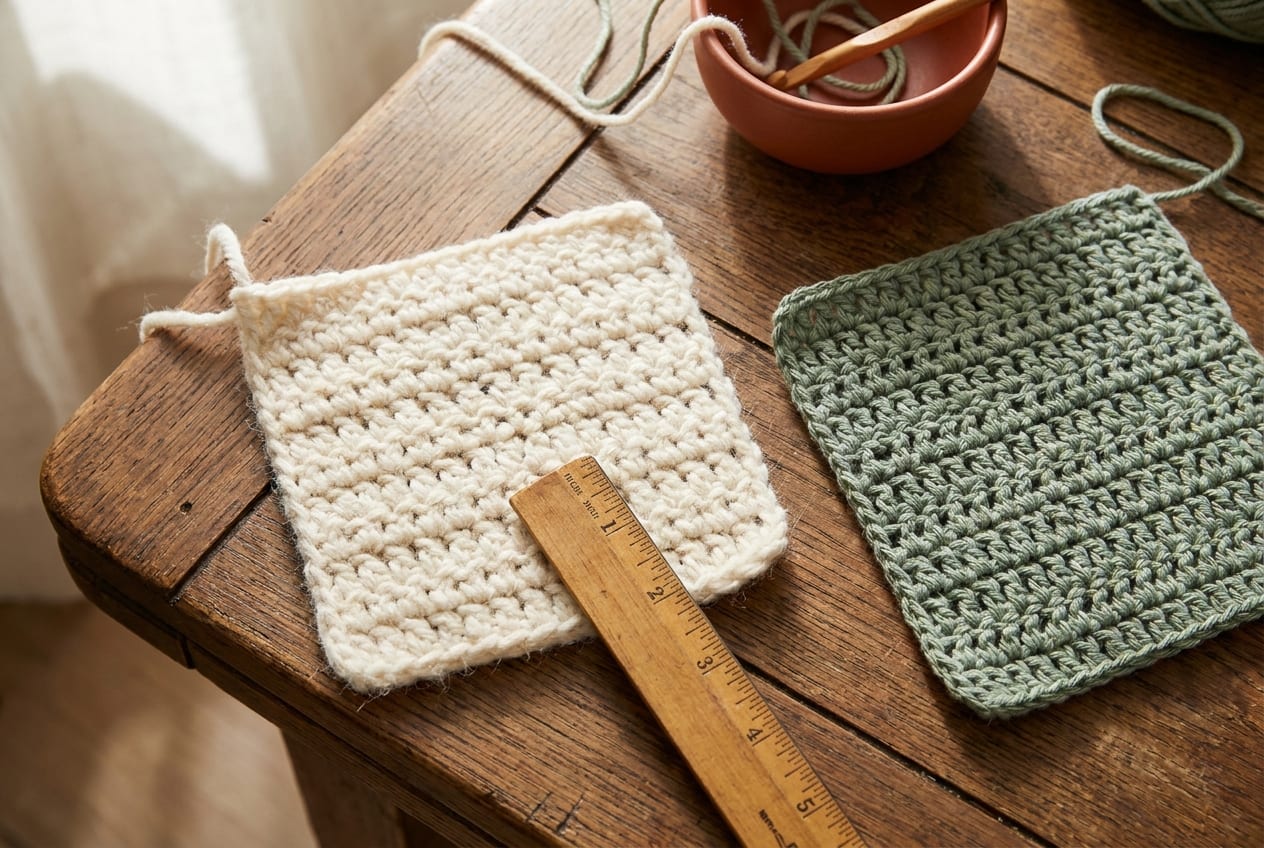
Gauge is the number of stitches and rows in a measured square, usually 4 inches (10 cm). Every pattern lists its gauge near the top, something like "16 sts and 18 rows = 4 inches in double crochet." Crochet a generous swatch with your substitute yarn and the hook the pattern recommends, block it the way you will block the finished piece, then measure.
- If you get more stitches per 4 inches than the pattern, your gauge is too tight. Go up a hook size and swatch again.
- If you get fewer stitches, your gauge is too loose. Go down a hook size and swatch again.
- When the stitch count matches, you are ready to start.
This sounds fussy for a scarf, and for a scarf you can often skip it. For anything that has to fit, a garment, a hat, a bag sized to its contents, gauge is the difference between a piece that fits and a pile you frog. Our gauge calculator does the math: enter your swatch numbers and the pattern gauge and it tells you if you are on, and how far off you are if not.
Step 3: match fiber and drape to the project
Weight and gauge control the size of the fabric. Fiber controls how it behaves. Two yarns can be the same worsted weight and the same gauge and still be wrong for each other, because one is rigid cotton and the other is fluid bamboo. Match the fiber to what the project is asking for.
Here is how the common fibers behave:
- Cotton has almost no stretch and gives crisp, clear stitch definition, but it is heavy and can feel rigid. It is right for dishcloths, market bags, summer tops, and anything you want to hold its shape. It is wrong for a soft, springy hat that needs to hug. For more on this fiber, see our guide to cotton yarn.
- Wool is elastic and warm, forgives uneven tension, and blocks beautifully. It is the workhorse for sweaters, hats, and mittens. Superwash wool is treated to survive the washing machine.
- Acrylic is washable, cheap, and hard-wearing, which makes it the practical choice for kids' items, charity makes, and anything that gets heavy use. It does not block, so the fabric stays however you crochet it.
- Alpaca is warm, soft, and drapes heavily, but it has little memory, so it grows and sags over time. Lovely for a shawl, risky for a fitted cuff.
- Bamboo is silky and drapes hard, with a cool hand that suits warm-weather garments. Like alpaca, it can grow.
The shortcut is to think about drape. A drapey yarn, alpaca, bamboo, silk, makes a fluid fabric that hangs and moves. A structured yarn, cotton, sturdy wool, holds an edge. A drapey shawl yarn is the wrong choice for a structured bag that needs to stand up, and a stiff cotton is the wrong choice for a shawl meant to pool around your shoulders. Read what the pattern is for, then pick a fiber that wants to do the same job.
Step 4: buy by total yardage, not skein count
This is the step people skip, and it is the one that leaves you one ball short on the final evening. Patterns list the yarn as a number of skeins of a specific yarn. Do not buy that number of skeins of your substitute, because yards per skein vary from yarn to yarn. One brand puts 200 yards in a skein; another puts 120 yards in a skein the same size.
The fix is simple arithmetic. Work out the total yardage the pattern needs, then buy enough of your substitute to match that total.
A worked yardage example
Say a blanket pattern calls for 6 skeins of a yarn that holds 210 yards per skein.
First, the total yardage the project needs:
6 skeins x 210 yards = 1,260 yards
Now look at your substitute. Suppose it comes in skeins of 170 yards each. Divide the total you need by the yards in one substitute skein:
1,260 yards / 170 yards per skein = 7.41 skeins
You cannot buy 7.41 skeins, so round up to 8. Notice that the pattern said 6 skeins, but your substitute needs 8 to hit the same total yardage. Buy 6 and you would run out with a quarter of the blanket left.
Add a little extra on top for safety, especially for a first attempt at a stitch, and buy it all in the same dye lot. The dye lot is a number on the ball band marking the exact batch a yarn was dyed in. Two balls of the same color from different lots can be visibly different, and the line where they meet shows in the finished piece. If you are still fuzzy on how yardage and weight relate on a ball band, our explainer on what is a skein of yarn breaks down every number printed there.
Step 5: match care if it matters
The last priority is care, and it matters more for some projects than others. A wall hanging never gets washed, so wash care is irrelevant. A baby blanket gets washed constantly, often hot, so it needs a washable fiber: acrylic, cotton, or superwash wool. The same goes for socks, kids' sweaters, and anything worn against the skin and laundered often.
Read the ball band's care symbols before you commit. Swapping a hand-wash-only wool into a garment someone will throw in the machine is a quiet disaster waiting to happen. Match the care to how the finished object will actually live.
Watch for fiber-specific behavior
A few fibers have quirks that surprise people mid-project or after the first wash. Keep these in mind so a substitution does not spring a surprise:
- Superwash wool grows when wet. The treatment that makes it machine washable also lets it stretch and lengthen when soaked, so a superwash piece can come out of a wet block longer than it went in. Account for that when you swatch and block.
- Cotton can stretch and sag under its own weight, especially in a large or heavy piece, because the fiber has no elastic memory to pull it back.
- Alpaca has little memory. It drapes wonderfully but grows over time, so a fitted alpaca garment can loosen with wear.
- Acrylic does not block. Wetting and pinning will not reshape it, and steam can flatten or "kill" it permanently. Whatever you crochet is what you get, so get your gauge right before you commit.
A quick yarn substitution checklist
Run this list before you buy a single ball:
- Weight. Is your substitute the same CYC number as the pattern's yarn?
- Gauge. Did you crochet and block a swatch, and does it match? Change hook size until it does.
- Fiber and drape. Does the fiber suit the project, structured for bags, drapey for shawls, washable for kids?
- Yardage. Did you add up the total yards the pattern needs and buy to that number, not the skein count?
- Dye lot. Is every ball from the same dye lot, with a little extra for safety?
- Care. Does the care match how the finished piece will be washed and worn?
Tick all six and a substitution stops being a leap of faith. It becomes a normal, repeatable part of working from any pattern. If you want more projects to practice on, our roundup of free crochet patterns lists the yarn weight and rough yardage for every one, which makes a swap easy to plan.
Frequently asked questions
How do I substitute yarn in a pattern?
Work in order: match the yarn weight category (CYC number) first, then crochet a gauge swatch and adjust your hook size until the gauge matches. Next, pick a fiber whose drape suits the project, add up the total yardage you need, and buy that amount in one dye lot.
Can I use a different yarn weight than the pattern calls for?
It is risky. A different weight changes the size, density, and drape of the fabric, so you will struggle to get gauge and the finished piece may not fit. If you must change weight, treat it as designing a new project and re-swatch everything, rather than following the pattern's numbers.
Is there a yarn substitution chart I can use?
The most useful yarn substitution chart lines up the CYC weight numbers (0 to 7) against the US, UK, and EU names and a recommended hook range. Match your substitute to the original's CYC number on that chart first, then confirm the swap by swatching for gauge before you commit.
How much substitute yarn should I buy?
Buy by total yardage, not skein count. Multiply the pattern's skein count by the original yarn's yards per skein to get the total, then divide that total by your substitute's yards per skein and round up. Add a little extra in the same dye lot for safety.
Can I replace wool with acrylic or cotton?
Yes, as long as you match the weight and re-check gauge. Be aware that wool is elastic and blocks well, while acrylic does not block and cotton has no stretch. For a fitted or springy piece, that change in behavior matters, so swatch first and judge whether the new fabric still suits the project.
Why does my project come out the wrong size after substituting yarn?
Almost always because the gauge was not checked. Two yarns of the same weight can still stitch up at different gauges, so a substitute can run larger or smaller than the original. Swatch with the new yarn, block it, and change your hook size until the gauge matches the pattern before starting.