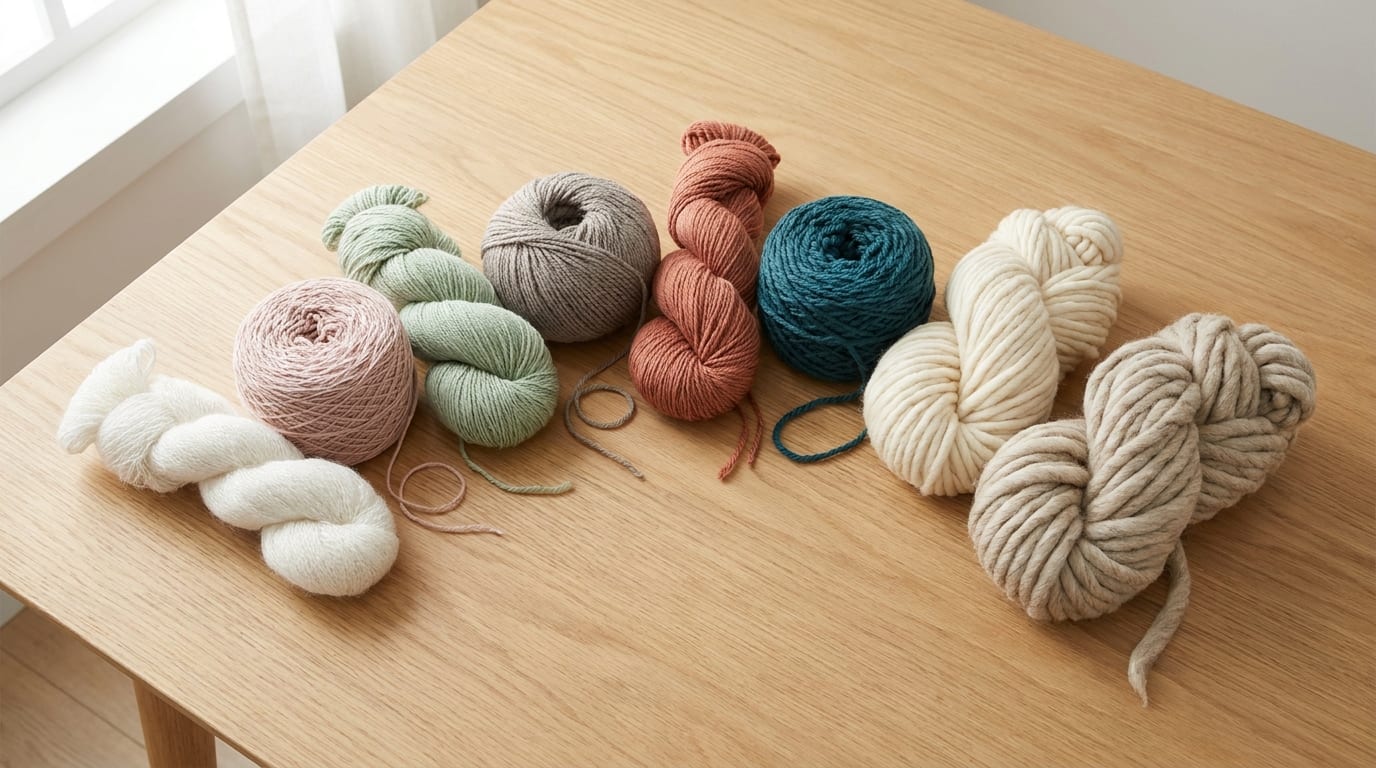
What yarn weight actually means
Yarn weight describes the thickness of the yarn strand. The word "weight" is a little misleading — it is not about how much a ball weighs on a scale, but about how thick the strand is. A thicker strand means larger stitches, faster work, and a heavier finished fabric. A finer strand means smaller, more detailed stitches, lighter fabric, and a project that takes longer.
The Craft Yarn Council (CYC) defines eight standard weight categories, numbered 0 through 7. Most yarn labels include a small skein symbol with the category number and name printed inside it. When a pattern specifies "worsted weight" or "DK," it is referring to these categories.
Understanding the system helps you read patterns correctly, substitute yarns with confidence, and choose the right weight for whatever you want to make.
The 8 yarn weight categories
0 – Lace
The finest category. Lace yarn is often made from a single thin ply or a very tightly twisted strand. It produces delicate, open fabric and is used for fine shawls, doilies, lace tablerunners, and anything where an airy, intricate look is the goal.
Lace yarn typically has more than 30 wraps per inch (WPI) and works on very small needles or hooks (1.5–2.5 mm). It is not a beginner-friendly weight — the fine strand is harder to see and to manipulate — but the results can be extraordinary.
1 – Super Fine (Fingering / Sock)
Super fine yarn, often called fingering or sock weight, is the standard for hand-knitted socks. It is thin enough to produce a fabric that fits inside a shoe without bulk, yet strong enough — especially in a wool/nylon blend — to withstand the friction of daily wear.
It works on 2.25–3.25 mm hooks or needles and has a WPI of around 14–30. Beyond socks, fingering yarn suits delicate baby garments, fine shawlettes, and any project where lightness matters more than speed.
2 – Fine (Sport / Baby)
Sport weight sits between fingering and DK. It works up faster than fingering but still produces a lightweight, fine-grained fabric. It is a common choice for baby garments, lightweight summer tops, and fine hats.
Typical hook or needle size is 3.5–4.5 mm, with a WPI around 12–14. Sport weight is underused by many crocheters — it deserves more attention for anyone who wants something lighter than DK without going all the way down to sock weight.
3 – Light (DK / Light Worsted)
DK (double knit) is one of the most versatile weights for garments. It produces a fabric with good drape and a relatively fine stitch definition, making it suitable for fitted cardigans, lightweight blankets, baby clothes, and accessory projects where you want clean stitch detail.
DK works on 4–4.5 mm hooks or needles. WPI is typically 11–12. It is faster to work than fingering or sport weight but lighter in the hand than worsted. If you want a garment that hangs well and is not too warm, DK is often the right choice.
4 – Medium (Worsted / Afghan / Aran)
Worsted weight is the most widely used weight in the English-speaking world, and the default for a huge number of published patterns. It strikes a balance: thick enough to work up quickly and see your stitches clearly, fine enough to produce a fabric with good stitch definition and a comfortable weight.
It suits hooks and needles around 5–5.5 mm, with a WPI of 9–10. Worsted is the go-to weight for blankets, hats, scarves, everyday garments, and most beginner projects. If you only ever work in one weight, many crocheters and knitters choose worsted.
Note: Aran weight sits at the heavier end of category 4 and is sometimes listed as a separate sub-category. It works on slightly larger hooks (5.5–6 mm) and produces a slightly denser fabric. The two terms are often used interchangeably in patterns, but if you are substituting yarn, a true aran yarn is thicker than a true worsted.
For a detailed look at this weight, see the worsted weight yarn guide.
5 – Bulky (Chunky)
Bulky yarn is thick, fast to work, and satisfying for large projects. A chunky blanket in bulky yarn takes a fraction of the time that a worsted blanket takes, and the bold stitch texture is a design feature in its own right.
Hooks and needles range from 8–12 mm, with a WPI of around 5–6. Bulky weight suits oversized scarves, thick cowls, chunky blankets, home décor items, and quick gift projects. It is a little harder to use for garments because the fabric can become heavy, but oversized sweaters in bulky yarn are a popular design in contemporary knitwear.
6 – Super Bulky
Super bulky yarn produces very large stitches and works up extremely fast. A small hat can be finished in under an hour; a simple blanket takes an evening. The hook or needle size is typically 12–25 mm, with a WPI of around 3–4.
Projects in super bulky yarn have a bold, chunky look. It is popular for arm-knitted or arm-crocheted blankets, very thick cowls, and statement accessories. Stitch definition is limited at this weight — intricate stitch patterns disappear in the thick strands — so simple stitches (single crochet, garter stitch) tend to look best.
7 – Jumbo
Jumbo is the thickest category, encompassing everything from very thick super bulky yarn to chunky roving, t-shirt yarn, and arm-knitting roving. Hooks and needles are 25 mm and above (or your arm, for arm knitting).
Jumbo weight is more of a craft/home décor category than a traditional garment weight. It suits wall hangings, baskets, very thick blankets, and novelty items. The stitch sizes are large enough to see across a room, which can be a striking visual effect.
Comparison table: all 8 weights at a glance
| Category | Name | WPI | Hook (mm) | Needle (mm) | Best for | |----------|------|-----|-----------|-------------|----------| | 0 | Lace | 30+ | 1.5–2.25 | 1.5–2.25 | Lace shawls, doilies | | 1 | Fingering / Sock | 14–30 | 2.25–3.25 | 2.25–3.25 | Socks, fine baby items | | 2 | Sport / Baby | 12–14 | 3.5–4.5 | 3.5–4.5 | Baby clothes, light tops | | 3 | DK | 11–12 | 4.0–4.5 | 3.75–4.5 | Garments, lightweight blankets | | 4 | Worsted / Aran | 9–10 | 5.0–5.5 | 4.5–5.5 | Most patterns, hats, blankets | | 5 | Bulky / Chunky | 5–6 | 8.0–12 | 6.5–9 | Chunky blankets, thick scarves | | 6 | Super Bulky | 3–4 | 12–25 | 10–19 | Arm knitting, very thick items | | 7 | Jumbo | 1–2 | 25+ | 19+ | Roving blankets, home décor |
WPI = wraps per inch. Wrap your yarn around a ruler and count how many strands fit in one inch. Use the number to identify an unlabelled yarn's weight category.
For a quick lookup when you are not sure which weight category your yarn falls into, the yarn weight converter at CrochetZen handles the maths.
How to choose the right weight for your project
Project type first, then yarn weight. Before picking a yarn, think about what the finished item needs to do.
A baby blanket needs to be soft, lightweight, and washable — DK or light worsted ticks those boxes. A market bag needs a firm structure that will not stretch out under weight — cotton sport or DK weight works well. A cosy winter cowl benefits from the warmth and speed of bulky or super bulky yarn. A delicate wedding shawl calls for lace or fingering weight.
Consider your timeline. Bulky and super bulky yarn works up fast — sometimes much faster than you expect. If you want a quick project for a gift, going up a weight or two is a genuine shortcut. If you want something fine and detailed, the time investment of a lighter weight is part of what makes the finished piece special.
Follow the pattern. If you are working from a published pattern, the designer chose the yarn weight deliberately. Changing to a different weight will change the size, drape, and texture of the finished item. You can substitute, but you will need to re-swatch and possibly recalculate stitch counts.
Match the yarn weight to the hook or needle on the pattern's gauge. If a pattern says "5 mm hook, 14 sc per 10 cm," find a yarn that produces that gauge. The yarn label's recommended hook size gets you close; a gauge swatch confirms it.
WPI: measuring yarn weight without a label
Wraps per inch (WPI) is a simple measurement you can do with any yarn and a ruler. Wrap the yarn snugly around the ruler (not tight, not loose — just relaxed) and count how many strands sit in one inch. The resulting number tells you the weight category.
This is useful for unlabelled yarn, yarn bought second-hand, or yarn where the label is missing or unclear. It is also a good double-check when a yarn claims to be one weight but feels off.
WPI benchmarks:
- 30+ WPI = lace (category 0)
- 14–30 WPI = fingering / super fine (category 1)
- 12–14 WPI = sport / fine (category 2)
- 11–12 WPI = DK / light (category 3)
- 9–10 WPI = worsted / medium (category 4)
- 7–8 WPI = aran (heavy category 4)
- 5–6 WPI = bulky (category 5)
- 3–4 WPI = super bulky (category 6)
- 1–2 WPI = jumbo (category 7)
A note on yarn labels
Most commercial yarn labels include the CYC weight category symbol — a small skein shape with a number inside. They also list the recommended hook and needle size in both metric and US, and the gauge (usually stated as stitches and rows per 10 cm on a given size needle in stockinette or equivalent).
When the label information and your swatched gauge disagree, trust your swatch. The label recommendation assumes an average tension, which yours may not match. Go up or down a hook size until your swatch matches the pattern gauge.
If you are using the yarn weight converter to identify an unlabelled yarn or to convert between systems, the WPI measurement combined with a small swatch is your most reliable method.