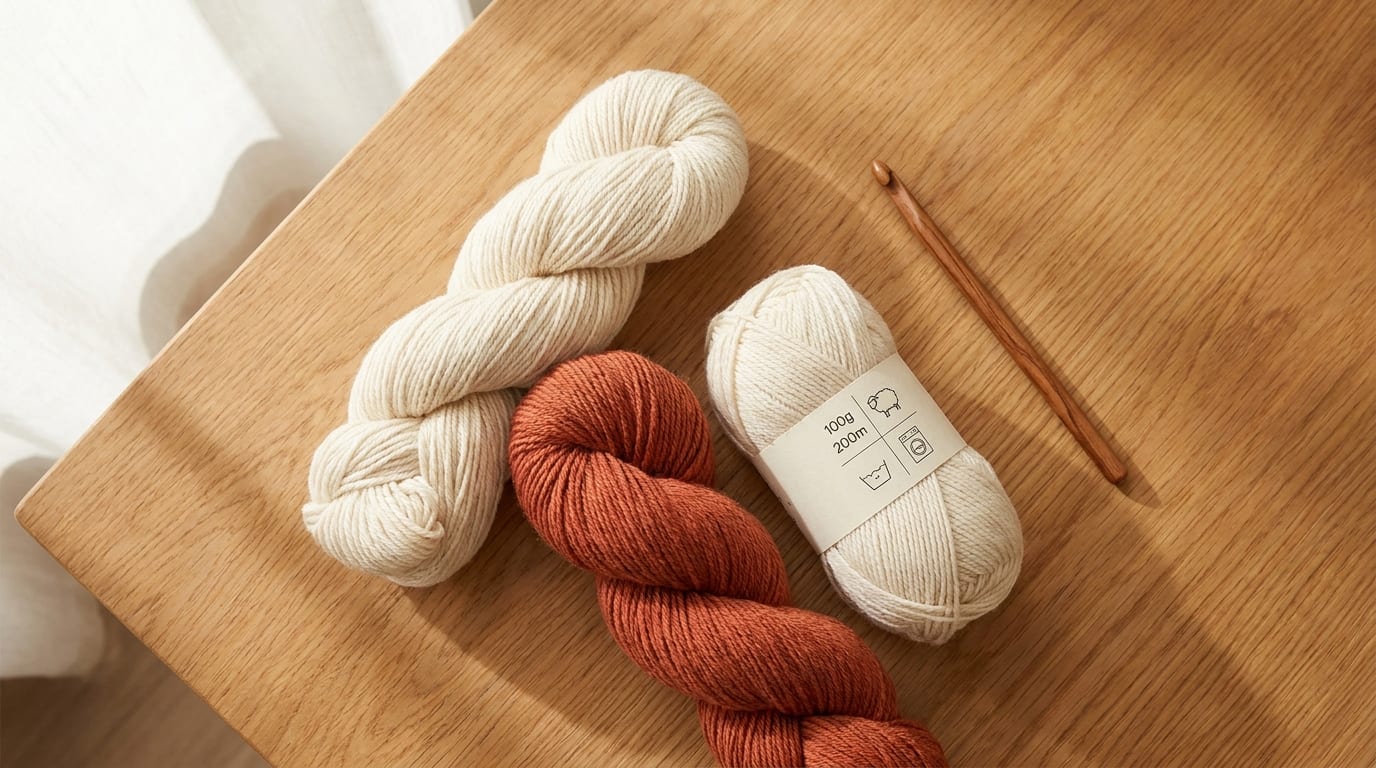
Everything printed on that small piece of paper
Yarn labels pack a surprising amount of information into a very small space. Brand name, colorway, fiber content, weight, yardage, recommended hook size, care instructions, and gauge all appear on most labels, often using symbols rather than words. Once you know how to read them, you can make better choices at the yarn store and avoid frustrating surprises mid-project.
Here is a walk through every element you will find on a standard yarn label, in the order that matters most when you are choosing yarn for a project.
Brand and yarn line
The brand name (Lion Brand, Paintbox, Drops, Cascade, and so on) and the yarn line name (Vanna's Choice, Simply DK, Safran, 220 Superwash) identify exactly which yarn you are holding. These two pieces of information together, not just the brand, are what you need to find the yarn again online or in another store.
Write them down or photograph the label before starting a project. If you run out mid-blanket, you will need both to reorder accurately.
Colorway name and number
The colorway is the color of the yarn, and it is listed both as a name ("Dusty Rose," "Slate," "Natural") and as a color number (a unique numerical code). The number is more reliable than the name when you are reordering because color names sometimes change across product lines or market regions. The number stays consistent.
Some labels also include a shade number, which indicates the specific color within a dye lot. See the next section for why that matters.
Dye lot
This is one of the most important numbers on the label, and one of the most frequently overlooked. Yarn is dyed in batches. Every skein in the same batch gets the same dye lot number. Skeins from different batches may look identical on the shelf but can show a subtle but visible color difference when worked next to each other in a finished piece.
Some yarns are labeled "dye lot free" or "no dye lot." This means the manufacturer uses a process that produces consistent color across batches. With these yarns, you can safely mix skeins from different lots.
Fiber content
Fiber content tells you exactly what the yarn is made from. It is listed as a percentage breakdown: "100% merino wool," "80% acrylic / 20% wool," "50% cotton / 50% bamboo." Every percentage point adds up to 100.
What fibers mean in practice:
Wool is warm, slightly elastic, and forgiving of tension inconsistencies because it has natural stretch. It takes dye beautifully and produces rich colors. Most wool felts if washed in hot water with agitation, so read care instructions carefully.
Superwash wool has been treated to be machine washable. It is slightly less elastic than untreated wool but far more practical for everyday items.
Acrylic is synthetic, machine washable, and inexpensive. It does not felt, which makes it good for beginners. It has less drape than natural fibers and does not breathe as well, but modern acrylic yarns can be very soft.
Cotton is breathable, cool, and has very little stretch. It is great for dishcloths, market bags, and summer garments. Cotton is heavier than wool for the same thickness and can be less forgiving of tension variation because it does not have the same elasticity.
Alpaca is very soft and warm, with a subtle sheen. It has less elasticity than wool and can be heavy, so it works best blended with other fibers for garments.
Bamboo and modal add drape and sheen. They are usually blended with cotton or wool to add fluidity to the finished fabric.
Weight symbol
The Craft Yarn Council weight system assigns every yarn a number from 0 to 7 based on thickness:
- 0 Lace: very fine thread for delicate lace and doilies
- 1 Super Fine: fingering and sock weight
- 2 Fine: sport weight
- 3 Light: DK (double knit) weight
- 4 Medium: worsted weight, the most common weight for beginners
- 5 Bulky: bulky weight
- 6 Super Bulky: very thick yarn for chunky projects
- 7 Jumbo: extremely thick roving or t-shirt yarn
The symbol appears as a small skein icon with the number printed inside. Weight 4 worsted is a good starting point for beginners because the stitches are large enough to see clearly and the yarn is easy to handle.
For a complete guide to what each weight looks like and which projects it suits, see our yarn weight guide.
Yardage and weight
Two numbers appear close together on most labels: the length of yarn in the skein and the physical weight of the skein.
Yardage is printed in both yards and meters (since yarn brands are international). This tells you how much yarn you actually have to work with. A skein of bulky yarn might weigh 100g but only contain 100 yards. A skein of fingering weight at the same 100g could contain 400 yards or more.
Grams or ounces is the physical weight of the skein. Patterns often call for a certain number of grams rather than skeins because skeins vary in size between brands.
To calculate how much yarn a project needs: find the total yardage the pattern calls for, then divide by the yardage per skein of your chosen yarn. Round up. Always buy an extra skein of the same dye lot if you are unsure.
Recommended hook or needle size
Most labels print a recommended crochet hook size and a recommended knitting needle size, since many yarns are used for both crafts. The crochet size might appear as "5 mm" or "US H-8" (both refer to the same hook).
This is a manufacturer's suggestion based on average tension and a standard fabric density. It is a starting point, not a fixed rule. Your tension may require a different size, and the pattern you are following may specify a different size deliberately (for example, amigurumi patterns often call for a smaller hook than the label suggests to create denser fabric).
Always prioritize the hook size that produces the correct gauge for your pattern over the number on the label.
Care symbols
Care symbols tell you how to wash, dry, and press the finished item. They use a set of standardized icons that appear on yarn labels worldwide.
Washing symbols:
- A tub with water: machine washable. A number inside (30, 40) is the maximum temperature in Celsius.
- A hand in a tub: hand wash only.
- A tub with an X through it: do not wash with water (dry clean only).
Drying symbols:
- A square with a circle inside: tumble dry safe. A dot means low heat; two dots mean medium heat.
- A square with a horizontal line: dry flat.
- A square with three vertical lines: hang to dry.
Ironing symbols:
- An iron icon: safe to iron. One dot is low heat; two dots are medium; three are high.
- An iron with an X: do not iron.
Dry cleaning:
- A circle with a letter inside: specific dry cleaning instructions for the cleaner.
If you are unsure, the safest default for most yarn is hand wash in cool water and dry flat. For acrylic yarn, machine washing on a delicate cycle with cold water is generally safe.
Gauge information
Some labels include a suggested gauge: for example, "18 stitches and 24 rows = 4 inches in single crochet." This is a useful reference, but remember it is based on the manufacturer's recommended hook size and average tension. Your gauge may differ.
For any project where size matters, work your own gauge swatch, wash and block it, and measure it before casting on. For our yarn substitution guide, which uses gauge as its central tool, see yarn substitution guide.
Before you throw the label away
Photograph the label. It takes five seconds and can save considerable frustration later. The information you will most likely need again is the colorway number (for buying more yarn), the dye lot (for matching a new skein), and the fiber content (for choosing the right washing method). Having that photograph means you do not have to try to remember which specific cream yarn you bought six months ago.
You can also find yarn information in our worsted weight yarn directory if you need to compare yarns by weight and yardage before shopping.