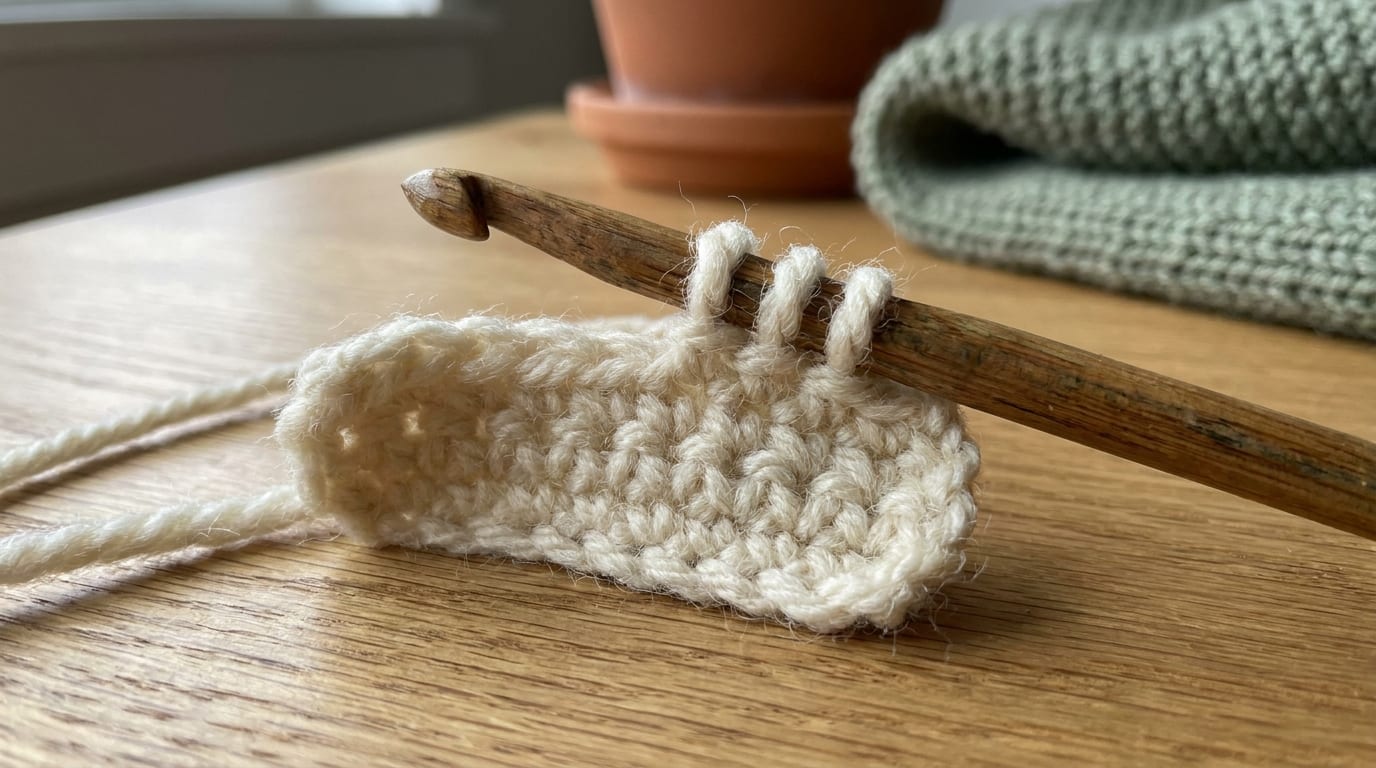
What sc2tog means, and when you decrease
A sc2tog is a single crochet decrease. The name is shorthand for "single crochet two together," and it does exactly that: it works two stitches into one, which removes a stitch from the round and pulls the fabric narrower. Where you had two stitches across, you now have one. That is the whole job of the sc2tog, and it is one of the two moves, alongside the increase, that lets flat crochet curve into three dimensions.
If you crochet from US patterns, this is built on the single crochet (US single crochet, UK double crochet), so a UK reader knows this same decrease as dc2tog. The letters change but the hands do the same thing. This guide covers both common ways to work it: the standard sc2tog that every pattern assumes, and the invisible decrease that amigurumi makers reach for instead. By the end you will be able to work either one, read the shorthand patterns use, and fix the handful of things that go wrong.
Decreasing is how you shape crochet inward. It closes the crown of a hat, draws in the toe of a sock, and shapes armholes and necklines in garments. In amigurumi, the craft of small crocheted stuffed toys, the decrease is what closes a sphere: after you stop increasing and work a few even rounds, you decrease round by round until the opening pulls shut over the stuffing. If amigurumi is new to you, our amigurumi for beginners guide covers the wider picture, and what is amigurumi explains where the craft comes from.
The standard sc2tog, step by step
The standard decrease is the version every written pattern assumes when it says sc2tog. You build it the way you build a normal single crochet, except you start two loops from two separate stitches before you close them off together. The example below is described for a right-handed maker; a left-handed maker mirrors the direction.
Work this slowly the first time so you can see the loops gather on the hook.
- Pull up a loop from the first stitch. Insert the hook into the next stitch, yarn over, and pull up a loop. You now have two loops on the hook. Do not finish the stitch yet.
- Pull up a loop from the second stitch. Insert the hook into the following stitch, yarn over, and pull up a loop. You now have three loops on the hook.
- Close them off together. Yarn over and pull through all three loops on the hook in one motion. Two stitches have become one.
That is a complete sc2tog. The single stitch you just made sits where two stitches used to be, so your count drops by one each time you work it. The standard version is quick and holds well, which is why it is the default in garments and accessories. Its one drawback shows up on stuffed toys: working through both loops of each stitch can leave a small bump or a faint hole at the decrease. In most fabric that is invisible. On the smooth, tight surface of an amigurumi, it shows, which is the reason the next method exists.
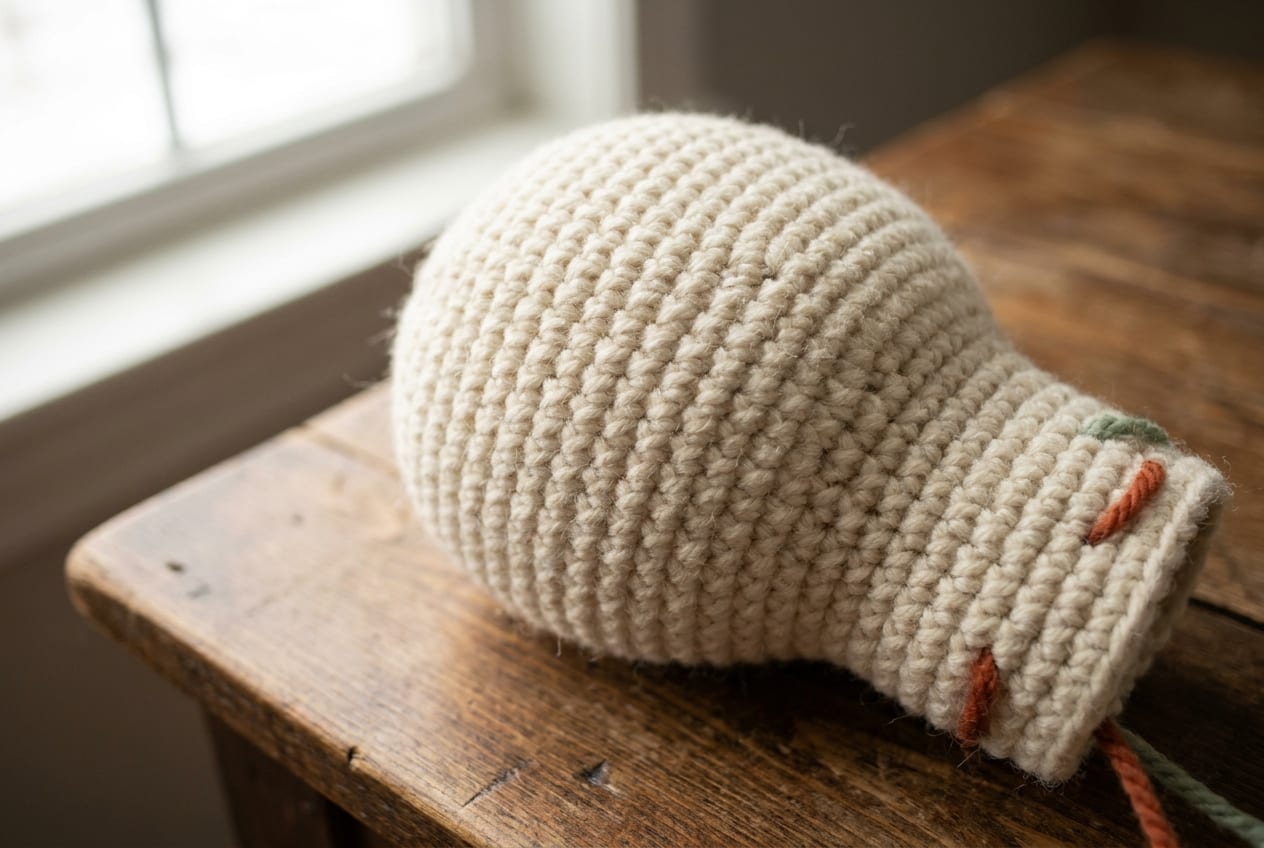
The invisible decrease, and why amigurumi prefers it
The invisible decrease is the amigurumi standard. It reaches the same result, two stitches into one, but it works through the front loops only, so the decrease sits flatter and all but disappears on the right side of the fabric. When you look at a well-made amigurumi and cannot spot where the rounds reduced, this is usually why.
Every crochet stitch has two strands at the top that form a small V, a front loop and a back loop. The standard sc2tog goes under both. The invisible decrease goes under only the front loop of each stitch, then closes them off in two passes instead of one.
- Front loop of the first stitch. Insert the hook into the front loop only of the next stitch. You now have two loops on the hook.
- Front loop of the second stitch. Insert the hook straight into the front loop only of the following stitch. You now have three loops on the hook.
- Pull through the first two loops. Yarn over and pull through only the first two loops on the hook. Two loops remain.
- Close off the last two. Yarn over and pull through the remaining two loops.
Because the move skims along the front loops, the leftover back loops tuck down and out of sight, so the decrease lays nearly flat with no bump or hole on the outside. That tidiness is the whole reason amigurumi uses it in place of the standard sc2tog. If a pattern simply says "dec" or "sc2tog" and the project is a stuffed toy, the invisible version is almost always the one the designer means, even when they do not spell it out. The decrease builds directly on the single crochet, so if that stitch is still new, the single crochet stitch page walks through it with photos, and our magic ring guide covers the start of the round you will be decreasing into.
How patterns write decreases
Patterns are written in shorthand, and the decrease has a few common forms. Knowing them saves you from second-guessing mid-round.
Most patterns write a single decrease as sc2tog or, more often in amigurumi, dec. Both mean the same thing: work one decrease over the next two stitches. The longer sc2tog spells out the mechanics; the shorter dec trusts you to know them. A line might read dec x6, which means work six decreases around, one after another, turning twelve stitches into six and pulling the round sharply inward. That is the kind of round that closes the top of a head or the base of a ball.
Just as often the decrease is folded into a repeat with plain single crochets, using bracket or parenthesis notation:
(4 sc, dec) x6
Read that left to right: single crochet into each of the next four stitches, then work one decrease over the next two, and repeat the whole sequence in the parentheses six times. Each repeat uses six stitches of the round below (four plus the two the decrease eats) and produces five, so a 36-stitch round comes out at 30. The number after the closing bracket is how many times you repeat, not how many stitches to make. The stitch count at the end of the line, often given in parentheses like (30), tells you what you should have when the round is done. If your count lands there, the round was worked correctly.
Common mistakes, and how to fix them
A few errors come up again and again with the decrease. Each one has a clear cause and an easy fix.
Forgetting the final yarn over
The most common slip is stopping a beat too early and leaving loops sitting on the hook. With the standard sc2tog, the stitch is not finished until you yarn over and pull through all three loops. With the invisible version, it is not finished until the second pull-through clears the last two loops. If you find an extra loop hanging on the hook when you move to the next stitch, you skipped the final yarn over. Pull it out and close the stitch off properly.
Adding a stitch instead of removing one
A decrease should lower your count by one. If your rounds are growing or staying flat when the pattern says they should shrink, you are most likely miscounting which stitches the decrease consumes, or working a plain single crochet where a decrease belongs. Count after each decrease round and compare against the pattern's number. When it runs high, you missed a decrease; when it runs low, you worked one too many.
Pulling too tight so the decrease puckers
Working the decrease with a hard, tight tension drags the surrounding stitches in and leaves a visible pucker or dimple. Keep the same relaxed tension you use for a normal single crochet, and let the decrease itself, not a death grip on the yarn, do the narrowing. If a finished piece puckers at the decreases, easing your tension on the next attempt usually clears it.
Using the standard decrease on amigurumi
The standard sc2tog is not wrong on a stuffed toy, but it tends to leave small holes or bumps that show on the tight surface and let stuffing peek through. If your amigurumi looks lumpy along the decrease rounds, switch to the invisible decrease. It is the single biggest upgrade to how a finished toy looks, and it costs you nothing but one changed habit.
The increase is the opposite move
If the decrease takes two stitches down to one, the increase does the reverse: it works two single crochets into one stitch, turning one into two and pushing the fabric wider. The two are mirror images, and amigurumi is built from balancing them. You increase round by round to grow a flat disc into a dome, work a few even rounds for the body, then decrease round by round to close it back up. A pattern that reads inc is asking for two stitches in one; a pattern that reads dec is asking for the decrease you just learned. Learn both and you can shape almost any rounded form. You can see the pair in action across our amigurumi patterns collection, where nearly every project leans on this one rhythm of growing and closing.
Frequently asked questions
What does sc2tog mean in crochet?
sc2tog stands for single crochet two together. It is a decrease that works two stitches into one, removing a stitch and making the fabric narrower. You pull up a loop from each of two stitches, then close all the loops off together so two stitches become one.
What is the difference between sc2tog and the invisible decrease?
Both turn two stitches into one. The standard sc2tog works through both loops of each stitch and can leave a small bump. The invisible decrease works through only the front loops, so it lays flatter and nearly disappears on the right side, which is why amigurumi uses it.
Is sc2tog the same as dec?
Yes, in nearly every pattern. The abbreviation dec just means decrease, and for single crochet projects that is a sc2tog. Amigurumi patterns tend to write dec, while other patterns spell out sc2tog. Both ask you to work one decrease over the next two stitches.
What does sc2tog mean in UK terms?
US single crochet is the same stitch as UK double crochet, so a US sc2tog is a UK dc2tog. The hand movements are identical; only the name changes. If you are following a UK pattern, look for dc2tog where a US pattern would say sc2tog.
Why does my crochet decrease leave a hole?
A visible hole usually means you used the standard sc2tog on a tight fabric like amigurumi, where it shows more. Switching to the invisible decrease, which works through the front loops only, closes that gap. Keeping an even, relaxed tension also helps the decrease sit flat.
How do I read (4 sc, dec) x6 in a pattern?
Work a single crochet into each of the next four stitches, then work one decrease over the next two stitches. That whole sequence in the parentheses repeats six times around the round. The number after the bracket is how many times to repeat, not how many stitches to make.