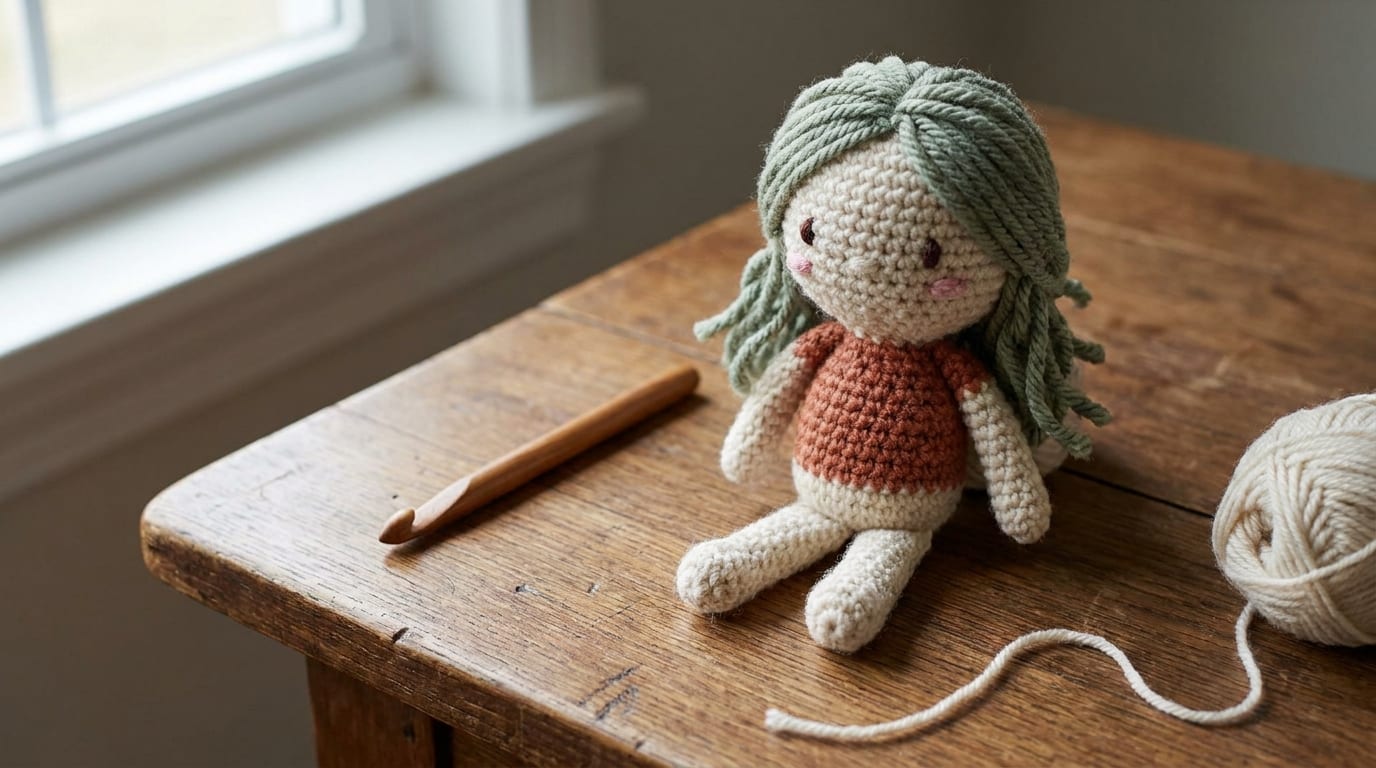
What a crochet doll is
A crochet doll is amigurumi in human form. Instead of a bear or a bunny, you are making a person or a character, with a face, hair, and often a little outfit. The technique underneath is the same one that builds every stuffed animal: single crochet (sc, UK double crochet) worked in a continuous spiral from a magic ring, with increases to widen the fabric and decreases to draw it back in. What changes is the proportion and the detail work. A doll lives or dies on its face and its hair, and that is where most of the time and most of the skill go.
This guide is the practical map. By the end you will know exactly how a crochet doll differs from an animal amigurumi, the parts a doll is built from and the choice you make at each one, how hard a first doll really is and what to start with, where to find crochet doll patterns and how to vet one, and how to make a doll safe for a small child.
If amigurumi itself is new to you, read what is amigurumi first. It covers the magic ring, the spiral, and the invisible decrease, and the rest of this page will read clearly once those are in your hands.
How a crochet doll differs from an animal amigurumi
The stitches are identical. The shaping toolkit is identical. So why does a doll feel like a step up from a teddy bear? Five things change, and each one adds a small layer of work.
Construction
Many dolls are built head and body in one continuous piece. You start at the top of the head, increase into a ball, work even, then start decreasing as usual, but instead of closing the sphere off you narrow it down to a neck and then widen again for the body. Head, neck, body, all in one unbroken tube. The arms and legs are made separately and sewn on at the end. Some patterns go further and work the whole doll in one piece to skip almost all the sewing, while others make every part separately, the way an animal usually is. Read the pattern's construction notes before you cast on, because head-and-body-as-one and fully-sewn are genuinely different makes.
Proportions
The classic amigurumi doll has an oversized round head on a smaller body. That single proportion is what reads as cute, the same trick that makes the animals charming. A more realistic or fashion-style doll goes the other way, with a smaller head and longer, slimmer limbs. Neither is harder to crochet, but the cute proportion is far more forgiving of a wobbly face, so it is the kinder place to start.
The face
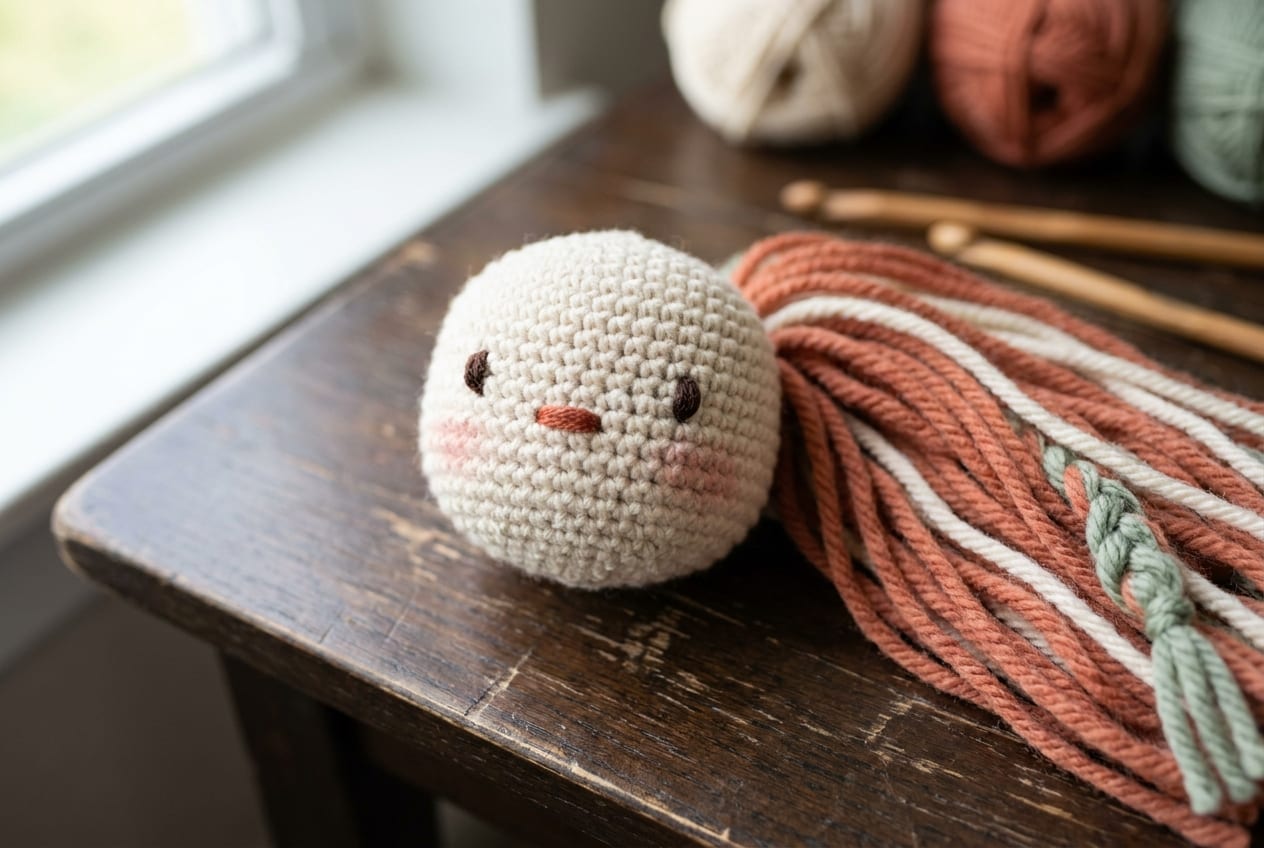
The face is the hard part, and it is the entire personality of the doll. You have two routes for the eyes: plastic safety eyes, which push through from the front and lock with a washer, or embroidered eyes worked in yarn. The nose and mouth are almost always embroidered, and many dolls get a little blush on the cheeks from chalk pastel or a dab of powder. Here is the thing nobody warns you about: eye placement and the gap between the eyes change the character completely. Set the eyes low and slightly wide and the doll looks sweet. Move them a few millimeters and it looks surprised, or stern, or older. Pin the features and audition them before you commit, because a stitched-on face is permanent.
Hair
Hair is added after the head and body are made, and it is usually the most time-consuming part of the whole doll. There are three common methods. You can attach strands one bundle at a time, knotting them through the stitches the way a latch-hook rug is made, which gives the most natural, brushable result and takes the longest. You can crochet a separate wig cap and sew it on. Or you can embroider the hair in long stitches directly onto the head for a quick, flat, stylized look. None is hard. Hair is simply slow, so budget time for it.
Clothes
Many dolls wear an outfit, either crocheted directly onto the body or made as small removable pieces that come on and off. Either way, clothes are a separate set of little fitted parts: a top, a skirt or trousers, sometimes shoes. Removable clothes are more work but let a child dress and undress the doll. Crocheted-on clothes are simpler and become part of the body.
One practical thread runs through all of this: color. A doll uses skin-tone yarn for the head, body, arms, and legs, then separate colors for the hair and the clothes. An animal often gets by on one or two colors, so a doll usually means more yarn changes and more ends to weave in.
The parts of a doll and the choices for each
It helps to see a doll as a short parts list, each with a decision attached. Here is the whole thing in order.
- Head and body. Worked as one continuous piece in most modern patterns, or as two pieces sewn together. Skin-tone yarn. The choice is the construction style, set by your pattern.
- Arms. Two small tubes, made separately and sewn on. Skin-tone yarn, sometimes changing to a sleeve color partway up. The choice is whether they hang loose or are sewn flat against the body.
- Legs. Two tubes, usually a touch fatter than the arms, made separately and sewn on. The choice is bare legs in skin tone, or legs that change color for socks and shoes.
- Eyes. Safety eyes or embroidered. The single biggest decision for both look and safety. Embroidered for young children, always.
- Nose, mouth, and cheeks. Embroidered, plus optional blush. The choice is how much detail, and a beginner doll wants very little.
- Hair. Attached strands, a crocheted wig cap, or embroidered. The choice is realism versus speed.
- Clothes. Crocheted-on or removable. The choice is simplicity versus playability.
How hard a doll is, and what to make first
Here is the honest answer. The stitches in a crochet doll are beginner level, every one of them. A simple doll still lands at intermediate, and the reason is everything that is not stitching: the face, the hair, and the assembly. You can know single crochet, increases, and decreases cold and still find your first doll fiddly, because reading a face and setting the limbs symmetrically are their own small skills.
So if you have made a few animals and you want to try a person, that is the right moment. If you have never made amigurumi at all, make a simple animal or two first, then come to a doll. The spiral and the invisible decrease should feel automatic before you take on a face. Our amigurumi for beginners guide walks through those first makes in order.
For a first doll, keep it small and keep it simple:
- Embroidered features, not safety eyes. Stitched eyes are more forgiving than they sound, and you can pick out a stitch and redo it if the expression is off. Safety eyes are permanent the instant the washer goes on.
- A simple hairstyle. Embroidered hair or a basic crocheted cap finishes in a fraction of the time of full attached strands. Save the long brushable hair for doll number two.
- Crocheted-on clothes, or none. A doll with a simple dress worked right onto the body skips a whole separate set of fitted pieces.
A small doll with the cute oversized-head proportion, an embroidered face, and simple hair drills exactly the new skills, face placement and limb assembly, without piling on the slow parts at the same time.
Where to find crochet doll patterns and how to vet one
There are crochet doll patterns everywhere, free and paid, and the same sources that serve animal amigurumi serve dolls. The places worth your time, roughly in order of how reliable the writing tends to be:
- Large pattern databases. Catalogs like Ravelry let you filter by "free" and by "doll" or "amigurumi" in a click or two, and sort by what other makers rated highly. The fastest way to see many options at once.
- Independent designer blogs. Often the strongest source for dolls specifically, because a designer writing on their own site tends to include the close-up photos of the face and the hair steps that a doll actually needs. Those photos are the difference between a clean face and a guess. Search the look you want plus "crochet doll pattern" and click through to the designer's own page.
- YouTube. The friendliest way to watch the assembly, which is the part hardest to picture from text. Pause and rewind through the hair attachment and the limb sewing, then read the chart for the counts.
- Pattern books. A good doll book gives you a consistent construction method across several characters, with the face and hair techniques explained once and reused, which is easier to learn from than ten different designers' approaches.
You vet a doll pattern the same way you vet any amigurumi, with two extra eyes on the parts that make a doll a doll:
- US or UK terms, stated up front. A US single crochet is a UK double crochet, so the same word means a different stitch in each system. The pattern should say which it follows.
- A stitch count in parentheses each round. Something like
(24)at the close of every round. This is the single most important line in any amigurumi pattern, doll or animal, because it catches a missed stitch on the round you made it. - Clear photos of the face and hair steps. Not just a hero shot. You want to see how the eyes are placed and spaced, and exactly how the hair is attached, because those are the steps that go wrong.
- Reviews from people who made it. They are an unofficial errata page and will point you at the round, or the assembly step, where everyone stumbles.
A frank word on free versus paid. Free crochet doll patterns exist in real abundance, and plenty are excellent. But a doll asks more of its instructions than an animal does, and for a complex doll a clear paid pattern is often worth the few dollars, purely for the face and hair guidance that a rushed free pattern tends to skip. For simple dolls, free is plenty. For an intricate one, do not be afraid to pay for good photos. If you want to browse the wider free landscape first, free amigurumi patterns covers where the clean ones live, and the amigurumi patterns hub sorts CrochetZen's library by difficulty.
Safety when the doll is for a child
A crochet doll is a wonderful gift for a child, and a few habits make it a safe one. A stuffed toy gets chewed, thrown, washed, and slept on, so anything that can come loose eventually will.
- Embroider the eyes for any child under three. Skip plastic safety eyes entirely for babies and toddlers. Even well-made safety eyes can work loose over years of hard use, and a loosened eye is a choking hazard. Stitched eyes carry no such risk.
- Attach the hair very securely. Hair is the part a small child pulls. Knot attached strands tightly and go back over a crocheted wig cap with extra stitches, or choose embroidered hair, which has nothing to pull free at all.
- Stuff firmly. A densely stuffed doll holds its shape and has no loose pockets of fiberfill to be worked out through a gap. Firm stuffing also keeps the seams from gaping.
- Sew every part on hard. Arms, legs, hair, and clothes should all be stitched down firmly, gone over more than once, with the ends woven in well. Give each part a real tug before you hand the doll over.
When in doubt, make the whole face from yarn, embroider the hair, and keep the design simple. A child does not need wire joints or tiny beads, and leaving them out removes the risk entirely. The yarn matters too: a soft, washable fiber survives a childhood, and our guide to yarn for amigurumi covers which fibers hold a shape and wash well.
Frequently asked questions
What is a crochet doll?
A crochet doll is amigurumi in human form, a person or character rather than an animal. It uses the same single crochet worked in a spiral from a magic ring, with increases and decreases for shaping. The difference is the proportion and the detail work, especially the face and the hair.
How is a crochet doll different from an animal amigurumi?
The stitches are the same. A doll often works the head and body as one continuous piece, narrowing at the neck, with arms and legs sewn on. It uses skin-tone yarn, an embroidered or safety-eye face, and added hair. The face and hair are what make a doll harder than an animal.
Is it hard to crochet a doll?
The stitches are beginner level, but a simple doll lands at intermediate because of the face, the hair, and the assembly. If you have made a few animals, you are ready. For a first doll, keep it small with embroidered features and simple hair, and pin the face before you sew it.
Where can I find free crochet doll patterns?
Large databases like Ravelry let you filter by free and by doll. Independent designer blogs are often the strongest source for dolls because of their close-up face and hair photos. YouTube is good for watching the assembly. Free crochet doll patterns are abundant, and many are excellent.
Should I use safety eyes or embroider the face on a crochet doll?
Both work for adults and older children. For any child under three, embroider the eyes in yarn instead of using plastic safety eyes, which can work loose and become a choking hazard. Embroidered eyes are also more forgiving for beginners, since you can pick out a stitch and redo the expression.
What yarn do I use for a crochet doll?
A smooth worsted or DK weight yarn in a skin tone for the head, body, arms, and legs, with separate colors for hair and clothes. Use a hook one or two sizes smaller than the yarn band suggests, so the fabric is tight enough that the stuffing cannot show through.