What filet crochet is
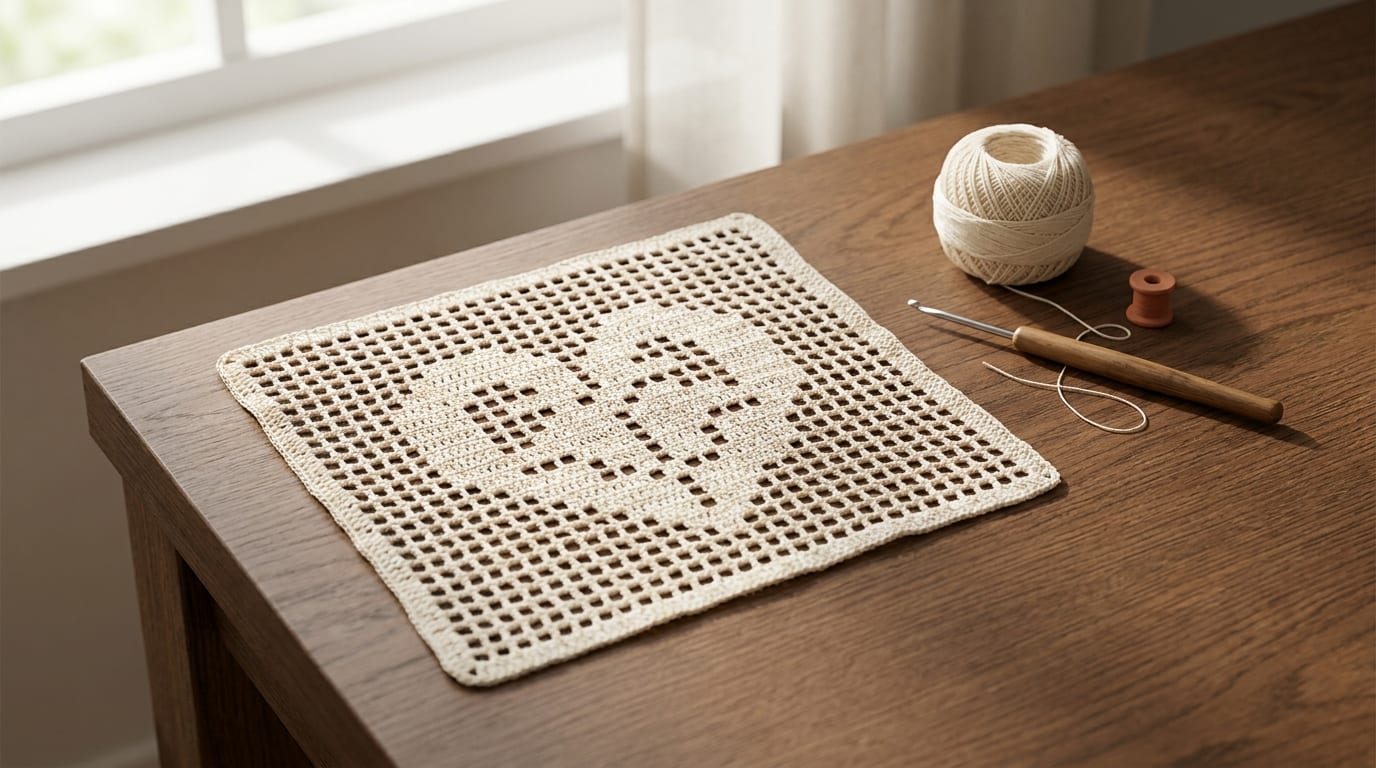
Filet crochet is a way of building pictures and lace from a grid of two kinds of square. One square is open, a small window of space called a mesh. The other square is solid, a little block of stitches. You arrange those open and filled squares across a grid, and the filled ones draw a shape against the open background. A heart, a flower, a row of letters that spell a name. The technique looks intricate, but it rests on a single repeated unit, which is what makes filet crochet friendly to learn.
Every square is made from the same humble parts: a double crochet (US dc, which is a treble in UK terms) and a chain (ch). That US and UK difference matters more here than in almost any other technique, because the whole grid is counted in dc posts. When a chart or pattern says double crochet, an American means the medium-height stitch worked with one yarn over, while a British reader calls that same stitch a treble. Confirm which notation your pattern uses before you count a single square.
This guide covers the two squares and their exact stitch makeup, how to read a filet chart, how to start a piece, a brief look at shaping the edges, what yarn and hook to reach for, and what people actually make with the technique.
The two squares: open and filled
Almost every filet pattern uses a square that is three stitches wide. Learn those two squares and you can work most charts labeled for beginners.
The open square (mesh)
An open square reads dc, ch 1, dc. You work one double crochet, chain one to bridge the gap, skip one stitch in the row below, then work the next double crochet. That single chain leaves a small window, and a field of those windows is the lacy mesh background that makes filet crochet look like a net.
The filled square (block)
A filled square, often called a block, replaces the chain space with a stitch. Instead of dc, ch 1, dc, you work dc, dc, dc. The middle double crochet drops into the stitch you would have skipped for a mesh, so the window fills in solid. Lined up next to each other, filled squares form the dense shapes that read as the image.
That swap is the entire grammar of the craft. Where the chart wants background, you make a mesh. Where it wants the picture, you make a block. Everything else is counting.
A note on variants. Some designers use a two-chain mesh, written dc, ch 2, dc, with the filled square spanning four stitches instead of three. The squares come out a little more rectangular, and the lace looks slightly more open. Neither version is more correct than the other. The pattern will tell you which mesh it is built on in its opening notes, so read that line first and stick with it for the whole piece.
| Square | Stitch makeup | What it does |
|---|---|---|
| Open (mesh) | dc, ch 1, dc | Leaves a window, forms the background |
| Filled (block) | dc, dc, dc | Solid stitches, forms the picture |
| Two-chain mesh (variant) | dc, ch 2, dc | Wider, more open window |
How to read a filet crochet chart
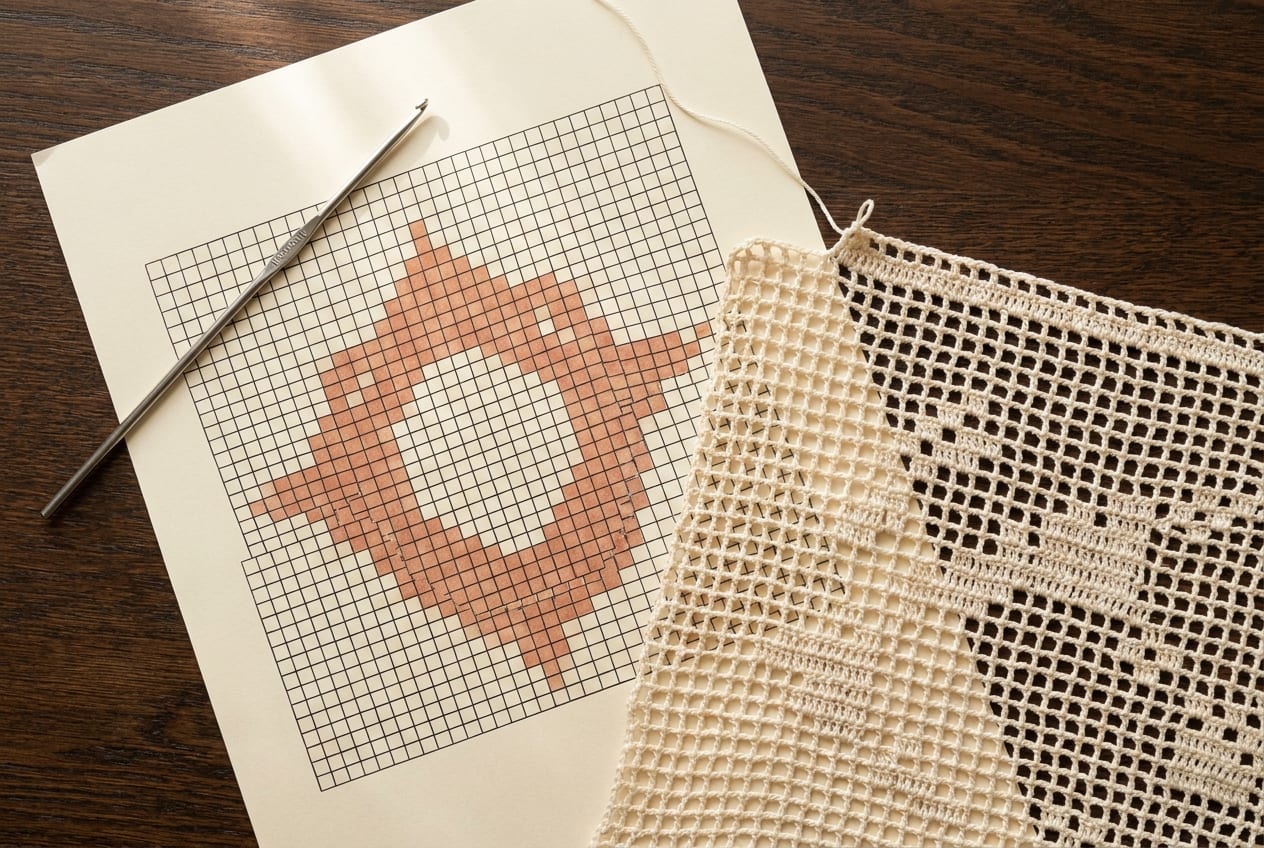
The core skill in filet crochet is reading a chart, and the chart is just the grid drawn out. Each cell on the paper stands for one square on your hook. A filled cell, usually shaded or marked with a symbol, means work a block. An empty cell means work a mesh. Put the blocks where the shading is, and the picture appears in your fabric.
A few habits make chart reading painless:
- Read each row in the right direction. Filet is worked back and forth, so you turn at the end of every row. You read the first row of the chart in one direction and the next row back the other way. Most charts mark the starting corner, and the row numbers usually run up one side.
- Count the squares, not the stitches. Think in cells. Tell yourself "three blocks, then two mesh, then a block" rather than counting individual
dcposts. The stitch count follows automatically from the squares. - Keep your place. A sticky note or a row marker under the line you are working stops you from drifting up or down a row, which is the most common way a shape comes out lopsided.
- Trust the grid. If your fabric does not match the chart, recount the current row before you pull anything out. A miscount almost always lives in the row on your hook, not three rows back.
If you would rather design your own grid than buy a chart, our stitch chart maker lets you mark filled and empty cells on a grid right in the browser, which is exactly the format filet uses. You can sketch a heart, a monogram, or a border and then work straight from the screen.
Starting a filet crochet piece
To begin, you chain a foundation based on how many squares wide your design is, plus a turning chain to lift up to the height of the first row. With a three-stitch square and a one-chain mesh, a common rule is to chain three times the number of squares, then add a few extra chains for the turn. Patterns spell out the exact foundation count, so follow the number given rather than improvising on your first project.
Many filet pieces open with a full row of mesh. That all-mesh first row gives you a clean, even net to build on and lets you count your squares before any shaping or shapes begin. From there you follow the chart row by row, swapping mesh for block wherever the grid tells you to.
A small practical tip. Work your foundation chain a touch loose. The first row of double crochet pulls on the chain, and a tight foundation makes the bottom edge draw in and curl. If your starting edge feels stiff, go up one hook size for the chain only, then return to the pattern hook for the rest. New to the building blocks underneath all of this? Our crochet stitches library walks through the chain and the double crochet with photos before you commit a whole chart to thread.
Shaping the edges
Most beginner filet patterns are worked as a plain rectangle, with every row the same number of squares. The mesh and blocks change inside that rectangle, but the outline stays square. This is the place to start.
Some designs, like a pointed edging or a shaped doily, add or remove squares at the ends of rows to shape the outline itself. At a high level, you increase a square at the start of a row by working extra chains and a treble (a taller stitch) to extend the grid outward, and you increase at the end by adding squares past the last stitch in the same way. Decreasing means slip stitching across squares to step the edge in, or simply turning early and leaving squares unworked. You do not need this for a first piece, and the pattern will hand you the exact stitch counts when you do. For now, know that the technique exists and that the outline of a filet piece can be shaped, not only the picture inside it.
Yarn and hook choice
Traditional filet crochet uses fine cotton thread and a small steel hook. The thin thread holds a crisp, defined edge, so the open windows stay open and the blocks read sharply, which is why heirloom doilies and lace curtains look so precise. Crochet cotton in a size 10 thread with a steel hook around 1.5 to 1.75 mm is a classic starting pair, though thread and hook sizes vary by brand.
You are not locked into thread, though. Filet works in any yarn. A worsted weight cotton with a 4 mm or 5 mm hook gives you a bolder, chunkier grid that grows quickly and reads well from across a room, which suits blankets and wall hangings. Larger yarn is also far easier on the eyes and hands for a first attempt, so many people learn the technique in worsted weight and graduate to thread once the counting feels automatic.
Whatever you choose, pick a smooth, firm yarn in a light, solid color for your first piece. Fuzzy or heavily textured yarn blurs the line between mesh and block, and a busy variegated color hides the very picture you are working so hard to create.
What to make with filet crochet
The technique has a long history in the home, and the projects show it. A few that suit the grid well:
- Doilies and table runners. The open mesh and solid motifs are a natural fit, and a round or oval doily is a classic showcase. See the doily pattern hub for shapes that use filet.
- Curtains and panels. Worked in thread, a filet panel filters light beautifully while a central motif sits in the middle of the window.
- Blankets and throws. In a heavier yarn, a large filet grid makes a graphic blanket, often with a single bold motif or a repeating border.
- Word and picture motifs. Because the grid behaves like cross-stitch, filet excels at lettering and figures. People spell names, dates, and short phrases, or chart hearts, flowers, birds, and small scenes.
If you are still finding your feet with hook and yarn in general, our calm introduction to crochet covers the foundations, and our roundup of free crochet patterns sorts projects by skill level so you can pick a gentle next step.
Frequently asked questions
What is filet crochet?
Filet crochet is a technique that builds pictures and lace from a grid of open and filled squares. Open squares are a small mesh window, and filled squares are a solid block of stitches. Both are worked in double crochet and chains, and you follow a chart to place the blocks that form the image.
What stitches do you use in filet crochet?
Just two. An open square (mesh) is worked as double crochet, chain one, double crochet. A filled square (block) is three double crochet in a row, with the middle stitch replacing the chain. In US terms that stitch is double crochet, while UK patterns call the same stitch a treble.
How do you read a filet crochet chart?
Each cell on the chart is one square. A shaded or marked cell means work a filled block, and an empty cell means work an open mesh. Read the rows back and forth as you turn your work, count in squares rather than individual stitches, and keep a marker under your current line.
Is filet crochet good for beginners?
Yes. Filet crochet for beginners works well because the whole technique rests on two simple squares repeated across a grid. If you can work a double crochet and a chain, you can follow a basic chart. Start with a plain rectangle and a heavier yarn before moving to fine thread.
What yarn and hook should I use for filet crochet?
Traditional filet uses fine cotton thread, often size 10, with a small steel hook around 1.5 to 1.75 mm for crisp lace. For a bolder look or an easier first project, use a smooth worsted weight cotton with a 4 to 5 mm hook. Pick a light, solid color so the picture stays clear.
What can you make with filet crochet?
Filet suits doilies, table runners, curtains, panels, and blankets, plus motifs that spell words or show hearts, flowers, and figures. Because the grid behaves like cross-stitch, it is well suited to lettering and pictures. Heavier yarn makes graphic blankets, while fine thread makes delicate heirloom lace.