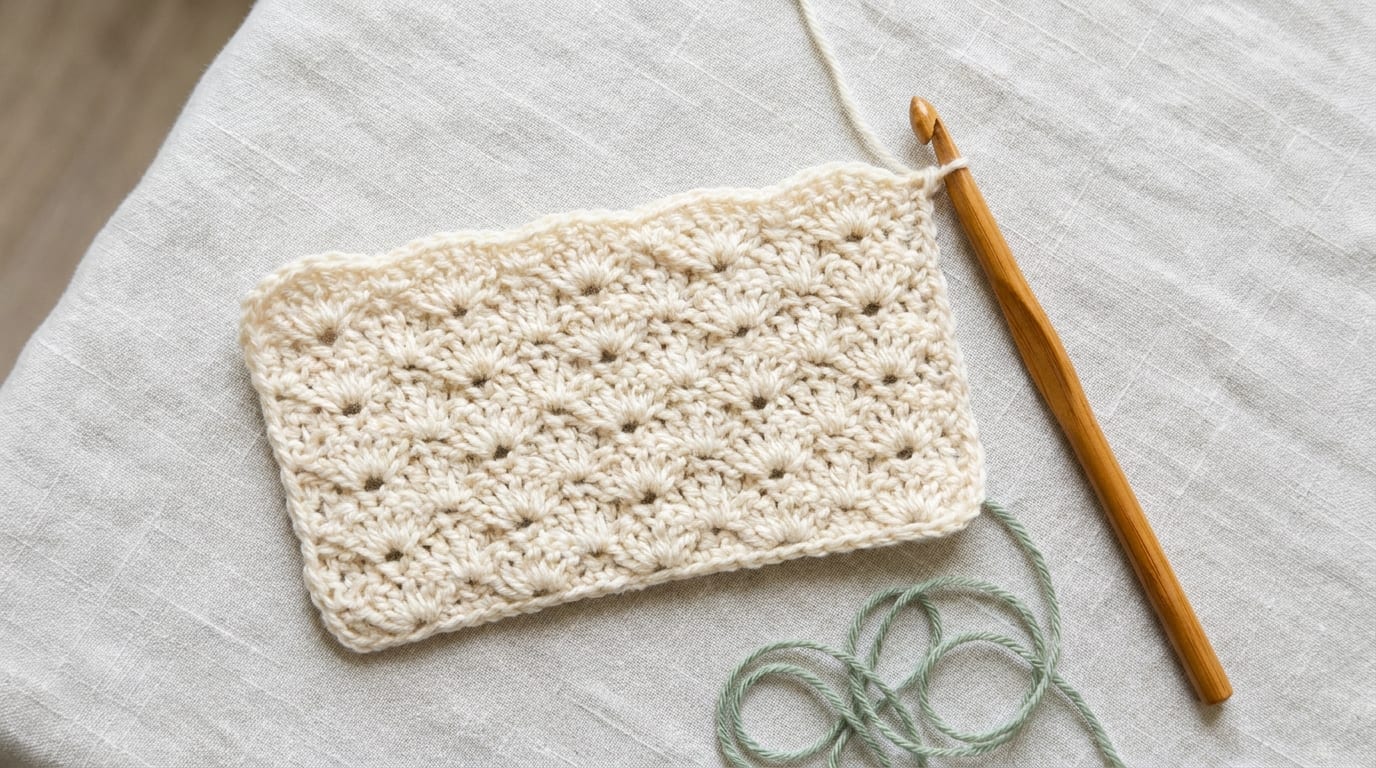
What the shell stitch actually is
The shell stitch is one of the most recognizable patterns in crochet. It creates a repeating fan shape that looks like rounded shells or scallops across the fabric. Despite how decorative it looks, it is built from just one stitch: the double crochet.
A standard shell is 5 double crochets all worked into the same stitch or space. Because all five share a single anchor point at the bottom but spread apart at the top, they splay outward into that classic fan shape. In between each shell, you skip a few stitches and work a single crochet to anchor the pattern and keep the shells from colliding.
That is the whole idea. Multiple double crochets in one spot, separated by anchors, repeated across the row.
Abbreviations for this post
- ch — chain
- sc — single crochet
- dc — double crochet
- sk — skip
- st — stitch
- sp — space
How to work a basic shell stitch
A shell is worked by making 5 dc all in the same stitch. Here is what that looks like step by step.
Working one shell:
- Identify the stitch where the shell will be placed.
- Yarn over, insert your hook into that stitch, yarn over and pull up a loop, yarn over and pull through 2 loops. You have 1 dc.
- Repeat from step 2 four more times in the exact same stitch. You now have 5 dc sharing one base.
- The stitches will naturally spread apart at the top, forming the fan shape.
That is one shell. The pattern builds by alternating shells with single crochets and skipped stitches so each shell has its own space.
Setting up a shell stitch foundation
The shell stitch works over a multiple of 6 stitches, plus 1 for the turning chain in many patterns. A simple formula to start: chain a multiple of 6, then add 2 extra chains for the turning chain.
For a swatch, try chaining 26 (24 + 2).
Row 1 (right side): Sc in 2nd ch from hook. Skip 2 ch. Work 5 dc in next ch (first shell made). Skip 2 ch. Sc in next ch. Repeat from skip across. Turn.
Row 2: Ch 3. Work 2 dc in first sc (half shell to start the row). Sc in center dc of first shell. Work 5 dc in next sc. Repeat across, ending with 3 dc in last sc. Turn.
Row 3: Ch 1. Sc in first dc. Work 5 dc in next sc. Sc in center dc of shell. Repeat across. Turn.
Repeat rows 2 and 3 to build the fabric.
Shell stitch scarf walkthrough
Here is a simple scarf pattern that works up quickly and shows off the shell stitch well.
Materials:
- 200g worsted weight yarn (a smooth 100% wool or acrylic blend works well)
- 5mm crochet hook
- Scissors and yarn needle
Gauge: One shell repeat (6 sts) = approximately 3.5 cm wide, 2 rows = 2 cm tall. Gauge is flexible for a scarf.
Foundation: Chain 32 (30 + 2 turning chains). This gives you 5 shell repeats across.
Row 1 (RS): Sc in 2nd ch from hook. [Skip 2 ch, 5 dc in next ch, skip 2 ch, sc in next ch] repeat across. Turn. (5 shells)
Row 2: Ch 3 (counts as first dc). Work 2 dc in first sc. Sc in center dc of first shell. [5 dc in next sc, sc in center dc of next shell] repeat across to last sc. Work 3 dc in last sc. Turn.
Row 3: Ch 1. Sc in first dc. [5 dc in next sc, sc in center dc of shell] repeat across. Turn.
Repeat rows 2 and 3 until the scarf measures about 150 cm, or your preferred length. Fasten off and weave in ends.
The scarf grows quickly because the double crochets in each shell cover a lot of height at once. A 150 cm scarf typically takes 4 to 6 hours depending on your pace.
Shell stitch variations
Once you are comfortable with the 5-dc shell, a few small changes open up a range of different fabrics.
3-dc shell (smaller shell)
Swap 5 dc for 3 dc in the same stitch. The resulting shells are more compact and the fabric is tighter, which suits bags, pot holders, and hats where you want less drape. Work over a multiple of 4 stitches instead of 6.
7-dc fan stitch
Add 2 more double crochets to get 7 dc in one stitch. The fans spread wider and create a more open, lacy look. This works beautifully for shawls and summer tops. Because the fan is wider, space them out with 3 skipped stitches on each side instead of 2.
Chain-space shell
Instead of working all 5 dc back to back, work 2 dc, ch 1, 2 dc in the same stitch. The chain space creates a small hole in the center of each shell for a more delicate texture. This variation is common in lacy blankets and baby garments.
Stacked shells
Work shells in the ch-1 spaces of the shells below rather than in the sc between them. The result is a denser, brick-like fabric where each shell sits slightly offset from the one below.
Yarn choices for shell stitch
The shell stitch shows best with smooth yarn. Here is what to consider:
Weight: Worsted weight (US 4) is the easiest to learn with because the stitches are large enough to count and your work grows quickly. DK weight gives a finer fabric with more drape, ideal for garments. Bulky yarn works for fast accessories but the shells become quite wide.
Fiber: Any smooth fiber works. Cotton gives crisp stitch definition and works well for dishcloths and market bags. Wool has elasticity that makes tension easier to manage. Acrylic is forgiving and widely available. Avoid mohair or highly textured yarns when learning because they make it hard to see the individual stitches.
Color: Solid or semi-solid colors show the shell shape most clearly. Variegated yarn can be beautiful in shells but may muddy the pattern if the color changes are very short.
Where to use the shell stitch
The shell stitch suits a wide range of projects because of the way it combines texture with relatively open fabric:
- Scarves and cowls are the classic starting point. The pattern works across a narrow width so you can focus on getting the rows consistent before tackling something larger.
- Baby blankets are another natural fit. The rounded shells have a soft, decorative look and the fabric grows faster than plain single crochet.
- Shawls made entirely from shells in a single color have a timeless look. Working increases at the edges while maintaining the repeat lets you grow the triangle shape.
- Market bags in cotton with a looser gauge create a stretchy, attractive mesh with the fan openings letting the bag breathe.
For more stitch references and step-by-step technique guides, visit the crochet stitches library. You can also find the shell stitch in the full shell stitch reference page with abbreviation charts and additional pattern notes.
The shell stitch rewards a small amount of attention during the first two rows. Once you understand where the sc anchors live and how to find the center of each shell, the rows settle into a rhythm and the fabric builds itself.