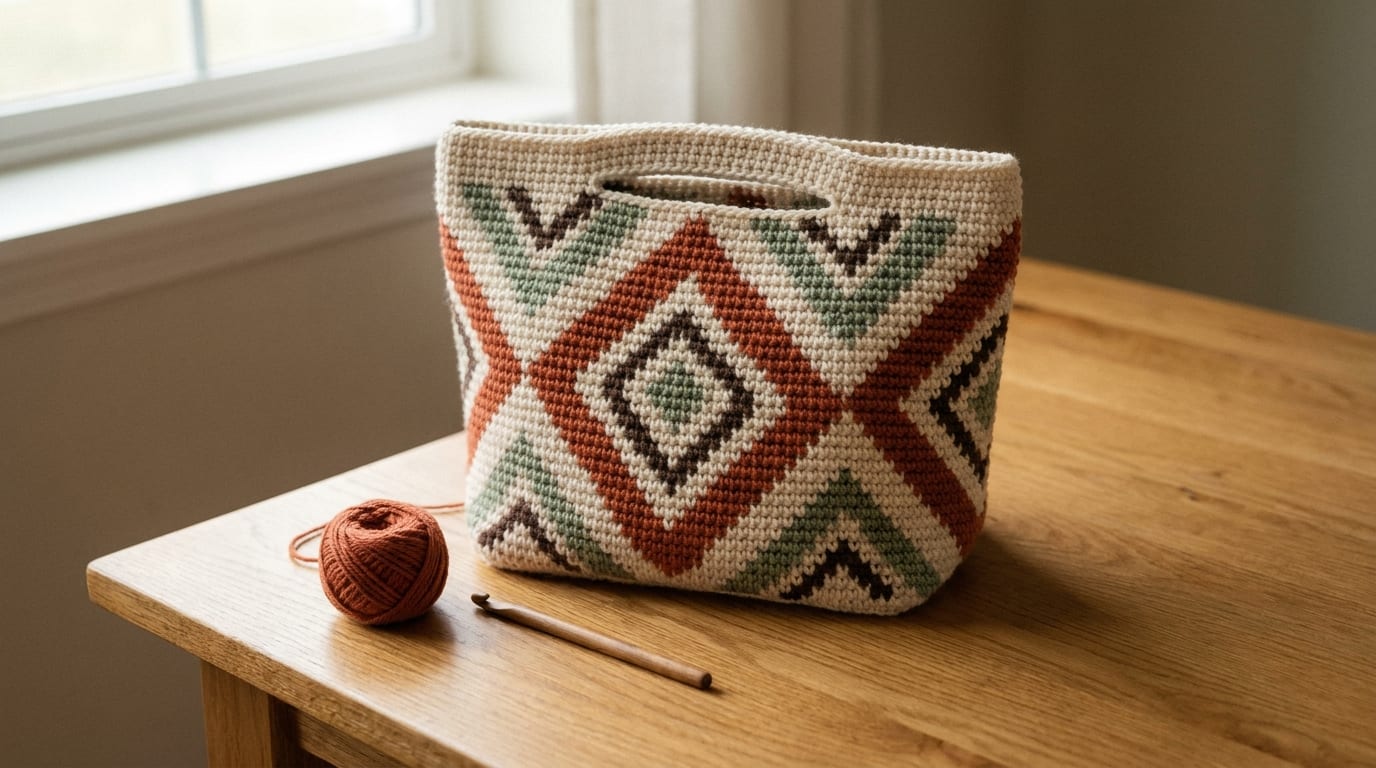
A colorwork technique built on one stitch
Tapestry crochet is a colorwork technique that lets you build crisp, multi-color geometric designs using mostly one stitch: single crochet (sc in US, UK double crochet). The trick is that you carry the colors you are not currently using along the top of the row and work your single crochets right over them, so the unused yarn disappears inside the stitches. The back stays tidy, the fabric comes out firm, and a flat field of single crochet turns into diamonds, chevrons, and the bold southwestern motifs the technique is known for.
This guide walks through what tapestry crochet actually is, how the carry works, the one rule for a clean color change, working in rounds versus rows, reading a grid chart, tension, and what to make first. If you are still new to the base stitch, our guide to single crochet covers the mechanics before you start adding color.
How carrying and crocheting over the yarn works
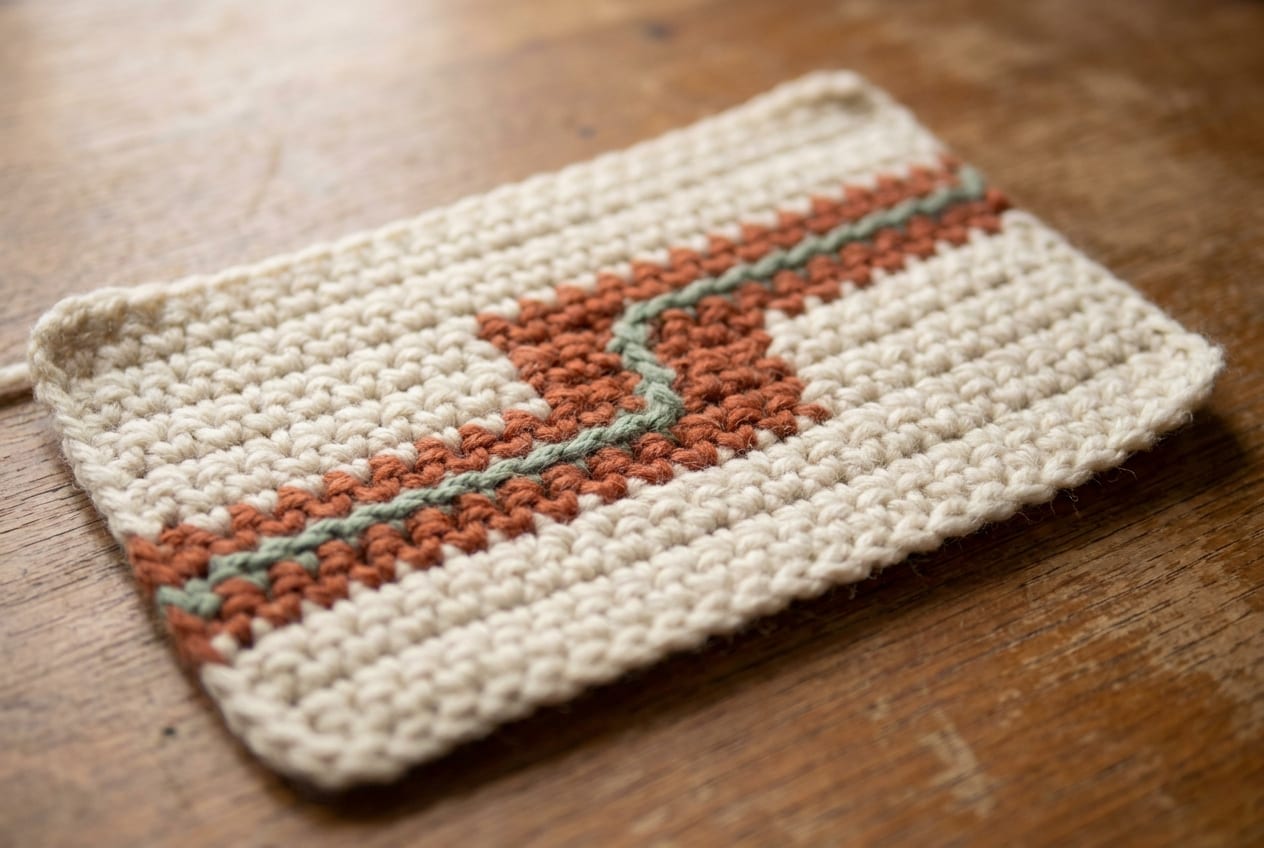
The whole technique rests on a single idea. At any moment you are crocheting with one color, but the other color is still attached. Instead of cutting it or letting it dangle on the back, you lay that unused strand along the top of the previous row, right where your next stitches will go, and you crochet over it.
Here is what that looks like in practice. You hold the working yarn as usual. The carried strand sits flat across the tops of the stitches you are about to work into. As you make each single crochet, you insert your hook, then complete the stitch so the carried strand gets trapped under the loops, hidden inside the stitch body. From the front, all anyone sees is a neat row of single crochet. The other color rides along inside, invisible, waiting for the square where the chart calls for it.
This is what gives tapestry crochet its character. Because the carried yarn is encased in the stitches, the fabric is thick and stable, with very little stretch. There are no long floats stranded loosely across the back the way there are in some knitting colorwork, so nothing snags. That density is exactly why the technique suits bags, baskets, and anything that needs to hold its shape.
One quick distinction, since people mix them up. Mosaic crochet looks similar from a distance but works differently: it builds its pattern from overlay stitches that reach down into earlier rows, and it does not carry a second color across the back the way tapestry crochet does. If you have seen both and felt confused, that carried strand is the line between them.
How to change color cleanly: the last-yarn-over rule
A clean color change is the difference between a sharp design and a muddy one, and it comes down to one rule about timing. You change color on the stitch before the new color is meant to show, not on the stitch where it appears.
Here is the rule. Work your single crochet almost to the end, up to the final step. A single crochet finishes with one last yarn over and pull through the two loops on your hook. On that very last yarn over, drop the old color and pull through with the new color instead. Finish the stitch in the new color.
Why this works: the last loop you pull through becomes the loop sitting on your hook, and that loop is what forms the top of the next stitch. So if you swap colors on the final yarn over, the next stitch starts clean in the new color with no half-and-half blending. The color change lands crisp and lives exactly where the chart says it should.
The step by step:
- Work the single crochet up to the last step, with two loops on your hook in the old color.
- Drop the old color to the back (it becomes the carried strand now).
- Yarn over with the new color and pull through both loops.
- Continue in the new color, carrying the old one along under your stitches.
That is the entire move. Most pattern instructions that say "change color" are quietly assuming you already know this last-yarn-over timing, so it is worth drilling on a small swatch until it feels automatic.
Working in rounds versus rows
Most tapestry crochet you will see, the bags, the baskets, the cup cozies, is worked in the round. There is a good reason for that, and it shapes how the technique behaves.
When you crochet in a continuous spiral or in joined rounds, the right side of the fabric always faces you. You never turn the work. That means your design stays oriented the same way the whole time and never reverses, so a chart reads straight up the page and the motif comes out exactly as drawn. The single crochets all lean the same direction, which keeps the geometry clean. This is why cylindrical projects are the natural home for tapestry crochet.
Worked flat in rows, things get trickier. You have to turn at the end of each row, which flips the fabric. On the return rows you are looking at the back of the design while you work, and you have to carry and trap the strands just as carefully from that side. Because the stitches lean one way on forward rows and the other way on return rows, the design can look slightly different on alternating rows, with the colorwork reading a little less crisp than the same chart worked in the round. It is absolutely doable, and plenty of flat tapestry crochet pieces look great, but expect to concentrate more on the turns and on keeping your carried tension even.
Reading a tapestry crochet chart
Tapestry crochet patterns are almost always given as a grid chart, and the grid is refreshingly literal. Each square is one single crochet, and the color of the square is the color you work that stitch in. There are no special symbols to decode, no stitch-height changes, just a colored grid that maps one to one onto your fabric.
To read it, start at the bottom and work up, the same direction your fabric grows. In the round, you read every row from right to left (or follow your pattern's stated direction), and because you never turn, every row reads the same way. Worked flat, you read right to left on the front rows and left to right on the return rows, mirroring the turn, exactly as you would for any flat charted colorwork.
Count as you go. If the chart shows five cream squares, then three terracotta, then five cream, you work five single crochet in cream, change to terracotta on the last yarn over of that fifth stitch, work three in terracotta, change back to cream on the last yarn over of the third, and so on. Counting is the whole game, and a miscount shows up immediately as a crooked motif, so it is easy to catch and fix in the same row.
You do not have to buy charts to get started. You can design your own colorwork grid with our free stitch chart maker and map out a tapestry design square by square, right in the browser. Sketching even a simple diamond or a row of triangles first makes the carrying and counting click much faster than diving straight into a complex pattern.
Tension: the skill that makes or breaks it
If tapestry crochet has one real skill to master, it is tension, and specifically the tension of the yarn you are carrying. The working yarn behaves the way it always does. It is the strand riding along inside the stitches that needs attention.
Carry the unused yarn at an even, relaxed tension. If you pull the carried strand too tight as you crochet over it, the fabric draws in and puckers, and your neat geometric design warps. If you let it sag too loose, the carried color peeks through between stitches and gaps appear, muddying the colorwork. The target is a strand that lies flat and follows the curve of the fabric without pulling or pooling. A few practical habits help:
- Keep the carried yarn flat across the stitch tops, not bunched, before you work over it.
- Don't yank after a color change. Give the new working yarn a gentle snug, then let it settle.
- Check the front every few stitches. If the row is starting to cup or the carried color is showing, ease your tension before you go further.
- Use a smooth, firmly plied yarn for your first project. Fuzzy or loosely spun yarn hides stitch definition and makes tension harder to read.
Tension evens out with practice the same way it does for plain crochet. Your first swatch will likely pucker a little. By the time you finish a small bag, your hands will have found the relaxed, consistent carry on their own.
What to make with tapestry crochet
Tapestry crochet shines on firm, structured pieces, which is why the same project types come up again and again:
- Bags and purses. The dense, stable fabric holds its shape and stands up to daily use, and the bold motifs make a tapestry crochet bag the showcase project for the technique. The bag is where most people fall for it. Browse our bag pattern hub for shapes to try the technique on.
- Baskets and bowls. Worked in the round over a firm cotton, tapestry crochet baskets stay upright on their own.
- Cup cozies. A small, fast, satisfying first round-project that drills the carry and color change in an evening.
- Wall hangings. Flat panels that lean into the geometric, southwestern look the technique is famous for.
If you want to widen your stitch vocabulary before committing to a full colorwork project, our crochet stitches library walks through the building blocks with photos, and our free crochet patterns roundup sorts beginner projects by skill level so you can warm up first.
Frequently asked questions
What is tapestry crochet?
Tapestry crochet is a colorwork technique, worked almost entirely in single crochet, that makes multi-color geometric designs. You carry the colors you are not using along the top of the previous row and crochet over them, hiding the unused strand inside your stitches. The result is a firm fabric with a tidy back.
How do you change colors in tapestry crochet?
Work the single crochet up to its final step, with two loops on the hook in the old color. On that last yarn over, drop the old color and pull through with the new color instead. Because that loop forms the top of the next stitch, the color change comes out clean and crisp.
What is the difference between tapestry crochet and mosaic crochet?
Tapestry crochet carries the unused color across the row and crochets over it, changing color stitch by stitch. Mosaic crochet builds its design from overlay stitches that reach down into earlier rows and does not carry a second color the same way. Both make geometric patterns, but the construction is different.
Why is my tapestry crochet puckering?
Puckering almost always comes from carrying the unused yarn too tightly. As you crochet over the carried strand, keep it flat and relaxed so it follows the fabric without pulling it in. Check the front every few stitches, and ease your tension before the row starts to cup.
Is tapestry crochet worked in rows or rounds?
Both work, but most tapestry crochet is worked in the round for bags, baskets, and cozies. In the round the right side always faces you, so the design never reverses and the chart reads straight up. Worked flat, you turn each row, carry from the back, and the motif can look slightly different on alternating rows.
What yarn works well for tapestry crochet?
A smooth, firmly plied yarn shows the colorwork most clearly and makes tension easier to read. Cotton is a popular choice for bags and baskets because it holds shape well and gives crisp stitch definition. Save fuzzy or loosely spun yarns for projects where stitch sharpness matters less.
Pinterest pin headlines (internal reference, strip before publish)
- A: "Tapestry Crochet: Carry Colors the Clean Way"
- B: "The One Rule for a Crisp Crochet Color Change"
- C: "How to Read a Tapestry Crochet Chart"