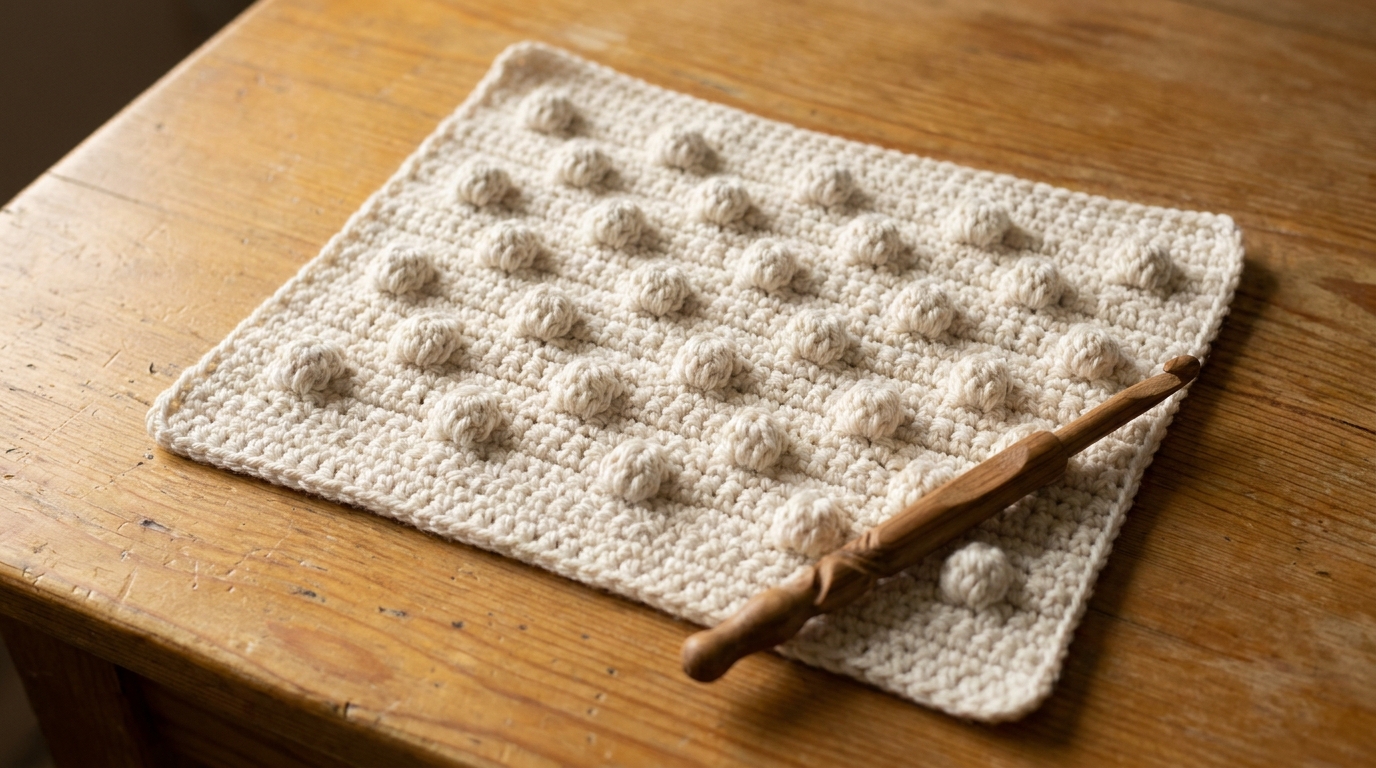
What makes a bobble a bobble
Crochet has a family of stitches designed to raise a rounded cluster above the surface of the fabric. Bobbles are one of those, and they have a specific construction that sets them apart from the others.
A bobble is worked by making 5 incomplete double crochets in the same stitch and then closing all of them together with one yarn over. The key word is incomplete. You work each double crochet almost all the way to the finish, stopping with two loops still on the hook, then repeat that into the same stitch four more times. At the end you have 6 loops on the hook. One final yarn over pulls through all of them at once, joining the cluster into a single bump.
Because the cluster is anchored at the bottom in one stitch and joined at the top, it naturally rounds outward and away from the fabric.
Bobble vs popcorn vs puff stitch
These three stitches are related but not the same, and patterns use them differently.
Bobble stitch: Made with 5 incomplete double crochets joined at the top. The bump is smooth and medium-sized. Because it is joined into the fabric continuously, it stays flexible and does not drop out of place.
Popcorn stitch: Made with 5 complete double crochets in the same stitch. After you work all 5, you drop the loop from your hook, reinsert it through the top of the first dc, then pull the loop through to cinch the top together. The popcorn is the most three-dimensional of the three and feels rigid. It sits very high.
Puff stitch: Made with 3 to 5 half double crochets, all pulled up to the same loop height before joining. The loops are kept long as you work, creating a softer, more pillow-like texture than a bobble. Puff stitches have less definition but a gentler look.
If your pattern calls for texture that is raised but still soft and flexible, a bobble is usually the right choice. If you want maximum height and a very sculptural look, a popcorn. For a soft, puffy fabric, a puff stitch.
Step-by-step: how to work a bobble stitch
Here is how to work a standard 5-dc bobble.
Abbreviations:
- ch — chain
- dc — double crochet
- yo — yarn over
- bob — bobble (5 incomplete dc joined together)
Working one bobble:
- Yarn over. Insert hook into the stitch where the bobble will sit.
- Yarn over and pull up a loop. You have 3 loops on hook. Yarn over, pull through 2 loops. Two loops remain. This is one incomplete dc.
- Without joining, yarn over again. Insert hook into the same stitch.
- Yarn over and pull up a loop. Yarn over, pull through 2 loops. Three loops now on hook. Second incomplete dc done.
- Repeat steps 3 and 4 three more times. You will have 6 loops on the hook.
- Yarn over and pull through all 6 loops at once. Chain 1 to close and stabilize the bobble.
The chain 1 at the end is optional but most patterns include it because it keeps the top of the bobble tidy and gives you a clear stitch to work into on the next row.
Which side do bobbles face?
This catches people out the first time. Bobbles push toward the side of the fabric facing away from you as you crochet. That means:
- If you work a bobble on a row facing the right side of the fabric, the bobble pushes to the wrong side (away from you, which is the back).
- If you work a bobble on a row facing the wrong side of the fabric, the bobble pushes to the right side (the front of the piece).
Most patterns place bobbles on wrong-side rows. You crochet with the wrong side facing you, the bobble pushes toward the right side, and when you turn the work, the bumps are all facing the way you want them.
This means that in a standard flat pattern, bobble rows and non-bobble rows alternate. The non-bobble rows are usually simple double crochet worked with the right side facing, and the bobble rows follow with the wrong side facing.
Placing bobbles in a pattern
Bobbles look best when they are evenly spaced with some flat fabric between them. Placing them too close crowds the work and makes it hard to see each individual bump. A common spacing is one bobble every 4 stitches with flat dc in between.
A basic repeat might look like this:
RS row: Ch 3 (counts as dc). Dc across. Turn.
WS row: Ch 3. Dc in next 2 sts. Bob in next st, dc in next 3 sts. Repeat across. Turn.
The asterisks mark the repeat. After every bobble you work 3 flat double crochets before the next bobble. This gives each bump room to breathe.
For a staggered pattern, offset the bobbles on every second bobble row. If the first WS row places bobbles on stitches 3, 7, 11, and so on, the next WS row places them on stitches 5, 9, 13. The bobbles end up in a diagonal grid, which many people find more visually interesting than a straight column.
How much yarn does the bobble stitch use?
Bobbles are yarn-hungry. Each one uses significantly more yarn than a flat stitch of the same height because you are essentially stacking 5 double crochets into one spot. A project with frequent bobbles might use 20 to 30 percent more yarn than the same project in plain double crochet.
When estimating yardage for a bobble project, start with the recommended amount and add an extra skein. Running out partway through a blanket is more frustrating than having leftover yarn.
Project ideas for the bobble stitch
Dishcloths and washcloths are the ideal first bobble project. They are small, so the yarn cost is low, you can practice your tension across a contained area, and the raised texture is practical for scrubbing.
Pillow covers show off the tactile quality of bobbles well. A solid-color pillow in a grid of bobbles looks geometric and calm without being busy. The structure of the stitch means the fabric holds its shape with less blocking.
Blankets with bobble rows at regular intervals are a popular project, sometimes called a "spot bobble blanket." You get long stretches of easy flat crochet broken up by occasional bobble rows. This pacing makes large blankets manageable because the bobble rows become a rhythm rather than a constant demand.
Bags made in cotton with a bobble exterior are durable and textural. The raised bumps give the bag extra grip.
For a full reference on this stitch including abbreviation charts, visit the bobble stitch page. To compare it alongside other textured stitches, see the crochet stitches library.
The bobble stitch is one of those techniques that looks complicated and feels obvious once you have done it a few times. Work a small swatch first to get comfortable with where the loops land, and the stitch will click quickly.