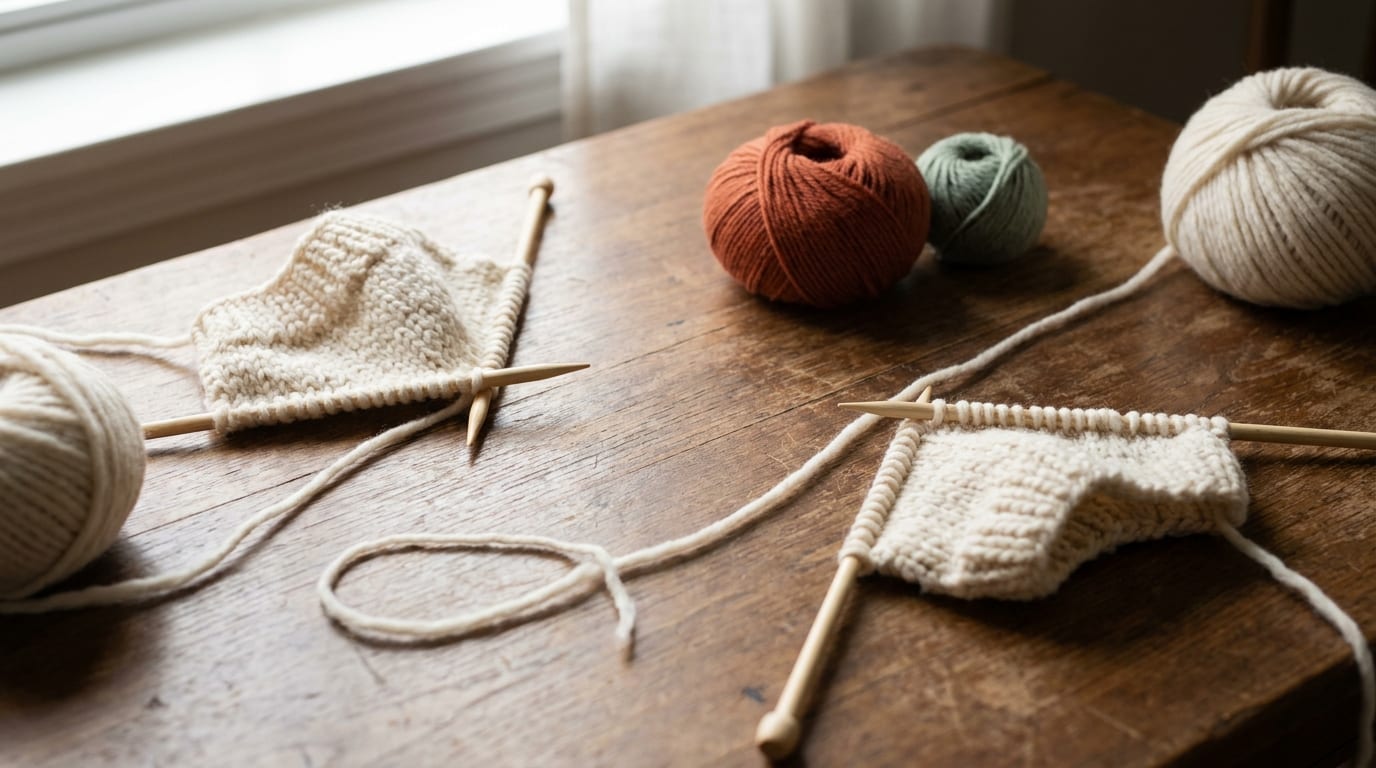
Same fabric, two ways to hold the yarn
Continental knitting and English knitting are the two main ways to hold the working yarn, and the surprise for most beginners is how little separates them. Both make exactly the same stitches. Both make exactly the same fabric. A scarf, a sock, a sweater, a lace shawl: you can knit any of them with either method, and once the piece is off the needles, nobody can tell which one you used. The only real difference is which hand holds the yarn and how the yarn gets around the needle.
So this is not a contest. Neither method is better, faster for everyone, or more correct. English knitting (often called throwing) tensions the yarn in your right hand. Continental knitting (often called picking) tensions it in your left. That single choice changes the rhythm of your hands, and not much else.
By the end of this guide you will know how each method works, how they compare on speed and comfort, why so many crocheters take to continental quickly, and how to decide which one to learn first.
The one real difference: which hand holds the yarn
Every knit stitch does the same four things. The right needle enters a live loop, the yarn wraps around the needle, a new loop is drawn through, and the old loop slides off. That sequence never changes. What changes between the two methods is the hand that manages the yarn during the wrap.
In English knitting, the working yarn lives in your right hand. Your right hand also moves the right needle, so it does two jobs. In continental knitting, the yarn lives in your left hand, draped over a finger and held taut, while your right hand moves the needle and scoops the yarn. The left hand mostly stays still and acts like a tension post.
That is genuinely the whole story. If you have already learned the knit stitch one way, switching methods is not learning a new stitch. It is moving the yarn to the other hand and getting your fingers used to a new path. Everything you know about reading a pattern, counting rows, and fixing mistakes carries straight over. For a wider view of how stitches build into fabric, our guide to what is knitting covers the foundations both methods share.
English knitting (throwing) explained
English knitting is the traditional method across much of the United States, the United Kingdom, and Ireland. Many knitters learn it first, and it has a reputation for being intuitive.
Here is the motion for a knit stitch:
- Hold the working yarn in your right hand, with a little tension running over your fingers.
- Insert the right needle into the front of the first loop on the left needle.
- Use your right hand to wrap the yarn around the right needle tip, counterclockwise. This wrapping motion is the throw.
- Draw that new loop back through the old one, then slide the old loop off the left needle.
The name throwing comes from that wrapping flick of the right hand. The yarn travels a slightly longer path, and the right hand does more moving, which is why English knitting can feel a touch slower once you are up to speed.
The upside is control. Because one hand is dedicated to the yarn, many knitters find it easier to set a precise, even tension, especially early on. That steady tension is a real help in colorwork, where uneven yarn tension shows up as bumpy or puckered stitches. If you want the gentlest possible start and like the idea of one hand fully in charge of the yarn, English is a fine place to begin.
Continental knitting (picking) explained
Continental knitting is the traditional method across much of continental Europe, which is where the name comes from. It is also the method many fast knitters gravitate toward.
Here is the motion for a knit stitch:
- Hold the working yarn in your left hand, draped over your index finger and held taut behind the work.
- Insert the right needle into the front of the first loop on the left needle.
- Use the right needle tip to catch, or pick, the taut strand your left finger is holding.
- Draw that loop through, then slide the old loop off.
The name picking describes step three: the needle picks up yarn that is already held in place, rather than the yarn being wrapped around it. Because the left hand keeps the yarn close and mostly still, the yarn travels a shorter distance and your hands make smaller movements overall.
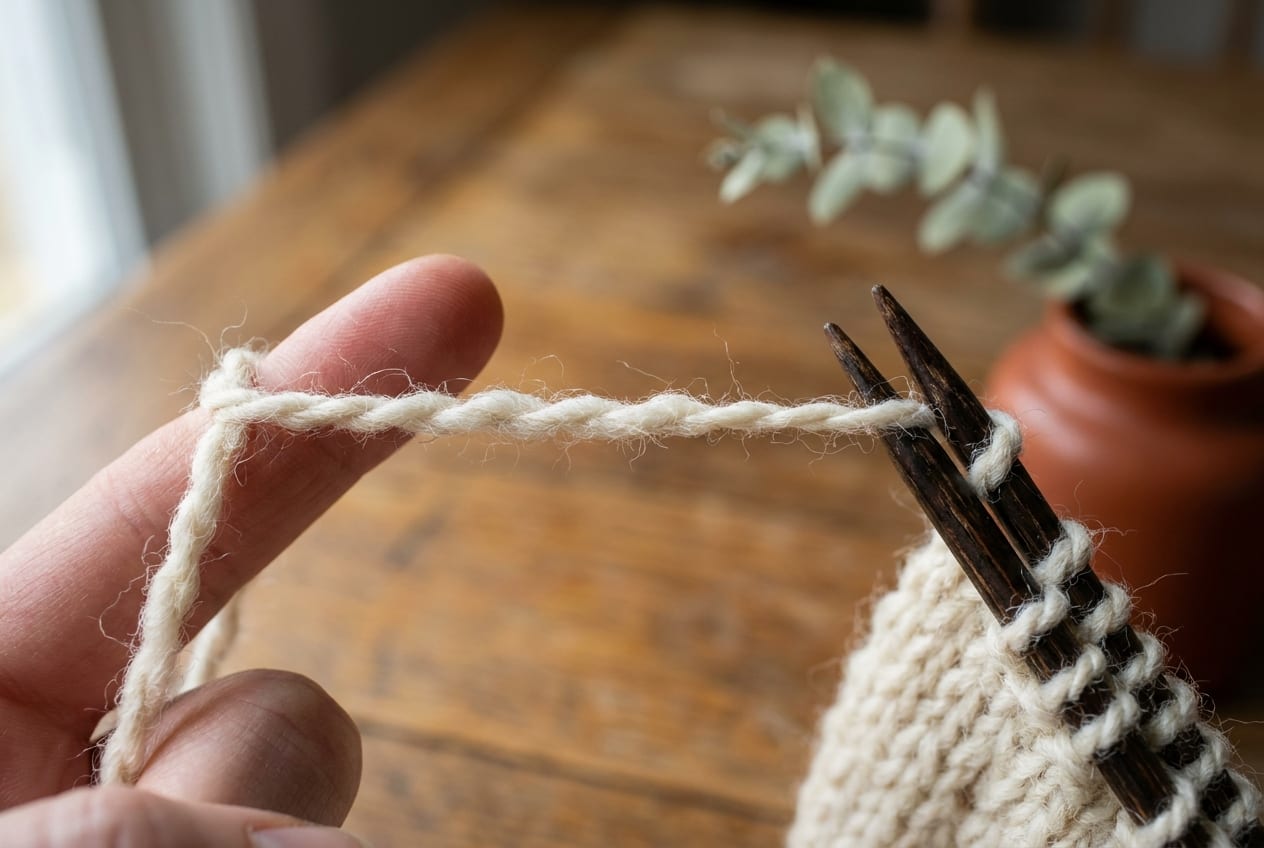
That shorter, smaller motion is the practical heart of continental knitting. It is the reason the method has a reputation for speed, and the reason it tends to involve less arm and wrist movement per stitch.
Speed and ergonomics compared
This is where most people want a verdict, so here is an honest one. Continental knitting is often faster once you have learned it, because the yarn path is shorter and the hands move less per stitch. That advantage is real, but it is not magic. A practiced English knitter can be quick too, and a brand-new continental knitter will be slow at first like anyone learning a new motion.
Ergonomics is more personal. Because continental moves the hands and arms less, some knitters find it easier on the wrists over a long session. Others find English more comfortable, particularly if the way they hold the yarn in their left hand feels cramped. There is no single right answer, and the body that matters is yours. If one method ever causes a pinch or an ache, that is worth listening to.
| | English (throwing) | Continental (picking) | |---|---|---| | Working yarn | Right hand | Left hand | | Yarn motion | Wrap around needle | Needle picks the yarn | | Yarn path | Longer | Shorter | | Typical speed | Steady | Often faster once learned | | Hand movement | More | Less | | Reputation | Easy, precise tension | Quick, gentle on motion |
Read the table as tendencies, not laws. The fabric is identical, so any speed or comfort difference is about your hands, not the result.
Purling in each method
Purling is the harder half of both methods, and it is worth being honest about that before you choose. The purl is the mirror of the knit, with the yarn held in front of the work, and it tends to be the step that slows new knitters down. You can read the full mechanics in our guide to the purl stitch, which applies whichever hand holds your yarn.
In English knitting, the purl is fairly straightforward. The yarn comes to the front, you wrap it around the needle much as you do for a knit, and you push the new loop through to the back. It is a clear, logical motion. It is also a little slower, since the right hand is again doing the wrapping.
In continental knitting, the purl is the step most new continental knitters struggle with. The yarn motion is fiddlier than the continental knit, and getting the left finger to feed the strand at the right angle takes practice. Many people find the continental knit easy and the continental purl awkward for a while. This is normal, and it passes. If continental purling frustrates you at first, that is not a sign you chose wrong. It is the part everyone wrestles with.
Why crocheters often take to continental
If you already crochet, continental knitting will probably feel oddly familiar, and there is a simple reason. In crochet you hold and tension the working yarn in your left hand, exactly the way continental knitting asks you to. Your left hand already knows how to feed yarn at a steady tension while the other hand does the hooking.
That overlap makes the transition smooth. The picking motion of a continental knit is close to the way a crochet hook catches yarn, so the hardest beginner hurdle, learning to tension yarn in the non-dominant hand, is one a crocheter has already cleared. If you are coming to knitting from a hook and want to know how the two crafts relate, our overview of what is crochet lays out the shared ground.
None of this locks a crocheter into continental. Plenty of crocheters knit English and love it. But if you crochet and you are choosing a first knitting method, continental is the one most likely to feel like home from the start.
A note on colorwork and other methods
There is one practical reason to eventually learn both methods, and it is colorwork. In stranded colorwork you carry two colors across a row. If you can knit English with one hand and continental with the other, you can hold one color in each hand and work both without constantly dropping and picking up yarn. Two-handed colorwork is smoother and faster, and it is a genuine payoff for being comfortable in both. That is a later goal, not a beginner task, but it is a good reason to keep the second method in mind.
English and continental are the two most common methods, but they are not the only ones. Portuguese knitting tensions the yarn around the back of the neck or through a pin worn on the chest, and the stitch is formed with a small flick of the thumb. Some knitters with wrist strain find it very comfortable, since the thumb does the work. It is less common than the two main methods, but worth knowing it exists if you ever want to explore further.
Which one should you learn?
Pick one method and stick with it long enough to get even tension. That is the real goal for a beginner, far more than choosing the theoretically faster style. Even tension is what makes a swatch look tidy, and it comes from repetition in a single method, not from hopping between them.
A few honest pointers to help you decide:
- If you already crochet, try continental knitting first. The left-hand yarn hold will feel familiar.
- If you want the gentlest learning curve and like the idea of precise, controlled tension, English knitting is a fine start.
- If you have any wrist sensitivity, the smaller motions of continental are worth a try, and Portuguese knitting is worth knowing about too.
- If you have no strong pull either way, just pick the one a friend or video teaches most clearly, and go.
Whichever you choose, the fabric will be the same, and you can always learn the other later. Many knitters end up fluent in both. For a full beginner path from your first cast on through your first finished project, our guide to knitting for beginners walks through it step by step.
Frequently asked questions
Is continental or English knitting better?
Neither is better. Both make identical stitches and identical fabric, so the only difference is which hand holds the yarn. Continental is often faster once learned, while English is known for easy, precise tension. Pick whichever feels more natural to your hands.
Is continental knitting actually faster than English?
Often, yes, once you have learned it. The working yarn sits in your left hand and travels a shorter path, so your hands move less per stitch. A practiced English knitter can still be quick, though, and a new continental knitter will be slow at first like anyone learning.
Which knitting method should crocheters learn?
Continental knitting usually feels most natural for crocheters, because you already hold and tension the yarn in your left hand the same way crochet does. That makes the hardest beginner hurdle, tensioning yarn in the non-dominant hand, one you have already cleared.
Is continental knitting harder to learn than English?
Not overall, but the parts that feel hard are different. The continental knit stitch is quick to pick up, while the continental purl is the step most beginners struggle with at first. English knitting feels intuitive early on but can be a little slower. Both even out with practice.
Can I switch between continental and English knitting?
Yes. They make the same fabric, so you can switch methods on the same project without it showing. Many knitters even learn both on purpose, because holding one color in each hand makes stranded colorwork much smoother and faster.
Does it matter which method I learn first?
Not much. What matters far more is sticking with one method long enough to get even tension, which is what makes your knitting look tidy. Choose the style a clear tutorial teaches, or continental if you crochet, and you can always learn the other later.