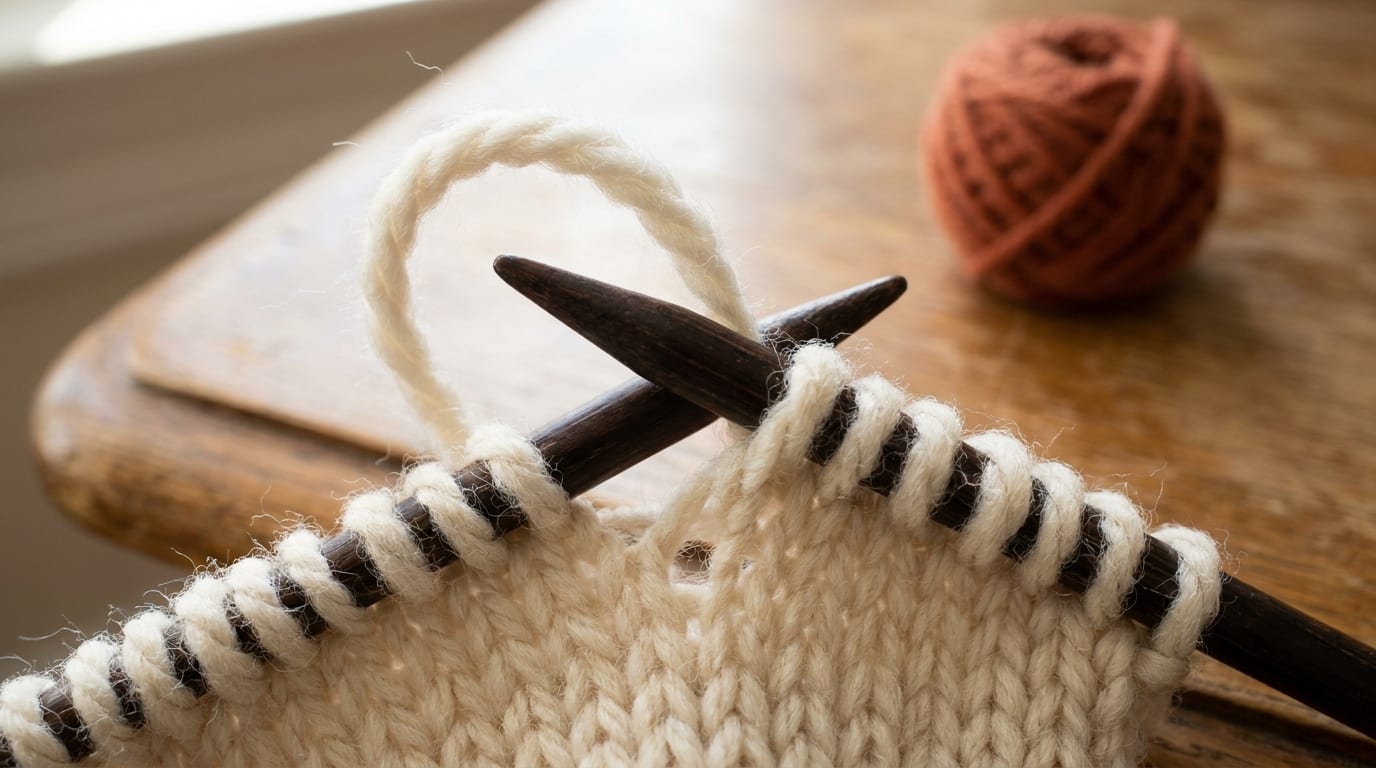
What a yarn over is
A yarn over is one of the simplest moves in knitting: you wrap the working yarn around the right needle before knitting the next stitch. That wrap creates a new loop on the needle (adding one stitch) and, if you leave it untwisted on the following row, it opens into a small hole.
That combination of a new stitch and a hole is what makes the yarn over the foundation of lace knitting. It is also used for buttonholes, eyelets, and as a visible increase when you actually want to add to your stitch count.
Before working yarn overs you should be comfortable with the knit stitch. If you want invisible increases instead, the M1L and M1R make one increases are what you are looking for.
Yarn over before a knit stitch
This is the most common version and the one you will see in almost every lace pattern.
Your yarn is normally at the back when you are about to knit. Here is how the yarn over works:
- Bring the yarn to the front between the two needles, as if you were about to purl.
- Knit the next stitch. Insert the right needle into the stitch, wrap the yarn from front to back over the right needle and through the stitch, and pull the new loop through. As you do this, the yarn naturally travels up and over the right needle. That arc over the top of the needle is the yarn over.
- Slide the stitch off the left needle as you would for any knit stitch. You now have both the new knit stitch and the yarn-over loop on the right needle.
- On the next row, you will encounter the yarn-over as an ordinary-looking loop. Knit or purl into it as your pattern directs. Leaving it untwisted preserves the hole. Knitting through the back loop would close it.
The step that confuses beginners is step one: you do not add the yarn over separately before touching the next stitch. You bring the yarn forward, then knit the stitch, and the act of knitting pulls the yarn back over the top of the needle. The yarn-over and the knit stitch happen as one smooth movement once you have the feel of it.
Yarn over before a purl stitch
A yarn over before a purl stitch is slightly different because the yarn is already at the front when you are about to purl.
Your yarn is at the front. Take the yarn up and over the right needle to the back, then bring it back to the front under the needle, ready to purl. The yarn has now made one complete loop around the right needle. Purl the next stitch as normal.
On the following row that loop is your yarn over stitch. Work it as the pattern directs.
The key is that the yarn has to travel all the way around the needle, not just from front to back. From front, over the top, to the back, then under and back to the front. A full circle.
Double yarn over
A double yarn over (written yo twice or yo2 in patterns) wraps the yarn around the right needle twice instead of once, creating a larger elongated loop.
Wrap the yarn over the needle twice before working the next stitch. On the following row you encounter a double loop. Most patterns tell you to knit into the first wrap and purl into the second, or to drop the second wrap entirely. This creates a noticeably larger hole than a single yarn over.
Double yarn overs appear in elongated stitch patterns, some drop-stitch designs, and in lace where a particularly large eyelet is needed. You will see them paired with a specific instruction for how to work them on the return row, so follow what the pattern says rather than guessing.
Yarn overs in lace versus eyelets versus increases
These three uses look similar but serve different purposes.
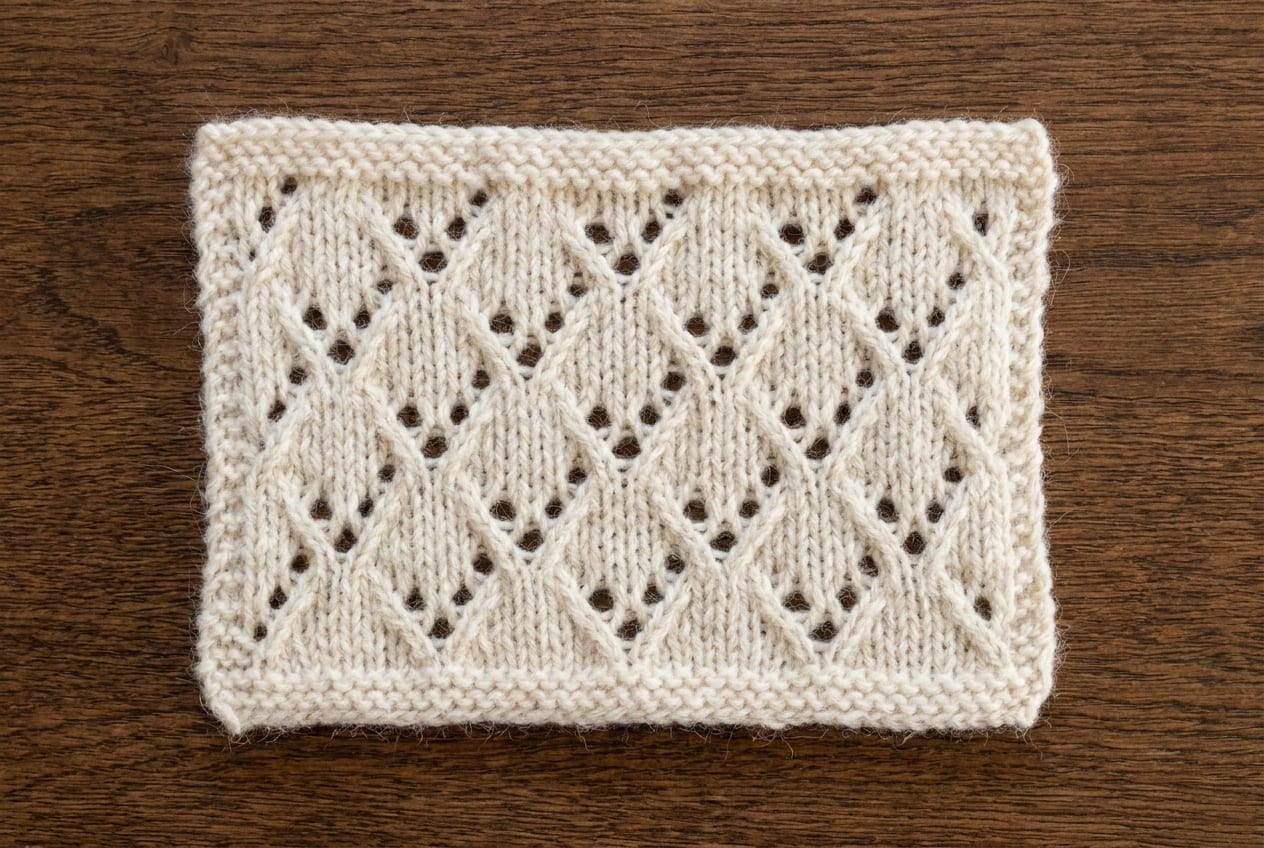
Lace: In lace knitting, every yarn over is paired with a decrease (k2tog, ssk, or similar) somewhere on the same row. The decrease removes one stitch to compensate for the one the yarn over adds. The total stitch count stays the same, but a decorative hole appears. Large panels of eyelets worked in patterns are lace.
Isolated eyelets: A single yarn over paired with a single k2tog at a specific point in a row creates one eyelet -- a clean round hole used for a button loop, a drawstring opening, or a simple decorative detail. The same logic as lace, just used once rather than across a whole row.
Increases: If a pattern says yo without a paired decrease on the same row, the stitch count rises by one. This is the yarn over used as a plain increase. It is less common in shaping because the hole it leaves is visible, but it appears in some older patterns and in decorative short-row methods.
Yarn over vs. make one: which to use
Both a yarn over and a make one increase add one stitch. The difference is whether you want a hole.
A yarn over adds a stitch and leaves a visible hole. You want this when the hole is decorative or functional -- lace patterns, buttonholes, eyelets.
A make one increase (M1L or M1R) lifts the bar between two existing stitches and twists it closed. It adds a stitch with no hole. You want this for garment shaping, seamless construction, and anywhere a clean increase matters.
Pattern abbreviations usually tell you which to use. If you see yo, work the yarn over and accept the hole. If you see m1, use the make one and keep the fabric smooth.
Common yarn-over problems
The hole closed up. You knit the yarn over through the back loop on the following row. Working through the back loop twists and closes the stitch. If you want the hole open, knit the yarn over through the front loop as you would any ordinary stitch.
There is an extra stitch on the needle. You worked a yarn over but forgot the paired decrease, or you accidentally worked an extra yarn over. Count your stitches at the end of the row. Lace rows almost always have the same stitch count at the end as the beginning.
The hole is too small. This usually means the yarn-over loop was worked very tightly. Try relaxing your grip on the yarn during the yarn over. On larger needles or with bulkier yarn the hole will open up naturally.
Once the yarn over feels natural, you have the key to reading lace patterns. Most lace instructions are just sequences of yarn overs and decreases in different orders. The knit stitch is still the foundation underneath all of it.
Frequently asked questions
Does a yarn over use extra yarn? A tiny amount, yes. The yarn over adds an extra wrap around the needle, which uses a short length of yarn. Over a long lace project this can add up, but for a swatch or small piece it is negligible.
Can I work a yarn over in garter stitch? Yes. A yarn over in garter stitch (where you knit every row) creates a hole just as it does in stockinette. On the return row, knit the yarn-over stitch as you would any other. The hole will be slightly less distinct than in stockinette because garter has more texture, but it is still visible.
Why does my pattern say k2tog after every yo? In lace, the yo adds one stitch and the k2tog removes one stitch, keeping the total stitch count constant. This pairing is the engine of all lace knitting. Sometimes the yo and its paired decrease are in different positions on the row -- the yarn over can come before or after the decrease depending on which direction you want the fabric to slant.