What circular knitting needles are, and why they are so versatile
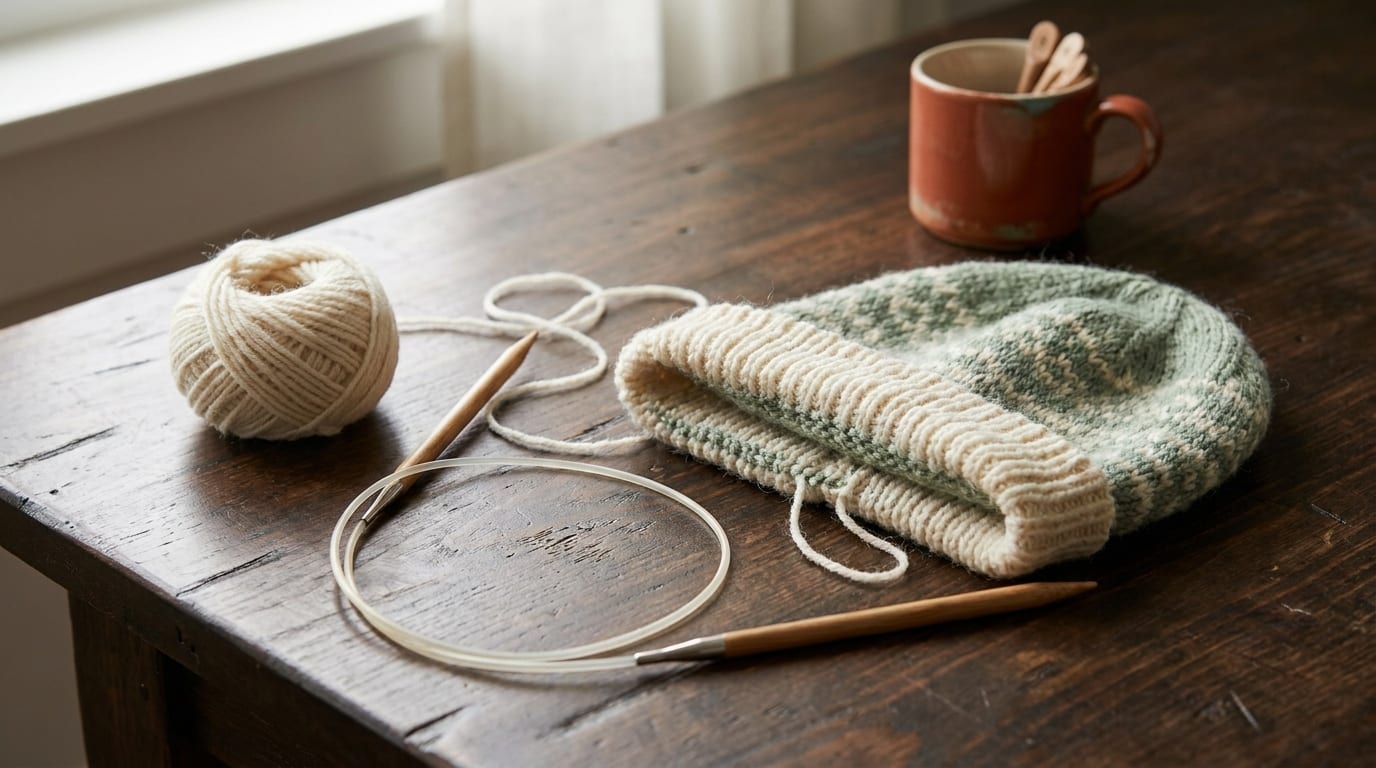
Circular knitting needles are two pointed needle tips joined by a thin, flexible cable. That single change in shape, swapping two rigid sticks for two short tips on a bendy cord, turns out to be one of the most useful tools in knitting. You can work in a continuous tube with no seam, or you can knit flat, back and forth, exactly the way you would on straight needles.
The cable does the heavy lifting, literally. On straight needles, the full weight of a wide shawl or a sweater body hangs off the tips and presses into your wrists. On a circular, the stitches slide onto the cable and pool in your lap, so your hands carry only the few stitches you are working at that moment. Many experienced knitters reach for circulars for everything, flat or round, for that reason alone.
This guide walks through fixed and interchangeable types, how to choose a cable length, how to knit in the round without the one mistake that ruins a project, knitting flat on circulars, the magic loop method, and how circulars compare to straight needles and double-pointed needles.
Fixed vs interchangeable needles
Circular needles come in two builds, and the choice mostly comes down to how much you knit.
A fixed circular is one molded piece. The tips and the cable are joined permanently at a set size and a set length, so a 4.0 mm needle on a 24 inch cable is one tool that only ever does that. Fixed circulars are cheaper per needle, and because the join between tip and cable is bonded in the factory, they tend to have the smoothest, most snag-free transition. Your stitches glide over it without catching.
An interchangeable set separates the two parts. You get a case of needle tips in a range of sizes plus several cables of different lengths, and the tips screw onto any cable. One set covers dozens of size and length combinations. If you knit often, interchangeables save money and shelf space over buying a separate fixed circular for every project. They also let you change the cable length partway through a piece, which is handy when stitch counts grow.
The small trade with interchangeables is the join. A screw connection, even a good one, has a seam where the tip meets the cable, and a cheap set can snag yarn there. A quality set closes flush and you stop noticing it.
| | Fixed circular | Interchangeable set | |---|---|---| | Build | One molded piece | Tips screw onto cables | | Cost | Cheaper per needle | Better value if you knit a lot | | Join smoothness | Smoothest, bonded | Good on quality sets | | Flexibility | One size and length | Many combinations | | Change cable mid-project | No | Yes |
For a first circular or two, buy fixed in the sizes a pattern calls for. Once you have a few projects behind you and know you are sticking with knitting, an interchangeable set pays for itself.
Cable lengths and what each suits
The cable length is measured tip to tip, and it matters more than beginners expect. The rule is simple: match the cable roughly to the circumference of the thing you are knitting. The stitches need to reach all the way around the cable without stretching to meet. Too long a cable for too few stitches and the work bunches up and pulls.
Here is what each common length is good for. Lengths are given in inches first, with the metric equivalent, since US and UK shops label them differently.
| Cable length | What it suits | |---|---| | 16 inch (40 cm) | Hats, cowls, small tubes | | 24 inch (60 cm) | Shawls, smaller sweaters, sleeves on larger sizes | | 32 inch (80 cm) | Sweaters, larger shawls | | 40 inch (100 cm) and up | Blankets, and the magic loop method |
A 16 inch (40 cm) circular is the classic hat length, long enough for the crown and snug enough that the stitches sit comfortably around the loop. A 24 inch (60 cm) cable is a workhorse for shawls and smaller garments. A 32 inch (80 cm) handles a whole sweater body. Anything 40 inches (100 cm) or longer is for blankets, and, importantly, for magic loop, where you deliberately want extra cable to spare.
How to knit in the round
Knitting in the round is what produces a seamless tube: hats, sleeves, sock legs, the body of a sweater. It is why so many garments are worked this way, because a tube has no seam to sew up and no purl rows to manage. Here is the sequence.
- Cast on the number of stitches your pattern asks for, just as you would on straight needles.
- Check for twists. Spread the stitches around the cable and make sure the cast-on edge points inward the whole way around, with no spiral. This is the warning above, and it is worth a slow look.
- Place a stitch marker on the right tip to mark the start of the round, then knit the first cast-on stitch, pulling the working yarn firmly to close the gap between the last and first stitches. The round is now joined.
- Knit every stitch, every round. When you come back to the marker, slip it across and start the next round.
That last point surprises people. To make stockinette in the round, the smooth V-shaped fabric you see on most sweaters, you knit every single round. No purling at all. Because you are always working on the outside of the tube, the knit side always faces you. This is the quiet magic of the knit stitch worked in a circle, and it makes hats and sweaters far faster than knitting them flat and seaming.
Knitting flat on circulars
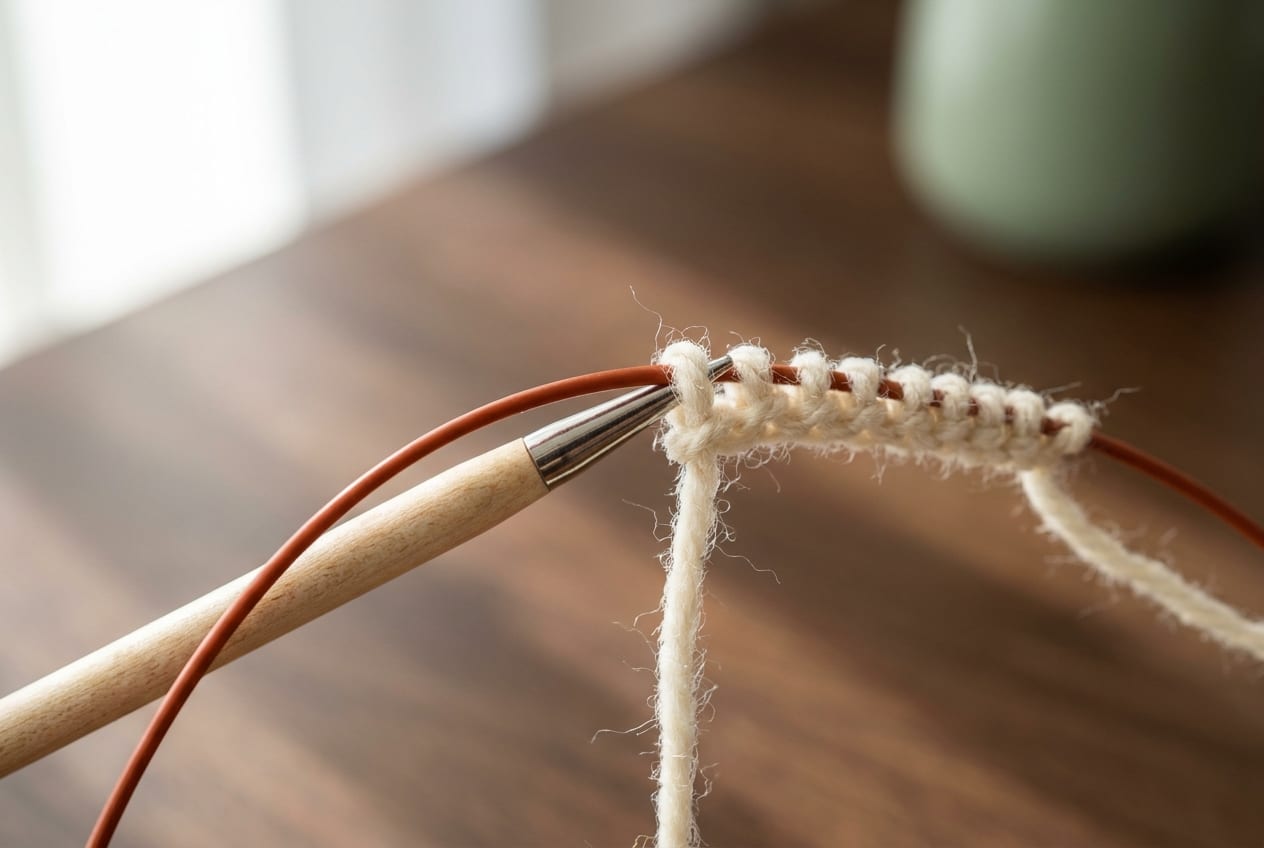
A circular needle is not only for tubes. You can knit flat on it, back and forth, exactly like straight needles. At the end of a row you simply turn the work around and knit the next row in the other direction, letting the stitches travel across the cable as you go. Nothing joins, so there is no tube, just a flat panel like a scarf or a blanket strip.
So why use a circular for flat work at all? The cable. A wide flat piece such as a blanket or the back of a cardigan has too many stitches to balance on straight needles without them sliding off the ends or straining your wrists. On a circular, the bulk rests on the cable and in your lap. This is why a lot of knitters own almost no straight needles and use circulars for nearly everything. If you are just starting out and learning the basics from our guide to knitting for beginners, a single circular can stand in for a whole drawer of straights.
The magic loop method
Magic loop is a technique for knitting a very small tube, like a sock, a sleeve, or the top of a hat, on one long circular needle. It solves a real problem: a 16 inch (40 cm) cable is too long to stretch a sock's worth of stitches around, and the older fix, four or five double-pointed needles, can feel fiddly. Magic loop replaces them with a single circular, usually 32 inches (80 cm) or longer.
The idea, in plain terms, works like this. You cast your stitches onto the long circular, then divide them into two halves. At the midpoint, you pull a loop of the bare cable out to one side so the stitches separate into a front group and a back group. You knit across the front group with the back group resting on the cable, then slide everything around, pull a new loop out the other side, and knit the second group. Two pulls of the cable equal one round. The extra cable length is exactly what gives you the loops to pull, which is why you want a long one.
It feels awkward for the first few rounds and then clicks. Once it does, many knitters give up double-pointed needles entirely, because one circular handles a sock from cuff to toe with nothing to drop.
Circular vs straight vs double-pointed
Three needle types, three jobs, with a fair amount of overlap. A quick comparison clears up which to reach for.
- Circular needles are the most versatile. They knit flat or in the round, handle any width because the cable holds the weight, and with magic loop they even cover tiny tubes. If you owned only one type, this would be it.
- Straight needles are fine for small flat pieces, a dishcloth, a scarf, a swatch. They are simple and comfortable for beginners, but they cannot knit in the round at all, and they struggle to hold a wide project without stitches sliding off.
- Double-pointed needles (DPNs) are short needles pointed at both ends, sold in sets of four or five, made for small tubes like sock toes and glove fingers. They do the job well, but they involve juggling several needles at once. Magic loop on a circular does the same work with less fuss, which is why many knitters lean on circulars instead.
If you are still building your kit, our wider knitting needles guide compares sizes and materials across all three types. And as with any needle, circulars come in the same materials, wood, metal, and carbon fiber, each with its own feel. Wood grips slightly and slows fast yarn, metal is slick and quick, carbon sits in between. What truly separates a good circular from a frustrating one is not the tip material at all, but the cable: it should be flexible, hold no kinks, and meet the tips in a join smooth enough that your yarn never catches.
Whatever needle you pick, your gauge can shift when you move from flat knitting to working in the round, so it is worth swatching the way you will actually knit the project. Our gauge calculator does the math for you. If you want the full picture of how needles, yarn, and stitches fit together, start with what is knitting and build from there.
Frequently asked questions
What are circular knitting needles used for?
Circular knitting needles work both ways. You can knit in the round to make a seamless tube like a hat, sleeve, or sweater body, or knit flat, back and forth, like straight needles. The flexible cable carries the weight of wide pieces, which is why many knitters use circulars for almost everything.
What is the difference between fixed and interchangeable circular needles?
Fixed circulars are one molded piece at a set size and cable length, cheaper per needle with the smoothest join. Interchangeable sets have tips that screw onto cables of different lengths, so one set covers many combinations and lets you change cable length mid-project. Buy fixed first, then a set once you knit often.
What cable length should I choose for circular needles?
Match the cable to the circumference of the project. Use 16 inch (40 cm) for hats and cowls, 24 inch (60 cm) for shawls and smaller sweaters, 32 inch (80 cm) for sweaters, and 40 inch (100 cm) or longer for blankets and the magic loop method. The stitches should reach around the cable without stretching.
How do I join in the round without twisting?
After casting on, spread the stitches around the cable and check that the cast-on edge faces inward the whole way, with no spiral around the cord. Then place a marker and knit the first stitch. A twist that gets knitted in becomes a permanent Mobius that cannot be fixed without ripping back, so check carefully first.
What is magic loop knitting?
Magic loop is a way to knit a small tube, like a sock or sleeve, on one long circular needle of 32 inches (80 cm) or more. You divide the stitches into two halves and pull a loop of cable out at each side, knitting one half at a time. It replaces double-pointed needles for many knitters.
Are circular or straight needles better for beginners?
A circular needle is the more flexible choice. It knits flat exactly like straight needles, so you lose nothing, and it also knits in the round and handles wide projects without straining your wrists. Straight needles are simple and fine for small flat pieces, but a single circular can cover far more as you learn.