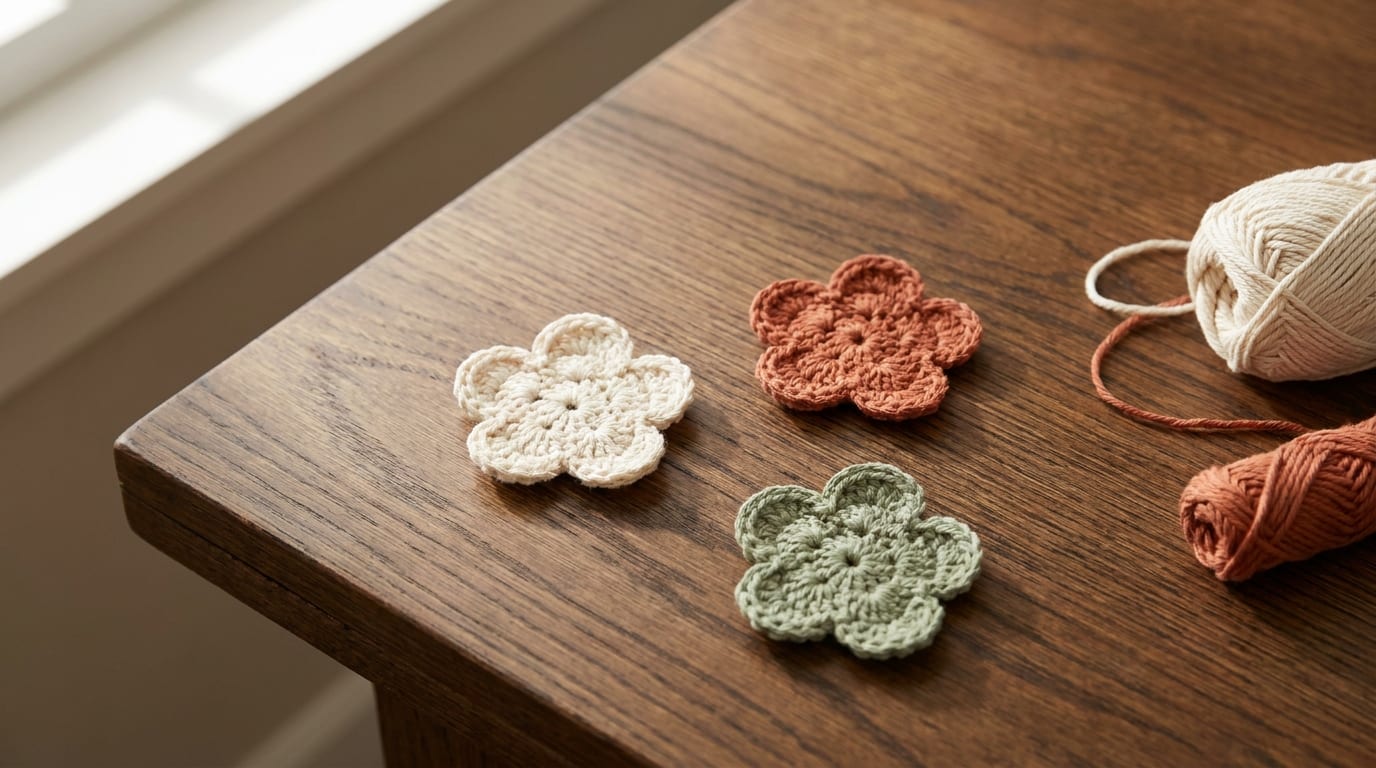
Easy crochet flowers, finished in a few minutes
Easy crochet flowers are the make that turns a beginner into a maker. You work one or two rounds, pull the yarn tight, and a small flower sits in your palm. There is no shaping to fuss over, no long pattern to track, and no way for it to go badly wrong. A simple crochet flower uses only the stitches you already know, or are about to learn in the next ten minutes: chain, slip stitch, single crochet, half double, and double crochet. That is the whole toolkit.
This guide gives you two patterns. The first is a five-petal flower, the friendliest first flower there is. The second is an even simpler loop flower for when you want something quick. You will also learn how to make either one bigger or smaller, what to do with the flowers once they pile up, and the handful of small fixes that keep your petals even. If you are brand new to the hook, our calm guide to crochet for beginners covers the basics first, and you can come back here when your hands feel ready.
Why flowers are a great beginner make
Most first projects ask you to keep going. A dishcloth is rows and rows of the same stitch, and a scarf is longer still. A flower is the opposite. It is small, it is flat, and it is done almost as soon as you start, which is exactly what keeps a new crocheter going. You get the satisfaction of a finished object in ten or fifteen minutes, and finished objects are what build the habit.
Flowers also teach without feeling like a lesson. The five-petal pattern below quietly walks you through working into a ring, spacing stitches evenly, and grouping stitches into a little fan, three skills that show up in granny squares, hats, and amigurumi later. You learn them on something forgiving, where a slightly wonky petal still looks charming. Nobody inspects a crochet flower for perfect symmetry.
And then there is what you can do with them. One flower is a hair clip. Five are a garland. A dozen scattered across a plain blanket turn it into something you made on purpose. Because each one uses so little yarn, you can experiment freely, try three colors, and keep the ones you like. Our wider guide to crochet flowers shows where these small makes can lead once you are comfortable.
What you need
The supply list for a small crochet flower is short, and you almost certainly have most of it on the table already.
- A little smooth cotton yarn. Cotton in a light, solid color shows the petals crisply, which is what makes a small flower look tidy. Cream, soft yellow, terracotta, and sage all read clearly. A single flower uses only a few yards, so this is a great way to use up scraps. Worsted weight makes a slightly bigger flower; lighter cotton makes a daintier one.
- A 3.5 to 4.0 mm hook. This range suits cotton nicely and keeps the stitches snug enough to hold their shape. If your flowers come out loose and floppy, drop a hook size.
- A yarn needle. A blunt large-eyed needle for weaving in the ends, and for sewing the flower onto whatever it is going to live on.
- Scissors. Any small sharp pair.
That is the entire list. No stuffing, no stitch markers, no special tools. If you want to compare hook sizes across the US, UK, and metric systems, our crochet hook converter lines them up in one chart.
The simple 5-petal flower, step by step
This is the flower to learn first. It works up in two rounds and gives you five soft petals, each a little fan of chains and double crochet. The pattern uses US terms, with UK terms in parentheses. Take the first round slowly; once the petals start forming in round two, your hands understand the rhythm and the rest goes quickly.
If you have not made a magic ring before, do not worry. You can either make one, or chain 4 and join into a ring, and both are explained in step one. Our full walkthrough of the magic ring has step-by-step photos if you want them.
- Make a ring. Make a magic ring, or chain 4 (
ch) and join with a slip stitch (sl st) into the first chain to form a small ring. Either way you end with a loop to work into. - Round 1, the base. Chain 1, then work about 10 single crochet (
sc, UK double crochet) into the ring. Join with a slip stitch into the first single crochet. You now have 10 stitches, and that count is what gives you 5 petals, so pause and count them before moving on. If you are using a magic ring, pull the tail gently to snug the center closed. - Round 2, the petals. Each petal sits across 2 stitches. Working into the round below, repeat this sequence: slip stitch into the next stitch, then into the following stitch work (chain 2, 2 double crochet, chain 2, slip stitch). That little group of chains and double crochet (
dc, UK treble) forms one petal between two anchor points. Repeat from the start of the sequence all the way around for 5 petals. - Fasten off. Cut the yarn, leaving a tail. Pull the tail through the last loop to lock it, then weave it into the back with your yarn needle. If you plan to sew the flower onto something, leave a longer tail now and skip the weaving, since you can use that tail to attach it.
That is a finished five-petal flower. The petals may look uneven on your first try, and that is normal. By your third flower they will match.
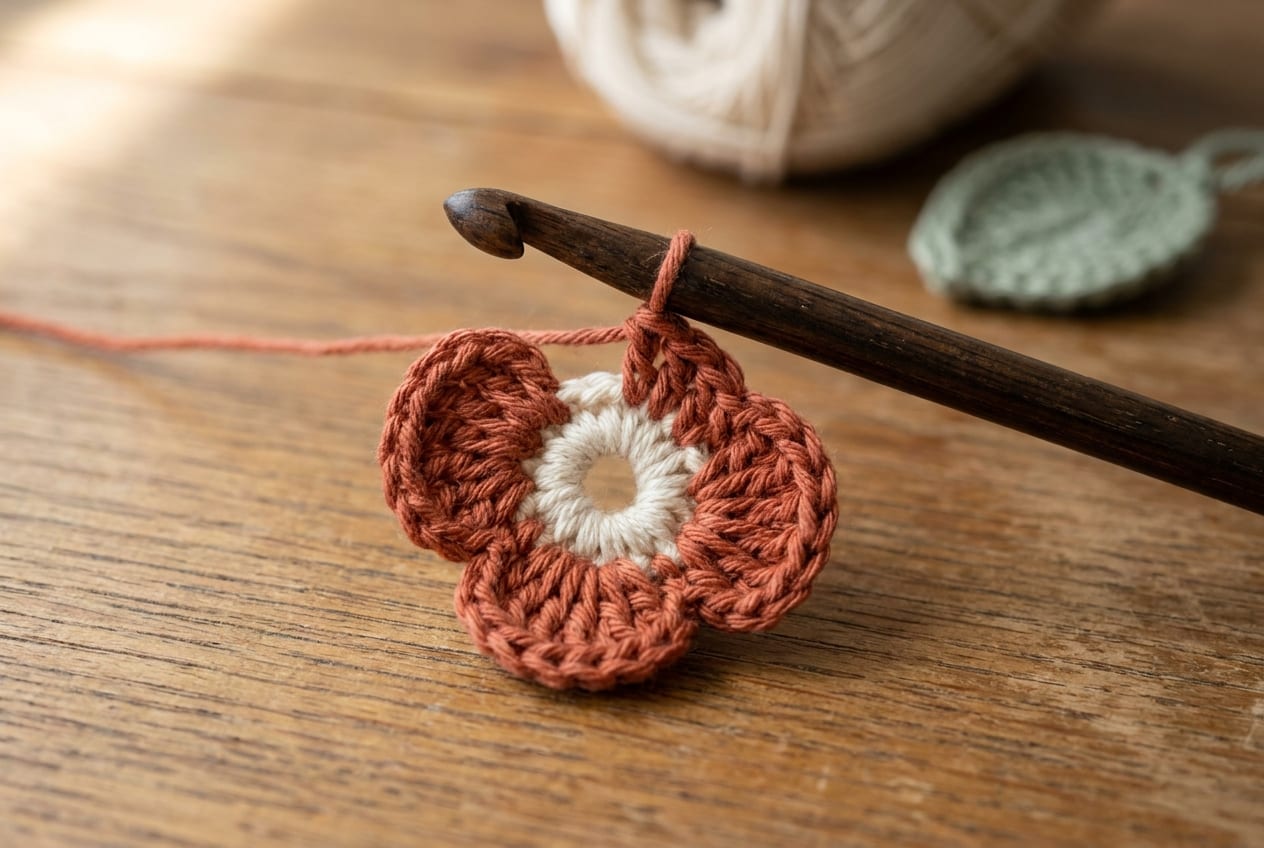
An even simpler loop flower
When you want something faster, or you are not quite ready for the fan-shaped petals, the loop flower is about as simple as crochet gets. It is one round of single crochet and then a round of small loops, and it finishes in well under ten minutes.
Start the same way: make a magic ring, or chain 4 and join into a ring. Chain 1 and work 10 single crochet into the ring, then join with a slip stitch. Now make the petals as loops. For tiny petals, work this around: chain 3, then slip stitch into the next stitch. Each chain-3 makes a small loop that stands up like a petal, and you will get a row of neat little loops all the way around.
For slightly bigger, rounder petals, swap the chain-3 loop for a fan worked into a chain space. After your round of single crochet, chain 2 and skip a stitch to make a small loop, slip stitch into the next stitch, and repeat to set up your loops. Then into each loop work (single crochet, half double crochet, double crochet, half double crochet, single crochet). Half double crochet (hdc, UK half treble) sits between single and double in height, so the petal rises in the middle and curves down at the edges, which gives it a rounded shape. Either version is a genuine easy crochet flower pattern you can make a dozen of in an afternoon.
Making it bigger or smaller
Once you can make the basic flower, sizing it is mostly about yarn, hook, and how tall your petal stitches are. Three levers do almost all the work.
- Change the yarn weight. The same pattern in worsted cotton comes out noticeably bigger than in lighter cotton, with no change to the steps. For a small crochet flower to tuck onto a clip, reach for thinner yarn and a smaller hook. For a bold flower on a bag, use worsted.
- Change the petal height. Taller stitches make taller petals. Swap the double crochet in the petals for treble crochet (one more yarn over) and the petals stretch longer and more pointed. Swap down to half double crochet and they sit shorter and rounder. This is the easiest way to change the look without learning a new pattern.
- Add a round. For a fuller, layered flower, work a second round of petals behind the first. After finishing round two, slip stitch back to a stitch in round one, then work another set of petals into those stitches so they peek out behind the front ones. Two layers give you a flower with depth.
Keep your stitch count in round one steady as you experiment. Ten stitches gives five petals; if you want six petals, start with 12 stitches and work your petals across pairs the same way. The center stitch count sets everything that follows.
What to do with your flowers
A pile of small flowers is the fun part, because they go onto almost anything. Here are the quickest finishes.
- Sew them on as appliques. This is the classic use. Leave a long tail when you fasten off, thread it onto your yarn needle, and stitch the flower onto a hat, a bag, a headband, or the corner of a blanket. A few small stitches through the back of the center hold it securely. The plainer the item, the more a flower lifts it.
- Make a hair flower. Sew or glue a single flower to a hair clip or an elastic. Cotton holds its shape well, so it survives being worn. A button or a small cluster of french knots in the center adds a finished touch.
- String a garland. Make five or six flowers in mixed colors, then thread a length of yarn through the back of each and space them out. Drape it across a shelf, a window, or a nursery wall for a quick, soft decoration.
- Top a gift. A single crochet flower tied to a wrapped present is a small handmade flourish that costs a few yards of yarn and a couple of minutes.
If you enjoy the shaping, a natural next project is a layered flower with a raised center. Our guide to how to crochet a rose walks through a coiled flower that builds straight on the skills here.
Tips and common fixes
Small flowers are forgiving, but a few habits make them come out neat every time.
- Count round one. The petal count depends entirely on the first round, so always count your single crochet before you start the petals. Ten stitches for five petals, twelve for six. If a flower comes out with a lopsided number of petals, the count in round one is almost always the reason.
- Keep your tension even. Petals look matched when each one is worked with the same snugness. If your tension wanders, one petal ends up bigger than its neighbor. The fix is the same as for any crochet: relax your grip, and do not pull the petal stitches tighter than the base round. The single crochet stitch page has a refresher if your base round feels uneven.
- Block a curling flower. Cotton flowers sometimes cup or curl, especially if the center is pulled very tight. A light block fixes it. Dampen the flower, press it flat with your fingers, pin it open to the shape you want, and let it dry. It will hold the flat shape afterward.
- Weave ends as you go. Two ends per flower add up fast across a dozen. Weave each tail in as soon as you finish a flower, unless you are leaving a long tail to sew it on, so you are not left with a bowl of loose threads at the end.
A small crochet flower is one of the few makes that looks good on the very first attempt and only gets better. Make a few in your favorite colors, keep them in a jar, and you will always have a quick gift or a way to brighten a plain make on hand.
Frequently asked questions
What is the easiest crochet flower for a beginner?
The simplest is a loop flower: one round of single crochet into a ring, then a round of chain-3 loops worked around as petals. It uses only chain, single crochet, and slip stitch, and it finishes in under ten minutes. The five-petal flower is the next step up and still very beginner friendly.
What stitches do I need to make a simple crochet flower?
Just the basics. The flowers in this guide use chain, slip stitch, single crochet, half double crochet, and double crochet, plus a magic ring or a chain-4 ring to start. If you can work a single crochet and a double crochet, you can make every flower here without learning anything new.
How much yarn does a small crochet flower use?
Very little, usually just a few yards per flower, which makes flowers a great way to use up leftover scraps. A small flower in light cotton might use three to five yards, and a bigger worsted-weight flower a little more. You can make a dozen from a single ball.
What yarn and hook work well for crochet flowers?
Smooth cotton in a light, solid color shows the petals most clearly, paired with a 3.5 to 4.0 mm hook. Cotton holds its shape well, which keeps the petals crisp. Worsted weight makes a bigger flower, and lighter cotton with a smaller hook makes a daintier one.
How do I make my crochet flower bigger?
Use a heavier yarn and a larger hook, or make the petal stitches taller by swapping double crochet for treble crochet. You can also add a second round of petals behind the first for a fuller, layered flower. The pattern steps stay the same; only the yarn and stitch height change.
How do I attach a crochet flower to a hat or bag?
Leave a long tail when you fasten off, thread it onto a yarn needle, and sew through the back of the flower's center into the item with a few small stitches. For clips and headbands you can sew or glue. Stitching through the center keeps the flower flat and secure.