A small make that pays off fast
Most crochet projects ask for patience measured in evenings. Crochet flowers are different. A single bloom is a tiny motif worked in the round, and once you know the method, you can finish one in the time it takes a kettle to boil. That fast payoff is exactly why so many people fall for them. You start a center, work a round of petals, fasten off, and there it is: a finished thing in your palm.
This is the overview page for the whole flowers cluster. By the end you will understand what a crochet flower actually is, how petals and centers are built, how layering turns a flat shape into a full bloom, and the common types of flower you can make. We will also cover what to do with them once they are done, how to make them stand up, which yarn to reach for, and where to find a good crochet flower pattern for free. The deep step-by-step guides live one click away on their own spoke pages, linked as we go.
What a crochet flower actually is
A crochet flower is a small motif worked in the round. You begin at the center, usually with a magic ring or a short chain joined into a ring, and then you build one or more rounds of petals outward from that center. That is the whole shape: a middle and some petals around it.
Because the work is circular and small, a flower does not need the long foundation chain or the careful edge counting that a scarf or blanket demands. You are working into a ring and into the stitches and spaces of the round below, round and round, until the petals are done. Most single-layer flowers take only a few minutes once the method clicks, which is part of why they make such a friendly project for a beginner or a satisfying palate cleanser between bigger makes.
If you are brand new to working in the round, or to crochet in general, the groundwork in what is crochet covers slip knots, the magic ring, and the basic stitches before you start shaping petals.
How petals and centers are built
This is the core idea, and once you have it, every flower pattern starts to make sense.
How a petal forms
A petal is almost always a cluster of stitches of graduating height, worked into one chain space or one loop. Picture a group like single crochet, half double crochet, double crochet, half double crochet, single crochet (in US terms; UK readers, that is double crochet, half treble, treble, half treble, double crochet) all worked into the same spot. The short stitches sit at the two ends and the tall stitch sits in the middle, so the whole group bulges outward into a rounded petal shape.
The logic is simple: taller stitches in the middle make a rounder, fuller petal, and shorter stitches at the edges pull the petal back in toward the center. Swap a double crochet for a treble in the middle and the petal grows pointier and longer. Use only single crochets and the petal stays small and flat. That single trick, varying stitch height across the petal, is what separates a daisy's long thin petals from a buttercup's round ones.
Behind each petal, many patterns ask you to work a small chain loop, then skip a stitch or two on the base round before starting the next petal. Those chain loops do two jobs. They space the petals evenly, and they give the next round of petals something to anchor to so it can sit behind the first round. Hold that thought, because it is the secret to layering.
How the center works
The center pulls everything together, both literally and visually.
A magic ring is the usual starting point. You wrap the yarn into an adjustable loop, work your first round of stitches into it, then pull the tail to cinch the hole closed. No gap in the middle, which matters for a flower because a hole in the center reads as a mistake rather than a bloom.
For a raised, realistic middle, a puff stitch or a popcorn stitch does the job. A puff is several half-finished stitches gathered into one soft lump; a popcorn is a group of complete stitches folded forward into a firmer bump. Either one gives you the domed, seedy center you see on a sunflower or a coneflower. Our crochet sunflower guide builds exactly this kind of puff center ringed by pointed petals.
Layering for a fuller bloom
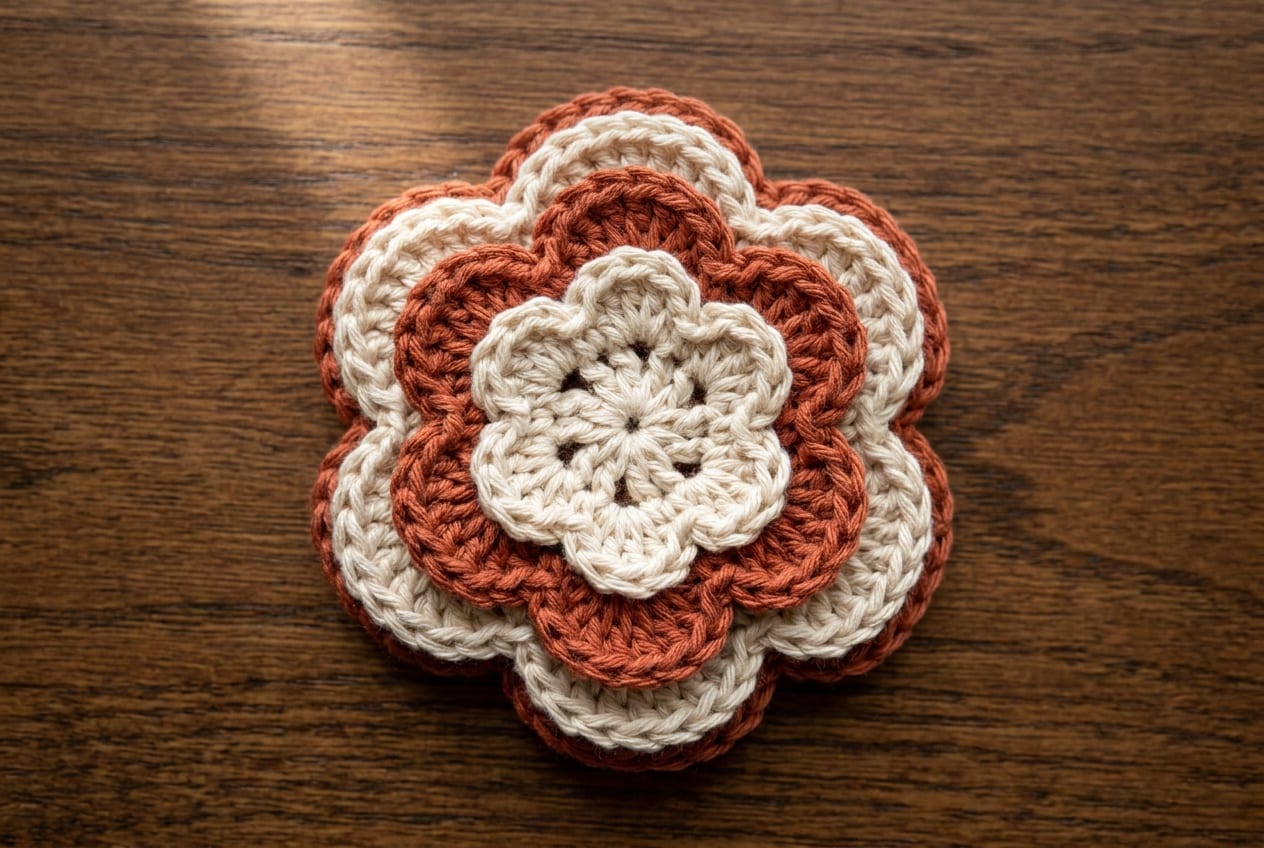
A single round of petals gives you a flat flower, which is perfect for sewing onto things. To get a flower that looks like it could sit in a vase, you stack rounds of petals so each set sits behind the last.
Here is how it works in practice. You finish your first round of petals. Then, instead of working the next round into the front of those petals, you work into the chain loops you left behind them, or into the stitches of an even earlier round. Because that anchor point sits further back, the new petals push the first round forward and fan out behind it. Add a third round anchored further back still, and the flower gains real depth.
This back-to-front stacking is exactly how a crochet rose gets its layered, cabbage-like fullness, and how a dahlia builds round after round of petals into a dense pom of a bloom. The petals can also grow taller round by round, smaller and tighter at the center, longer and looser at the outside, which mimics the way a real flower opens. You do not need many rounds. Two turns a flat flower into something dimensional, and three is plenty for most blooms.
The common types of crochet flower
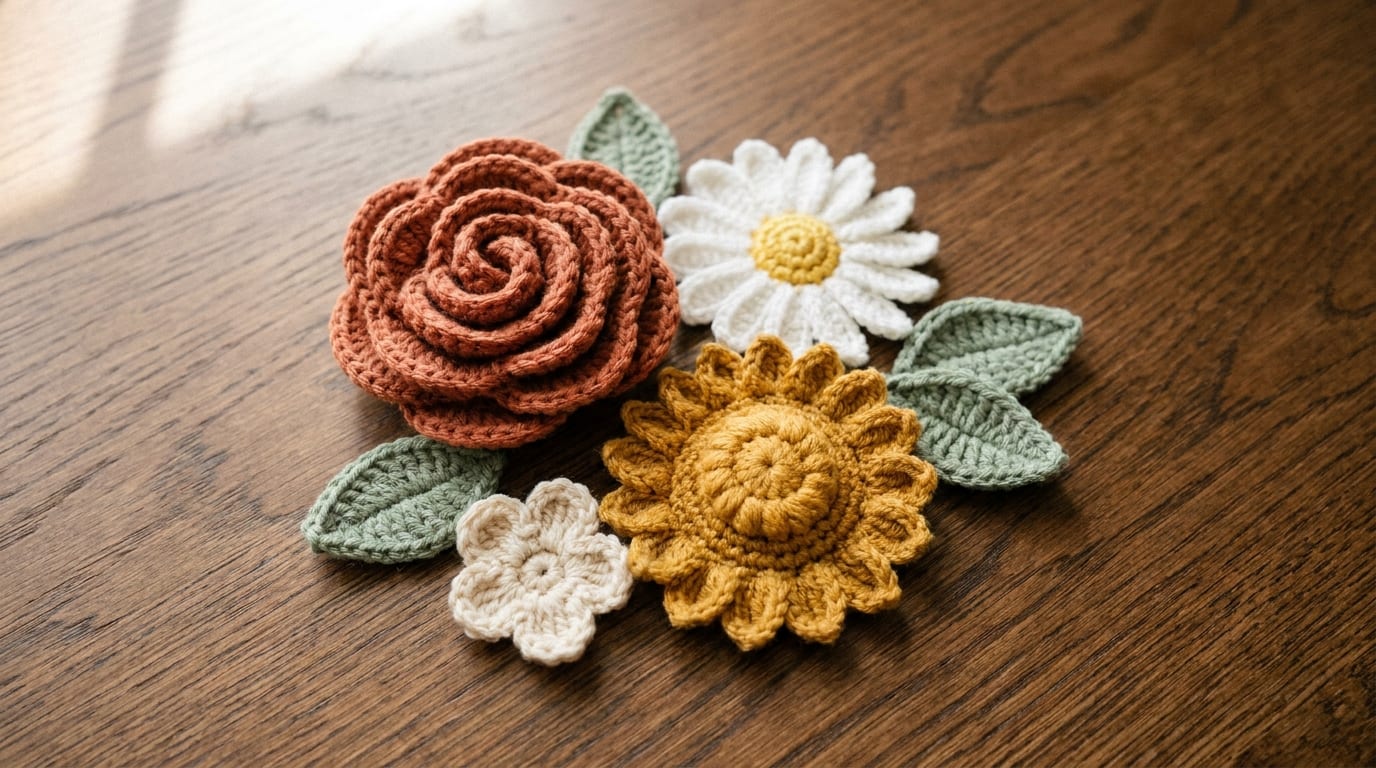
Almost every flower you will want to make is a variation on the center-and-petals idea. Here are the ones worth knowing first, each with a link to its full pattern or guide. You can also browse the whole flower pattern hub for more.
- The simple five-petal flower. The friendly first flower. A magic ring, a round of single crochet, then five petals worked as small clusters into chain loops. It is fast, forgiving, and the template every other flower builds on. Our easy crochet flowers guide walks through this one stitch by stitch.
- The rose. Less a ring of petals than a long strip. You crochet a row of graduating petal shapes along a chain, then coil that strip into a spiral and stitch the base so it holds. The coil is what gives a rose its layered swirl. See how to crochet a rose for the full method.
- The daisy. Long, thin petals radiating from a small round center, usually a contrasting color. Each petal is often a chain reached back into and worked as a slim spoke, which keeps it narrow rather than rounded.
- The sunflower. A raised puff or popcorn center ringed by a round (or two) of pointed petals. The contrast between the domed brown center and the bright petals is the whole look. Build it with our crochet sunflower guide.
- The tulip. A cupped, three-dimensional bloom rather than a flat motif. The petals curve inward and the shape is worked more like a tiny vessel, which makes it a fun step up once flat flowers feel easy.
And no bouquet looks finished without greenery. A few crochet leaves worked in sage or forest green give your flowers a stem to sit on and balance the color. For a flower that lives flat inside a blanket or cushion, the flower granny square sets a bloom into a classic square so it joins neatly with other motifs.
What to do with crochet flowers
Finished flowers are the start, not the end. The use you have in mind should shape how you make them, and the biggest fork is keeping them flat versus building them up.
Flat, single-layer flowers shine as appliqués, sewn straight onto something. A flower on the brim of a hat, the corner of a bag, the front of a plain blanket, or a headband turns a basic make into something with character. Because they lie flat, they sew on cleanly with a yarn needle and the same color tail you left at fasten-off.
Add a pin back and a flat flower becomes a brooch in seconds. A little hot glue or a few stitches through the bar of a brooch pin, and you have a wearable that costs almost nothing in yarn.
For bouquets, you build the flower fuller and give it a stem. Run a length of floral wire up through a crocheted stem or directly into the back of the bloom, add a leaf or two, and group several together. A jar of crocheted flowers never wilts and never needs water, which is part of the charm.
Strung along a chain or a length of twine, flowers become a garland for a mantel or a nursery. Glued or sewn to a clip, they become hair clips. The same little motif covers a lot of ground.
If you want a broader pool of projects to drop a flower into, our roundup of free crochet patterns sorts makes by skill level so you can find a hat or bag to decorate.
Making your flowers stand up
A flat flower flops, and for an appliqué that is fine. For a bouquet or a brooch you want some backbone. There are three reliable ways to get it.
The first is yarn choice, covered in full just below: cotton holds a crisp shape far better than a soft, springy wool, so a flower in cotton stands prouder straight off the hook.
The second is wire. Running thin floral wire down a crocheted stem, or threading it through the back of the bloom, lets you bend the flower into position and have it hold. This is the standard trick for bouquet flowers that need to angle out of a jar rather than slump into it.
The third is fabric stiffener. Painting a finished flower with a fabric stiffener (or a homemade mix of watered-down craft glue) and letting it dry hard locks the petals into shape permanently. It is the right move for a flower that needs to stay open and sculptural, like a statement brooch or a flower meant to sit on a shelf.
Choosing yarn for crochet flowers
Yarn changes a flower more than almost any other choice you make.
Cotton gives crisp, defined petals and holds its shape. Each stitch stays where you put it, edges stay sharp, and the finished flower does not droop. That makes cotton the natural pick for appliqués, brooches, and bouquet flowers, anything where you want the petal shape to read clearly and last.
Worsted weight wool or acrylic makes a bigger, softer bloom with rounder, plusher petals. It works up faster because the stitches are larger, and the result has a cozy, slightly fuzzy look rather than a crisp one. Reach for it when you want a soft flower on a hat or a chunky bloom on a blanket, where a little squish suits the project.
Hook size follows the yarn. A smaller hook tightens a flower and firms up the petals; a larger hook opens it out and softens it. If your cotton flower looks loose and floppy, drop a hook size and the petals will firm up nicely. For more on matching yarn to project, the wider crochet stitches library covers how stitch height and fabric density interact.
Where to find free crochet flower patterns
You do not need to buy a single pattern to fill a vase. Good free crochet flower patterns are everywhere if you know where to look.
Large pattern databases are the place to start. Ravelry holds tens of thousands of designs and lets you filter to free patterns only, then narrow by flower, by yarn weight, and by difficulty. It is the fastest way to see a lot of options at once.
Independent designer blogs are where the real teaching happens. A good blog post gives you clear step photos for every round, which is exactly what a flower needs since the petal clusters are hard to picture from written notation alone. These are usually the easiest free patterns to actually follow.
YouTube suits anyone who learns by watching. A video lets you pause and replay the moment a petal forms, which can clarify a technique that a written pattern leaves murky. Search the flower type plus "crochet tutorial" and you will find dozens.
Yarn-brand sites publish free patterns to sell their yarn, and the patterns are typically well tested and cleanly written. They often come with a clear photo and a tidy materials list.
Pinterest is for discovery rather than the pattern itself. Use it to find a flower you love, then click through to the original source for the actual instructions, since the pin alone rarely has them. When you land on the source, that is when the real pattern lives.
Once you have picked a flower, head to the spoke that matches it: easy crochet flowers for your first bloom, how to crochet a rose for the coiled classic, crochet sunflower for a puff-centered statement, and crochet leaves to finish the bunch.
Frequently asked questions
How do you crochet a simple flower for beginners?
Start with a magic ring, work a round of single crochet into it, then make petals by working small clusters of stitches into chain loops around the ring. A basic five-petal flower uses one round of petals and takes only a few minutes once you can work a magic ring. Our easy crochet flowers guide walks through it step by step.
What yarn should I use for crochet flowers?
Cotton is the usual choice because it gives crisp, defined petals and holds its shape, which suits appliques and bouquets. Worsted weight wool or acrylic makes a larger, softer bloom with plusher petals. If your flower looks floppy, try going down a hook size to firm up the stitches.
How do you make a crochet flower stand up?
Three things help. Work the flower in cotton, which holds its shape better than soft wool. Run floral wire down a crocheted stem or through the back of the bloom so you can bend it into position. Or paint the finished flower with fabric stiffener and let it dry hard to lock the petals open permanently.
How do you make crochet flower petals?
A petal is a cluster of stitches of graduating height worked into one chain space or loop, such as single crochet, half double, double, half double, single crochet. The taller stitch in the middle makes the petal bulge outward into a rounded shape, while the shorter stitches at the ends pull it back toward the center.
How do you make a crochet flower look fuller?
Layer the petals. After your first round, work the next round of petals into chain loops left behind the first round, so the new petals sit behind and push the front ones forward. Two or three stacked rounds turn a flat flower into a full, dimensional bloom, which is how roses and dahlias get their depth.
Where can I find free crochet flower patterns?
Ravelry lets you filter tens of thousands of patterns to free ones and narrow by flower type. Independent designer blogs give the clearest step photos, YouTube is ideal for watching a petal form, and yarn-brand sites publish well-tested free patterns. Use Pinterest to discover a flower, then click through to the original source for the instructions.