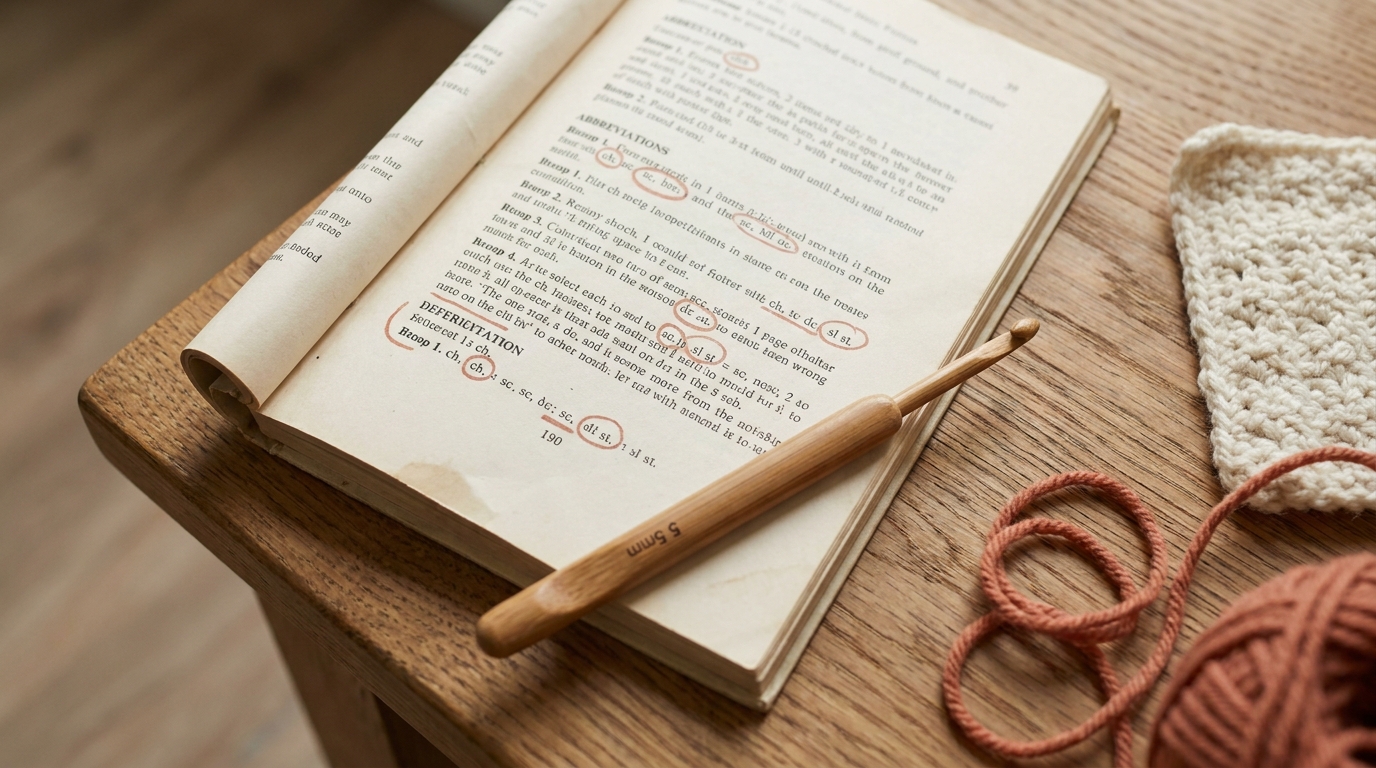
Why crochet abbreviations exist
Crochet patterns would be tedious to read in plain language. Writing out "insert hook, yarn over, pull up a loop, yarn over, pull through two loops, yarn over, pull through two loops" every time you need a double crochet would make a two-page pattern stretch to twenty pages. Abbreviations compress all of that into two letters: dc.
Once you know what the abbreviations mean, a dense-looking pattern line like ch 3, dc in each of next 5 sts, sk 2 sts, sc in last st becomes a clear, readable sentence. The barrier is knowing the code, and this guide gives you all of it.
One important note before the table: there are two crochet terminology systems in wide use, US and UK, and they use the same words for different stitches. We will cover that conflict in its own section. Everything in the table below uses US terminology, which is standard on most English-language pattern sites, apps, and North American publishers.
If you are just starting out, the what is crochet guide covers the basics of how patterns are structured before you dive into the abbreviation system.
Complete US crochet abbreviations table
| Abbreviation | Full name | What it means | |---|---|---| | ch | chain | Foundation stitch; the basis of most starting chains and turning chains | | sl st | slip stitch | Lowest stitch; used for joining rounds, moving across stitches, and finishing seams | | sc | single crochet | Short stitch, one loop through, one yarn-over pullthrough | | hdc | half double crochet | Between sc and dc in height; yarn over before inserting hook | | dc | double crochet | Workhorse stitch; two yarn-overs when completed; very common | | tr | treble crochet (triple crochet) | Tall stitch; yarn over twice before inserting hook | | dtr | double treble crochet | Very tall stitch; yarn over three times before inserting | | trtr | triple treble crochet | Extra tall specialty stitch; yarn over four times before inserting | | sc2tog | single crochet two together | Decrease: joins two stitches into one using sc | | dc2tog | double crochet two together | Decrease: joins two stitches into one using dc | | inc | increase | Work two stitches into the same stitch to add one stitch | | dec | decrease | Reduce stitch count; method depends on stitch used | | ch-sp | chain space | The open loop or gap created by a chain in a previous row | | st | stitch | Refers to a single stitch | | sts | stitches | Plural of stitch | | sp | space | An open area between stitches, usually a chain space | | sk | skip | Pass over the next stitch without working into it | | rep | repeat | Work the bracketed or starred section again | | rnd | round | One complete circuit in circular crochet | | rnds | rounds | Plural of round | | RS | right side | The public-facing side of the fabric | | WS | wrong side | The back or inside-facing side of the fabric | | BLO | back loop only | Insert hook under only the back loop of the stitch | | FLO | front loop only | Insert hook under only the front loop of the stitch | | BL | back loop | Same as BLO | | FL | front loop | Same as FLO | | PM | place marker | Insert a stitch marker at this point | | SM | slip marker | Slide the existing stitch marker from one hook to the other | | MR | magic ring (magic loop) | Adjustable loop used to start circular crochet without a hole at the center | | t-ch | turning chain | The chain(s) worked at the beginning of a row to bring the hook to the right height for the next stitch | | yo | yarn over | Wrap yarn over the hook | | yoh | yarn over hook | Same as yo | | cont | continue | Keep working as established | | approx | approximately | Used with measurements when exact precision is not critical | | beg | beginning | The start of a row, round, or pattern section | | rem | remaining | Stitches or rows left after working a section | | tog | together | Work multiple stitches together as a decrease | | prev | previous | Refers to the row or round just worked | | foll | following | Refers to the next instruction or row | | alt | alternate | Work every other stitch or row as specified | | lp | loop | A loop on the hook or in a stitch | | lps | loops | Plural of loop | | bobble | bobble stitch | Multiple dc started and joined at the top; creates a raised bump | | puff | puff stitch | Multiple hdc started and joined; softer than a bobble | | pop | popcorn stitch | Multiple complete dc in one stitch, then joined and pushed to the front | | cl | cluster | Multiple stitches started separately but finished together at the top | | shell | shell stitch | Multiple dc worked into the same stitch or space, fanning outward | | v-st | v-stitch | Two dc with a chain between them, worked into the same space | | picot | picot | Small decorative loop, typically ch 3 or 4, slip stitched into the base |
US vs UK crochet terms
The same stitch names mean different things in US and UK patterns. This is one of the most reliable sources of confusion for crocheters who work from patterns by international designers.
| US term | US abbreviation | UK term | UK abbreviation | |---|---|---|---| | slip stitch | sl st | slip stitch | ss | | single crochet | sc | double crochet | dc | | half double crochet | hdc | half treble crochet | htr | | double crochet | dc | treble crochet | tr | | treble crochet | tr | double treble crochet | dtr | | double treble crochet | dtr | triple treble crochet | trtr |
The key to remember: every US stitch name above half double crochet is one step lower than its UK equivalent. US double crochet = UK treble crochet. If you work a UK pattern thinking the dc means US double crochet, your stitches will come out shorter than intended and the whole fabric will be compressed.
Most modern pattern sites declare their terminology clearly, either US or UK, in the pattern header. If a pattern does not say, look at the context. An enormous shawl pattern written by a designer based in the UK or Australia is likely using UK terms. A pattern on Ravelry by a North American designer almost certainly uses US terms. When in doubt, look for a stitch called "double crochet" that appears very frequently in simple patterns. In the US system that is a tall versatile stitch; in the UK it is the short workhorse single crochet. The relative frequency and pattern context will usually tell you which system you are in.
Reading pattern notation
Knowing what the abbreviations mean is half the skill. The other half is reading how patterns arrange them.
Asterisk repeats. An asterisk (*) marks the start of a repeat section. A second asterisk or a semicolon marks the end. The instruction after the closing marker tells you how many times to work the section. Example: * dc in next 3 sts, ch 1, sk 1 st; rep from * 4 times means you work the dc in next 3 sts, ch 1, sk 1 st section four additional times after the first pass. You work it five times total.
Parentheses for stitch clusters. Parentheses group stitches that all go into the same stitch or space. (dc, ch 2, dc) in ch-sp means you work a double crochet, chain 2, and another double crochet all into the same chain space. This is a v-stitch worked in a specific location.
Brackets for repeats within repeats. Some patterns use brackets [] alongside asterisks when there is a repeat nested inside another repeat. Read from the inside out.
Stitch counts in parentheses at row end. Many patterns close each row or round instruction with a number in parentheses: Row 3: sc across. (24 sts) This is the expected stitch count at the end of that row. It is your check. If you count 22 or 26 stitches instead of 24, you made a mistake somewhere in the row. These counts are extremely useful for catching errors before they compound into later rows.
Sizes in parentheses. Patterns sized for multiple options often write all sizes together: ch 31 (35, 39, 43). The first number is the smallest size; numbers inside parentheses are larger sizes in order. Decide your size before you start and follow that column throughout. Many experienced crocheters circle their size in the pattern or highlight it digitally before beginning.
For more detail on how these elements fit together across a full pattern, the crochet stitches library covers each stitch in depth so you can follow pattern instructions for any stitch you encounter.
A reference to bookmark
You do not need to memorize every abbreviation in this table before you start crocheting. Most patterns for beginners use only six to eight abbreviations. Learn those first: ch, sl st, sc, hdc, dc, sk, st, rep. That set carries the majority of beginner patterns comfortably. Add abbreviations to your working knowledge as you encounter them in new patterns rather than trying to absorb the full list at once.
Keep this page bookmarked for quick lookups. Whenever a pattern uses a term you do not recognize, check here first before searching more broadly.