What crochet tension actually is
Crochet tension is how tightly you pull the yarn through each stitch. More specifically, it is the combination of two things: how firmly you grip the hook and how much resistance your non-dominant hand applies to the yarn as it feeds through. Together these two forces determine the size of every loop you make.
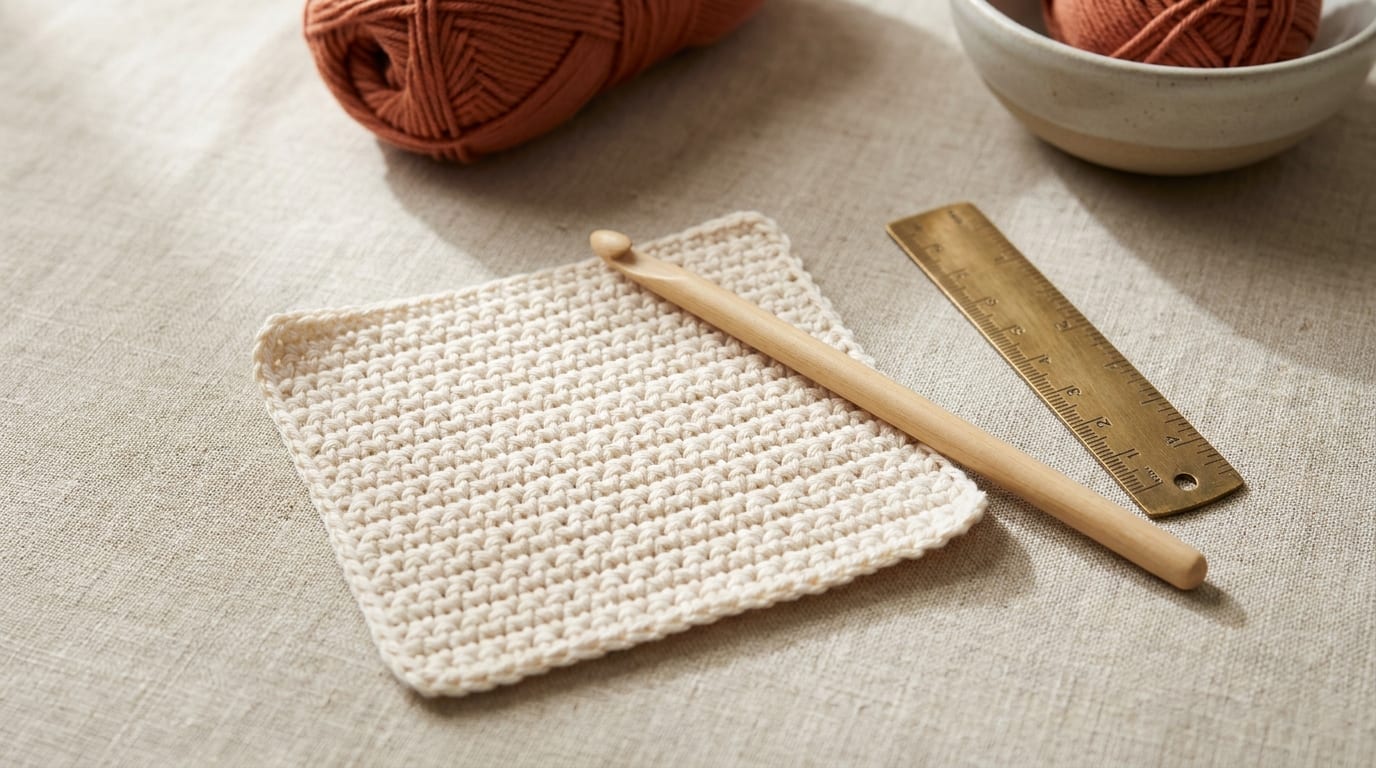
When tension is consistent, meaning you apply roughly the same pull to every stitch, your fabric comes out even. The stitches look like neat columns of V shapes, they sit at the same height, and the edges lie flat. When tension varies, some stitches will be tighter and smaller than others, and the finished fabric will have an uneven, sometimes wavy texture.
Why tension matters
Tension affects three things: gauge, drape, and the finished size of your project.
Gauge is the number of stitches and rows that fit into a given measurement, usually a four-inch square. Every pattern is designed around a specific gauge. If your tension is tighter than the designer's, your stitches will be smaller and your finished piece will come out smaller than stated. If your tension is looser, it will come out larger. For a dishcloth or a scarf, that may not matter. For a sweater, a hat, or an amigurumi body where pieces need to fit together, it matters quite a lot.
Drape is how the fabric moves and falls. Tight tension produces a stiff, dense fabric that holds its shape well. Loose tension produces a softer, more flowing fabric. Neither is inherently better; the right tension depends on what you are making.
Signs your tension is too tight
The most obvious sign: you struggle to insert your hook into the previous row's stitches. If you are forcing the tip of the hook through each stitch rather than sliding it in smoothly, your stitches are too snug.
Other signs of tight tension:
- The fabric feels stiff and dense, more like felt than soft yarn
- The edges of your piece curl inward
- The finished piece is noticeably smaller than the pattern states
- Your hand and wrist tire quickly because you are gripping hard
Signs your tension is too loose
Loose tension often announces itself by stitches falling off the hook before you are ready to work them. The loops sit so loosely on the shaft that the hook moves through them without resistance.
Other signs of loose tension:
- The stitches look large and uneven, with visible gaps between them
- The fabric feels floppy and stretches easily
- The finished piece is larger than the pattern states
- The edges wave or ruffle rather than lying flat
How tension changes during a project
This catches almost every beginner by surprise. You start a project with relaxed, even tension, work a few rows, and then without noticing you begin to tighten up. By row five or six, your stitches are visibly smaller than the first two rows.
This happens because concentration creates physical tension. As you focus on counting stitches or following a new stitch pattern, your hand grips the hook a little harder, your shoulders lift slightly, and your pinky wraps the yarn a little tighter. The result is a piece that gets progressively denser as you go.
The fix is to check in with your body every few rows. Loosen your grip, take a breath, and slow down. It sounds simple because it is; most tension problems are muscle memory problems, not technique problems.
Five practical tips to improve your tension
1. Relax your grip
The single most common cause of tight tension is gripping the hook too hard. Try this: hold the hook firmly enough that it will not wobble or slip, but loosely enough that a friend could pull it out of your hand without much resistance. Your knuckles should not whiten. Your wrist should be able to rotate slightly with each stitch.
If you notice your grip tightening mid-row, stop, open and close your hand a few times, and continue.
2. Keep a consistent yarn path
How the yarn travels from the ball to your hook matters. If the path changes mid-row because your hand shifts position or you let the yarn slip off your index finger, your tension will shift with it. Find a yarn path that feels comfortable and try to maintain it throughout the row.
A basic starting position: yarn over the index finger, under the middle and ring fingers, and once around the pinky. Adjust the pinky wrap until the resistance feels right, and then try to hold that position consistently.
3. Slow down
Speed and tension are linked. When you crochet faster than your hands are ready for, the movements become less precise and the tension becomes less controlled. Slowing down, even slightly, gives your hands time to apply consistent resistance on every stitch.
As muscle memory builds, your hands will find a comfortable rhythm at a faster speed. Speed comes with practice; forcing it early creates tension problems.
4. Work a gauge swatch and block it
A gauge swatch is a small test square, usually four to six inches, worked in the stitch and yarn the pattern calls for. Blocking the swatch (wetting it, pinning it flat, and letting it dry) shows you the true stitch size after the fibers have relaxed. If your swatch gauge does not match the pattern gauge, adjust your hook size: go up a size if your stitches are too small, down a size if they are too large.
Working a swatch before a large project also gives your hands time to settle into the yarn and find their natural tension before it counts.
5. Switch hook size
If you have tried adjusting your grip and slowing down and your tension is still consistently off, changing hook size is the most reliable fix. Going up half a millimeter or a full millimeter opens up tight stitches. Going down does the opposite. You do not need to change how you crochet; you just change the tool.
When tension does not matter much
Not every project needs precise tension control. For items where exact dimensions are not important, small variation in tension will not affect the result.
Tension matters most for:
- Garments (sweaters, cardigans, tops) where fit depends on stitch size
- Hats and socks where circumference needs to match a specific measurement
- Amigurumi, where even tension prevents stuffing showing through gaps and helps pieces fit together
Tension matters less for:
- Dishcloths, washcloths, and pot holders
- Scarves and cowls where a few extra centimeters in width is not a problem
- Blankets worked in panels where pieces are joined rather than shaped
If you are working a dishcloth or a practice scarf, do not stress about achieving a specific gauge. Focus instead on keeping the stitches at a consistent size relative to each other. That consistency is the skill you are building, and it transfers directly to projects where gauge does matter.
For a deeper look at gauge and how to use it when substituting yarn, see our guide to crochet gauge. And if you are still finding your tension hard to control, revisiting how to hold your crochet hook often reveals the root cause.