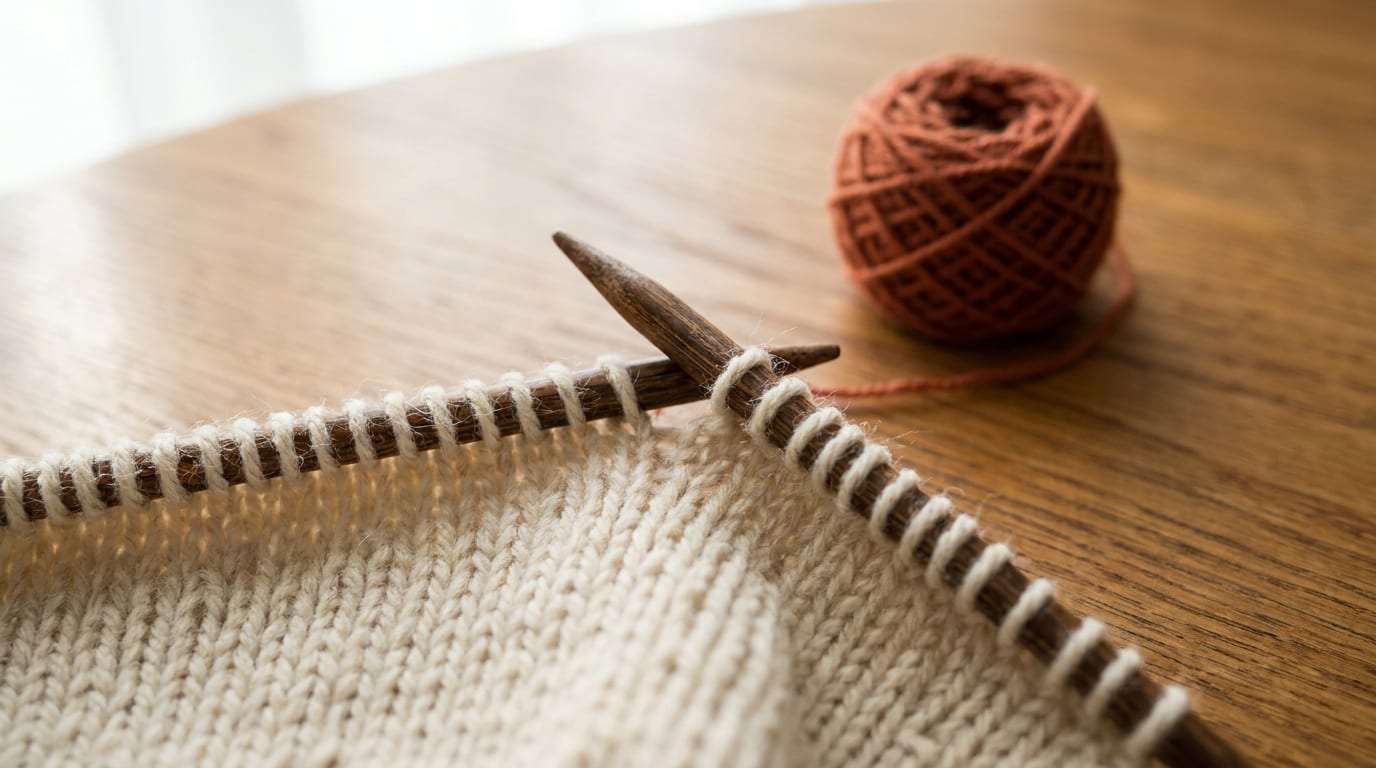
The decrease that leans the right way
Sooner or later a pattern asks you to shape something. The top of a hat, the raglan line of a sweater, the point of a shawl. That shaping is made of decreases, and the two you meet first are k2tog and SSK. They look like a matched pair on the needle, and for a reason: one leans right, the other leans left.
SSK is the left-leaning one. SSK knitting is worth getting right early, because clean decreases mirror each other neatly down both sides of a shape, which is the difference between a tidy raglan and a lumpy one. This guide covers what SSK means, how to work it stitch by stitch, why it leans left, how it differs from k2tog, where it shows up in patterns, and the small fixes for the loose or twisted SSK that frustrates most beginners.
If you are brand new to the craft, our calm introduction to knitting covers casting on and the knit and purl stitches first. Once SSK feels natural, its purl-row twin is slip slip purl (SSP), which keeps the same left lean on wrong-side rows.
What SSK actually means
SSK stands for slip, slip, knit. It is a decrease, which means it reduces your stitch count by one: two stitches become a single stitch. The name is the method. You slip one stitch, slip another, then knit those two together in a way that makes the finished stitch lean to the left as you look at the right side of the fabric.
Decreases come in pairs because shaping usually happens on both edges of a piece at once. On the right edge of a sweater front you want the decreases to lean one way, and on the left edge you want them to mirror that. SSK and k2tog are that pair. Most patterns assume you know both.
How to work SSK step by step
Work these steps on a knit row, with the right side of the fabric facing you.
- Slip the first stitch knitwise. Insert the right needle into the next stitch as if you were going to knit it, but instead of knitting, just slide it onto the right needle unworked.
- Slip the second stitch knitwise the same way. You now have two slipped stitches sitting on the right needle, and their legs have changed orientation.
- Insert the tip of the left needle into the fronts of both slipped stitches at once, going in from left to right.
- Wrap the working yarn around the right needle as if to knit, and knit both stitches together through their back loops.
- Slide the two old stitches off the left needle. One new stitch remains on the right needle, and it leans to the left.
That is the whole decrease. The slipping is what reorients the stitches so the final knit-together leans left instead of right.
Why it leans left
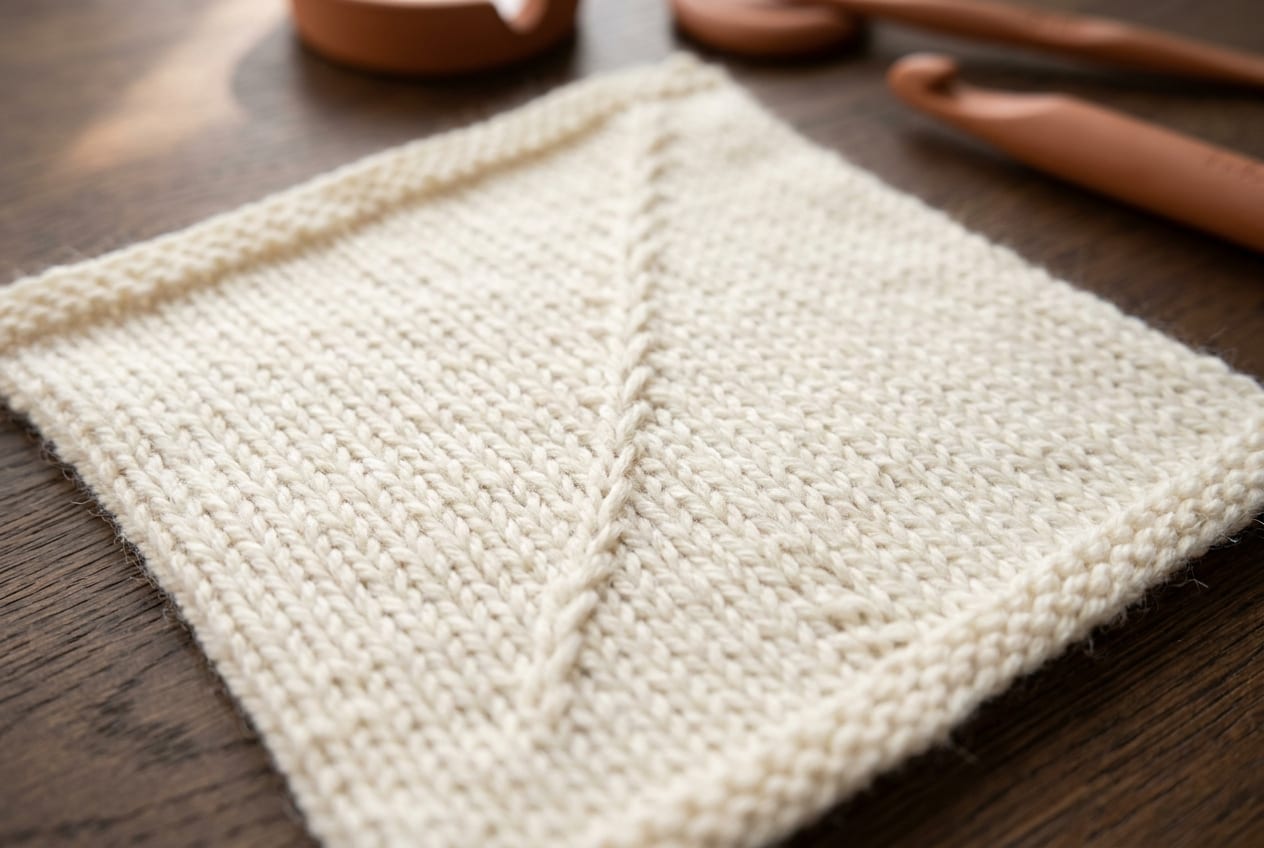
When you slip the two stitches knitwise before knitting them, you rotate each stitch so its legs sit in the opposite orientation to normal. Knitting them together through the back loops then pulls the new stitch down and to the left. With k2tog you skip the slipping entirely and just knit two stitches together through the front, which lets them lean right.
So the lean is not decoration. It is a direct result of how the two stitches are mounted on the needle before you work them. That is also why a sloppy SSK so often comes from slipping the stitches the wrong way, which we will fix below.
In a knitting chart the lean is built into the symbol itself. SSK is drawn as a left slant and k2tog as a right slant . The mark literally points the way the finished stitch leans, so once you can read the symbol you know which decrease the pattern wants.
SSK vs k2tog
These two are constantly used together, so it helps to see them side by side.
| Feature | SSK | k2tog | |---|---|---| | Full name | Slip, slip, knit | Knit two together | | Leans | Left | Right | | Stitch count | 2 become 1 | 2 become 1 | | Worked through | Back loops, after slipping | Front loops, no slipping | | Typical use | Left edge of a shape, left side of a raglan | Right edge of a shape, right side of a raglan |
A pattern that says "decrease at each end of the row" usually means k2tog at the start and SSK at the end, or the reverse, so the two edges mirror each other. Read the pattern to see which goes where.
Where SSK shows up in patterns
Once you start looking, SSK is everywhere shaping happens. A few places you will meet it again and again:
- Raglan sweaters. The diagonal lines from underarm to neck are built from paired decreases, with SSK on one side of each seam and k2tog on the other.
- Hat crowns. As a hat narrows toward the top, evenly spaced decreases pull it closed, and SSK keeps the lines leaning cleanly.
- Mitten and sock gussets. The shaping around a thumb or heel uses mirrored decreases so the gusset tapers smoothly.
- Lace. Many lace patterns pair an SSK with a yarn over, where the left lean is part of the design and not just shaping.
In every one of these, the value of a clean SSK is the same: the decreases line up into a smooth, deliberate line rather than a row of little bumps.
The improved SSK, once you are ready
If your standard SSK still leaves a small gap next to its k2tog partner, try the improved version. Work it exactly the same way, but slip only the first stitch knitwise and slip the second stitch purlwise. Then knit the two together through the back loops as usual. That small change seats the second stitch more tightly and closes most of the gap. Learn the standard SSK first so the motion is automatic, then reach for the improved version when you want a crisper edge on a finished garment.
Three common SSK mistakes
Slipping purlwise instead of knitwise
This is the big one. If you slip the stitches purlwise (inserting the needle as if to purl) the stitches end up twisted and the decrease looks bumpy and tight. Slip both stitches knitwise unless your pattern specifically says otherwise.
A loose, gappy SSK
The first stitch of an SSK often comes out larger than its k2tog partner, leaving a small gap. Snug the working yarn after the decrease, and give the left-leaning column a gentle tug when you block the finished piece. Some knitters slip only the first stitch knitwise and the second stitch purlwise (an "improved SSK") to tighten it, but learn the standard version first.
Losing track on the edges
Mixing up which side gets SSK and which gets k2tog turns a clean mirrored shape into a confusing one. Put a removable marker at each decrease edge for the first few rows until the pattern of left-lean and right-lean is obvious in the fabric.
Frequently asked questions
What does SSK mean in knitting?
SSK stands for slip, slip, knit. It is a decrease that turns two stitches into one. You slip two stitches knitwise, then knit them together through their back loops, which makes the finished stitch lean to the left on the right side of the fabric.
What is the difference between SSK and k2tog?
Both decrease two stitches into one. SSK leans to the left and is worked by slipping two stitches then knitting them through the back loops. K2tog leans to the right and is worked by knitting two stitches together through the front loops with no slipping. Patterns pair them to mirror shaping on opposite edges.
Why does my SSK look loose or messy?
The usual cause is slipping the stitches purlwise instead of knitwise, which twists them. Slip both knitwise. A small gap is also normal, so snug the yarn after the decrease and even it out when you block the finished piece.
Is SSK the same as slip slip knit?
Yes. SSK is simply the abbreviation for slip slip knit. The two terms are interchangeable in patterns and tutorials.
What is the purl-side version of SSK?
It is called SSP, or slip slip purl. SSP is the left-leaning decrease worked on a purl row, and it pairs with SSK so a left-leaning column stays consistent whether the row is knit or purl. See our slip slip purl tutorial for the steps.
Pinterest pin headlines (internal reference, strip before publish)
- A: "SSK Knitting: The Clean Left-Leaning Decrease"
- B: "SSK vs K2tog: Which Way Does It Lean?"
- C: "Fix Your Messy SSK in One Step"