
The increases that mirror each other
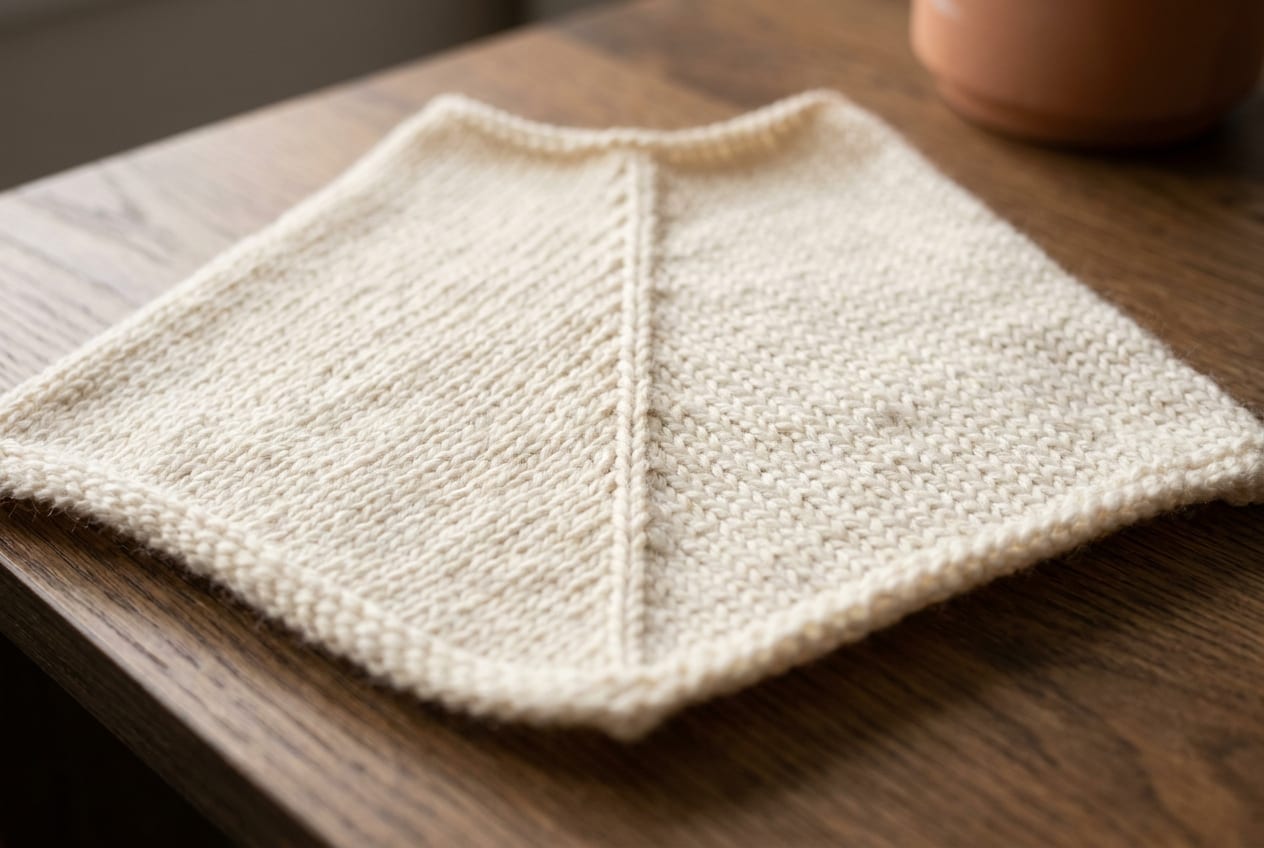
When a pattern needs to get wider, it adds stitches. The cleanest way to add a single stitch in the middle of a row is the make one increase, written M1. It comes in two flavours: M1L leans left, M1R leans right. They are the increase partners to the SSK and k2tog decreases, and just like those, you use them in mirrored pairs so the shaping on both edges matches.
The make one increase has one more trick: worked correctly, it leaves no hole. You lift the little horizontal strand between two stitches and twist it as you knit it, which closes the gap. This guide covers both M1L and M1R step by step, why the twist matters, and which one to use where.
New to knitting? Begin with our calm introduction to knitting. If you already know how to shape inward, these increases are the outward mirror of the SSK decrease.
Find the bar first
Both versions work into the horizontal strand of yarn that runs between the stitch you just knit and the next stitch on the left needle. Spread the two stitches apart and you will see it, a small ladder rung of yarn. That strand is what you lift and knit. Because it was not a stitch before, knitting it adds one to your count.
How to work M1L (left-leaning)
- With the left needle tip, lift the bar between the two stitches by inserting the needle under it from front to back.
- The strand now sits on the left needle.
- Knit that lifted strand through the back loop. Going through the back loop is what twists the strand and closes the hole.
- Slip it off. You have made one new stitch that leans gently to the left.
How to work M1R (right-leaning)
- With the left needle tip, lift the bar between the two stitches by inserting the needle under it from back to front. This is the opposite direction to M1L.
- The strand now sits on the left needle, mounted the other way.
- Knit that lifted strand through the front loop. The opposite mount plus the front-loop knit twists it the other way and closes the hole.
- Slip it off. You have made one new stitch that leans gently to the right.
The whole difference between the two is the direction you scoop the bar and which loop you knit. Front-to-back then knit through the back is M1L. Back-to-front then knit through the front is M1R.
Why the twist matters
If you knit the lifted strand without twisting it (straight through, the way you would knit a normal stitch), you get a small eyelet hole where the strand stretches open. That is fine if you want a decorative hole, but for invisible shaping you twist the strand by knitting through the opposite loop. The twist takes up the slack and the increase blends in. A forgotten twist is the number one reason a make one leaves a gap.
Make one versus knit front and back
The make one is not the only single increase. The other common one is knit front and back, written kfb, where you knit into the same stitch twice before sliding it off. Kfb is easier and faster, which makes it friendly for beginners, but it leaves a small visible bar that looks like a tiny purl bump at the base of the new stitch.
That bar is fine in garter or casual pieces and distracting in smooth stockinette. The make one takes a moment longer but disappears into the fabric, which is why patterns that care about a clean right side ask for M1L and M1R. Learn kfb for speed and the make one for polish, then choose based on where the increase will show.
When to use M1L and M1R
Use them anywhere a pattern shapes outward and you want the increases to mirror:
- Sleeves knit from the cuff up, with an increase at each end of an increase row.
- Top-down yokes and raglans, where increases fan out from the neckline.
- Mitten and sock gussets, paired with decreases for smooth tapering.
- Shawls, where mirrored increases shape the wings.
A pattern that says "M1L, knit to last stitch, M1R" is asking you to lean the two new stitches toward the center, so the shaping looks symmetrical. Read which one the pattern wants on each side.
Frequently asked questions
What does M1 mean in knitting?
M1 means make one, a way to add a single stitch by lifting the horizontal strand between two stitches and knitting into it. Because that strand was not a stitch before, working it increases your count by one. M1L leans left and M1R leans right.
What is the difference between M1L and M1R?
Both add one stitch invisibly. M1L lifts the bar from front to back and is knit through the back loop, leaning left. M1R lifts the bar from back to front and is knit through the front loop, leaning right. They are used in mirrored pairs so shaping looks symmetrical.
Why does my make one increase leave a hole?
The strand was not twisted. When you knit the lifted bar straight, it stretches into an eyelet. Knit it through the opposite loop, the back loop for M1L and the front loop for M1R, so the strand twists and closes the gap.
Are M1L and M1R the opposite of SSK and k2tog?
In effect, yes. M1L and M1R are mirrored single increases, while SSK and k2tog are mirrored single decreases. Patterns use the increases to widen and the decreases to narrow, pairing left-leaning and right-leaning versions on opposite edges.
Which increase is the most invisible?
The twisted make one (M1L and M1R) is among the most invisible single increases because it adds a stitch from the strand between stitches rather than from an existing stitch. A knit front and back increase is easier but leaves a small visible bar.
Pinterest pin headlines (internal reference, strip before publish)
- A: "M1L vs M1R: The Mirrored Make One Increases"
- B: "Make One Without Leaving a Hole"
- C: "The Invisible Increase, Both Directions"