Granny square patterns, sorted by type and by project
One good granny square is worth hundreds of projects. That is the quiet trick behind the whole format. A granny square pattern is short, often a single page, and once you can work it you can repeat it into a blanket, a bag, a cardigan, or a cushion without learning anything new. The square is the unit. The project is just how many you make and how you join them.
So this guide treats granny square patterns the way they actually work. First, the main types of square and what each one looks like, because the center and the fill are where they differ. Then the projects a square turns into, how to read a granny pattern without getting tripped by the notation, and where to find free granny square patterns that are worth your evening. A short vetting list closes it out.
If the square itself is new to you, start with how to crochet a granny square. It walks through the classic version stitch by stitch, and after that every pattern below reads cleanly.
The main types of granny square
Every granny square is the same idea worked a different way. You build outward from the center in rounds, and the center plus the fill stitch is what gives each type its character. Here are the six you will meet most, each with where to go next on CrochetZen.
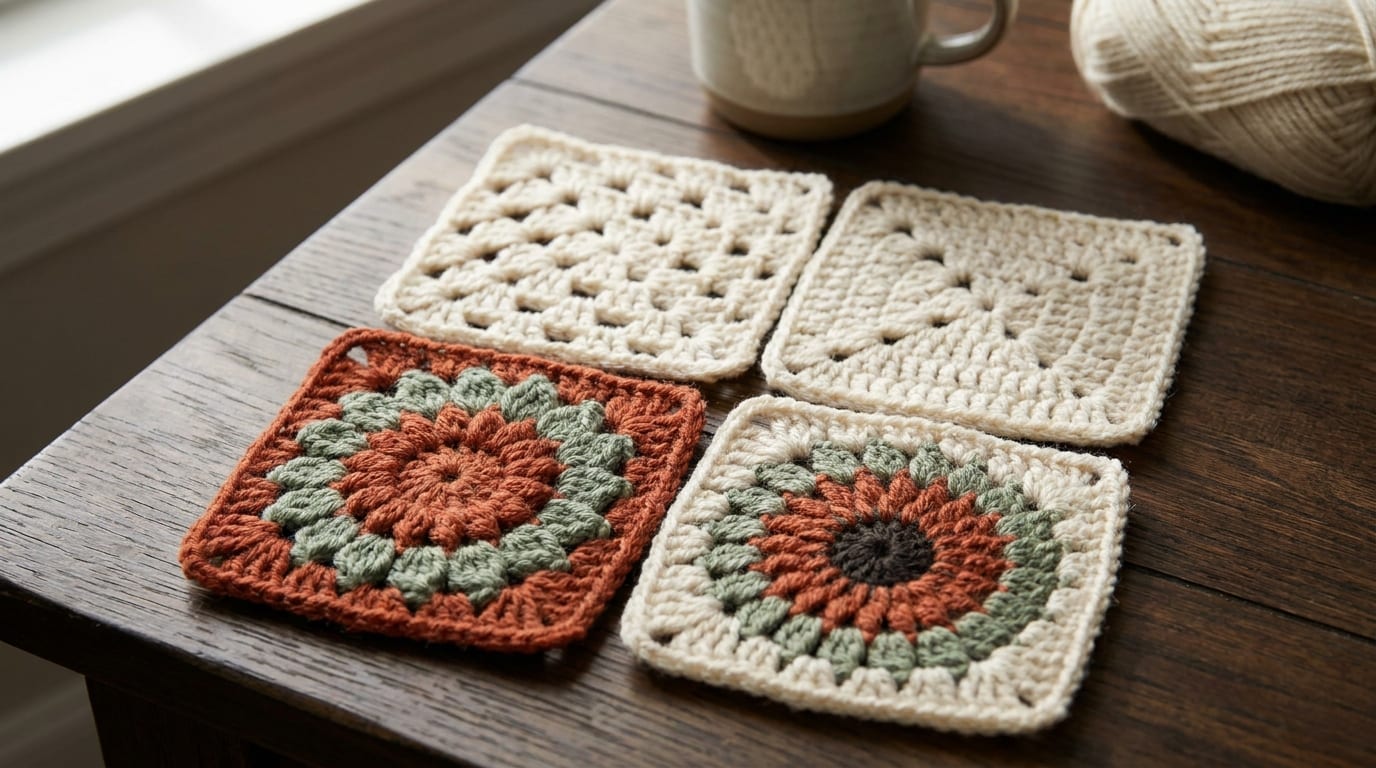
Classic granny square
The original. You work clusters of three double crochet (US dc, UK treble)
separated by chain spaces, with a larger chain space at each of the four corners.
The gaps between clusters make it lacy and open, which is why it grows so fast
and uses less yarn than a solid motif. This is the square everyone learns first,
and the
how to crochet a granny square tutorial
covers it round by round. It is free, it is simple, and you can make one from
that tutorial without buying a pattern at all.
Solid granny square
The same square shape with the gaps closed. Instead of clusters with spaces between them, you work the stitches right next to each other so the fabric comes out dense and smooth, with only the corner spaces left open. A solid square uses more yarn and gives a warmer, sturdier fabric, which makes it a favorite for blankets meant to be sat under. See the solid granny square sub-hub for the variations.
Flower granny square
A raised flower sits at the center, usually a popcorn or a puff stitch worked into a ring to make petals that stand off the surface. The rounds after the flower square off the shape so it still joins like any other granny. It adds a bit of texture and a clear focal point, and it teaches you popcorn or puff stitches in a small, low-stakes piece. The flower granny square sub-hub collects them.
Sunburst granny square
A radiating center that reads like rays spreading from the middle, often worked in a gradient of two or three colors so the burst glows outward before the square fills in around it. The sunburst is where color order does the heavy lifting, so these patterns lean on a clear round-by-round color list. The sunburst granny square sub-hub has the options.
Hexagon granny
A six-sided motif worked on the same principle, clusters and corner spaces, but with six corners instead of four. Hexagons tessellate, which means they tile together with no gaps, so they make a striking blanket or wrap once joined. They take a moment longer to learn because of the extra corners, but the rhythm is the same. The hexagon granny square sub-hub shows how they fit together.
Heart granny square
A heart set into the center of the square, shaped with a mix of stitch heights so the lobes and point read clearly, then squared off in the outer rounds. These are popular for gifts, baby blankets, and anything that wants a soft touch. They sit a notch above the classic square because of the shaping inside, but a well written pattern walks you through it. See the heart granny square sub-hub.
Granny square patterns by project
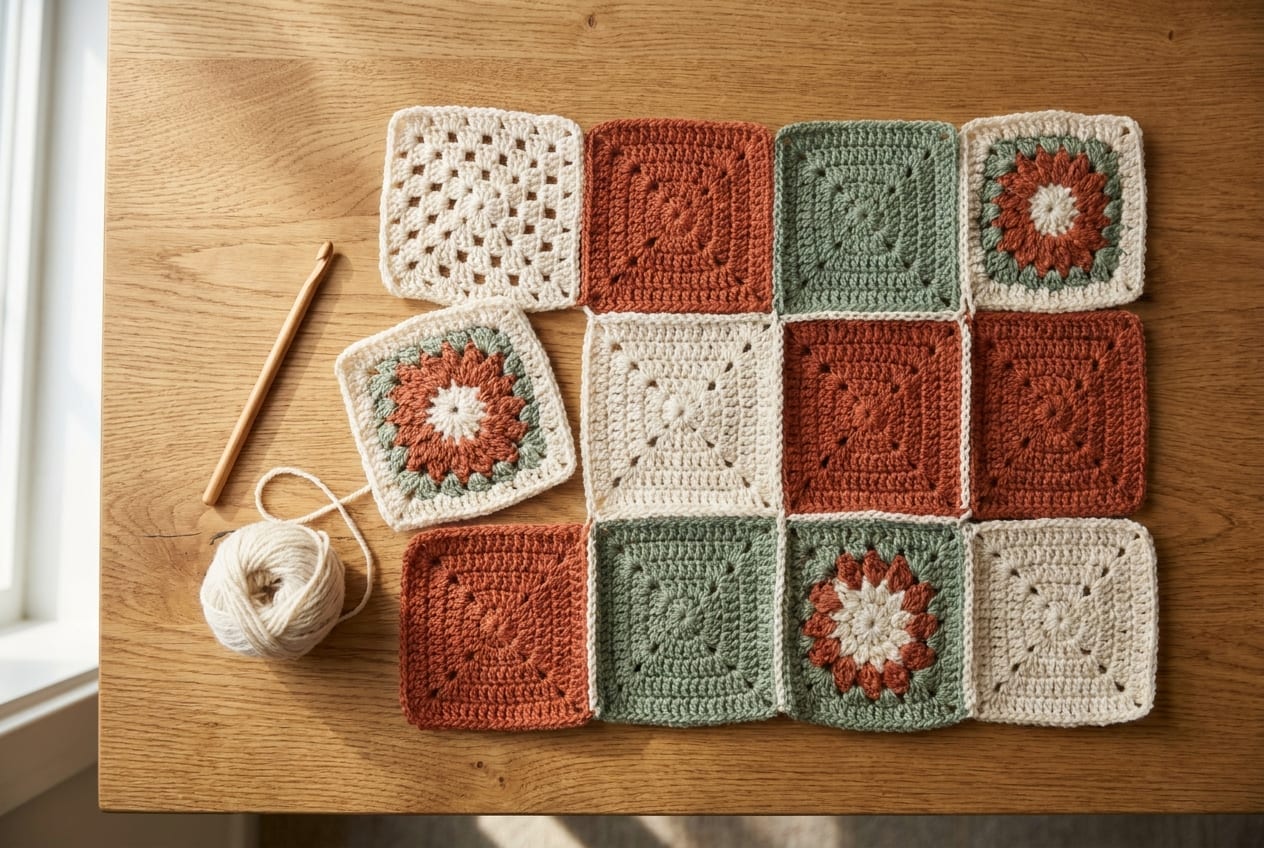
Once you can make a square, the pattern you reach for next is really a joining and quantity plan. Here is what the same square turns into, roughly in order of how often people make each one.
- Blankets. The classic use, and the reason most people learn the square at all. A blanket is the simplest project of all because there is no shaping, just squares joined into a grid and an edging around the outside. The granny square blanket guide covers sizes, how many squares you need, and the joining methods.
- Bags and purses. Two squares, or a strip of them, seamed into a pouch with a handle. The open classic square gives a relaxed market-bag look, the solid square gives a structured one. A small, fast project that shows off a single pretty motif.
- Cardigans and vests. Make a stack of squares, lay them out into a garment shape, and join. There is almost no shaping, which is why a granny square cardigan is many people's first wearable. You can carry one square in your bag and work it anywhere.
- Tops. Lighter garments worked in cotton or a fine blend, often just a few large squares joined at the shoulders and sides. The mesh of a classic square breathes well, which suits warm weather.
- Scarves and wraps. A single column of squares, or a strip of hexagons, makes a scarf with no edges to keep straight. A gentle way to practice joining before you commit to a whole blanket.
- Cushions. Two squares the size of a cushion insert, joined around the edge with a closure on one side. A quick way to turn one square you love into something for the sofa.
How to read a granny square pattern
A granny pattern looks dense the first time, but it is only ever telling you four things: which terms it uses, what to work each round, where the corners go, and which color comes next. Read it in that order and it untangles fast.
US or UK terms. This is the first thing to check, because the same word means
a different stitch in each system. A US double crochet (dc) is a UK treble
crochet (tr), and a US single crochet (sc) is a UK double crochet (dc). A
classic granny built from US double crochet clusters would read as treble
clusters in a UK pattern, even though your hands do exactly the same thing. A good
pattern states which notation it follows at the top. If it does not, look at the
photo and the stitch heights to work out which one it means.
The round notation. Granny squares are worked in rounds, not rows, and the pattern numbers them Round 1, Round 2, and so on, usually with a stitch count at the end of each. That count is your safety net. If the pattern says a round should finish with a set number of clusters or stitches and yours does not match, you caught the error on the round you made it rather than four rounds later.
The chain-space and corner notation. Granny squares are built on chain spaces,
the small gaps you make with a chain or two between clusters, and a bigger space
at each corner. Patterns write these in shorthand, often as ch-1 sp or ch-2 sp for a space, and they tell you to work your next cluster into that space
rather than into a stitch. The corner is just a larger space, frequently (3 dc, ch 2, 3 dc) worked into one corner gap, which is what turns the corner and keeps
the square flat. Once you see that pattern repeat, every round is the same move.
The color list. Multicolor squares name a color for each round, sometimes as letters like A, B, and C set against a key at the top. A sunburst or a flower square leans on this list, so read the whole color order before you start and lay your yarn out in sequence.
Vet a granny pattern the same way you would vet any pattern. It should state its terms, show clear photos from a useful angle, give a stitch count per round, and ideally carry reviews or comments from people who actually made it. The wider free crochet patterns roundup uses the same check for blankets, hats, and garments, so the habit carries across everything you make.
Where to find free granny square patterns
A square you like is the easy half. Here is where a clean, well written free granny square pattern actually lives, roughly in order of how reliable the writing tends to be.
- Large pattern databases with a free filter. Big catalogs let you tick "free" and search "granny square" in a click or two. Ravelry is the one most people know, and its filters are the fastest way to see hundreds of free options at once and sort by what other makers rated highly.
- Yarn-brand sites. Yarn companies publish free granny square patterns formatted for their own yarns, which takes the guesswork out of substitution because the weight and yardage already match what you can buy. Handy when you want a finished size you can trust.
- Independent designer blogs. Often the highest quality of the lot. A designer writing on their own site usually includes step photos, a clear stitch count each round, and notes on the parts that trip people up. Search the square type plus "free crochet granny square pattern" and click through to the designer's own page.
- YouTube. The friendliest route if you would rather watch a square grow than read it. You can pause, rewind, and match your hands to the screen. Slower than reading a one-page pattern once you are comfortable, but excellent while a new center is still unfamiliar.
- Pattern apps and libraries. These gather free patterns and keep them in one tidy place, so you are not re-hunting for a file you liked last month.
A word on Pinterest. It is wonderful for discovery and useless as a source. Almost every pin links back to a designer's site, so treat it as a search tool and always click through to the original, because the pinned image often has little to do with the pattern behind it.
And the honest note worth repeating: the classic granny square is free and simple enough that you do not need a paid pattern at all. The how to crochet a granny square tutorial gives you the whole thing for nothing, and from that one square you can reach the granny square blanket and most of the projects above.
A quick checklist before you start a granny pattern
Run this short check before the hook touches the yarn. It takes a minute and saves the evening.
- Terms stated. US or UK, named at the top. If a free pattern skips this, work it out from the photo before you start.
- A stitch count per round. The single most useful line in a granny pattern. It lets you catch a miscount on the round you made it.
- Corner placement that is clear. You should be able to see exactly what goes into each corner space. That is what keeps the square flat and square.
- A color order you can lay out. For anything multicolor, read the whole sequence first and set your yarn in order.
- A finished size at a stated gauge. This is what lets you plan how many squares a blanket or bag will need.
- Photos and reviews. More than one angle, and a few comments from people who made it. They are an unofficial errata page.
If a pattern is missing two or more of these, the project is not doomed, you will just be filling the gaps as you go. That is fine for one quick square and frustrating for a hundred. For the full picture of every square type and project, the granny square hub gathers them in one place.
Frequently asked questions
What is a granny square pattern?
It is a short set of instructions for one crocheted motif worked in rounds from the center out. It gives the stitch count for each round, where the corners go, and the color order. Because squares join together, one good granny square pattern becomes hundreds of different projects.
Where can I find free granny square patterns?
Large databases like Ravelry let you filter by free and search granny square in a click. Yarn-brand sites publish free patterns matched to their yarns, independent designer blogs are often the highest quality, and YouTube suits anyone who prefers to watch. Use Pinterest only to discover, then click through to the source.
What is the easiest granny square pattern for a beginner?
The classic granny square is the easiest by far. It is just clusters of three double crochet (UK treble) with chain spaces between them and a bigger space at each corner. It uses one repeated move, grows quickly, and is free to learn from a tutorial, so it needs no paid pattern.
What is the difference between a classic and a solid granny square?
A classic granny square has chain-space gaps between the clusters, which makes it lacy and open and uses less yarn. A solid granny square closes those gaps so the stitches sit side by side, giving a dense, warmer fabric. Both are the same shape and join the same way.
Why are some granny square patterns labeled US and others UK?
American and British crochet name the same stitches differently. A US double crochet equals a UK treble, and a US single crochet equals a UK double crochet. A classic granny uses US double crochet, which a UK pattern calls treble. Read the terms note at the top before you begin.
How many granny squares do I need for a blanket?
It depends on the square size and the blanket size you want. A common throw uses squares of about six inches across, so a lap blanket might take 35 to 48 and a larger one more. Work one square first, measure it, then divide your target dimensions by that size to plan.