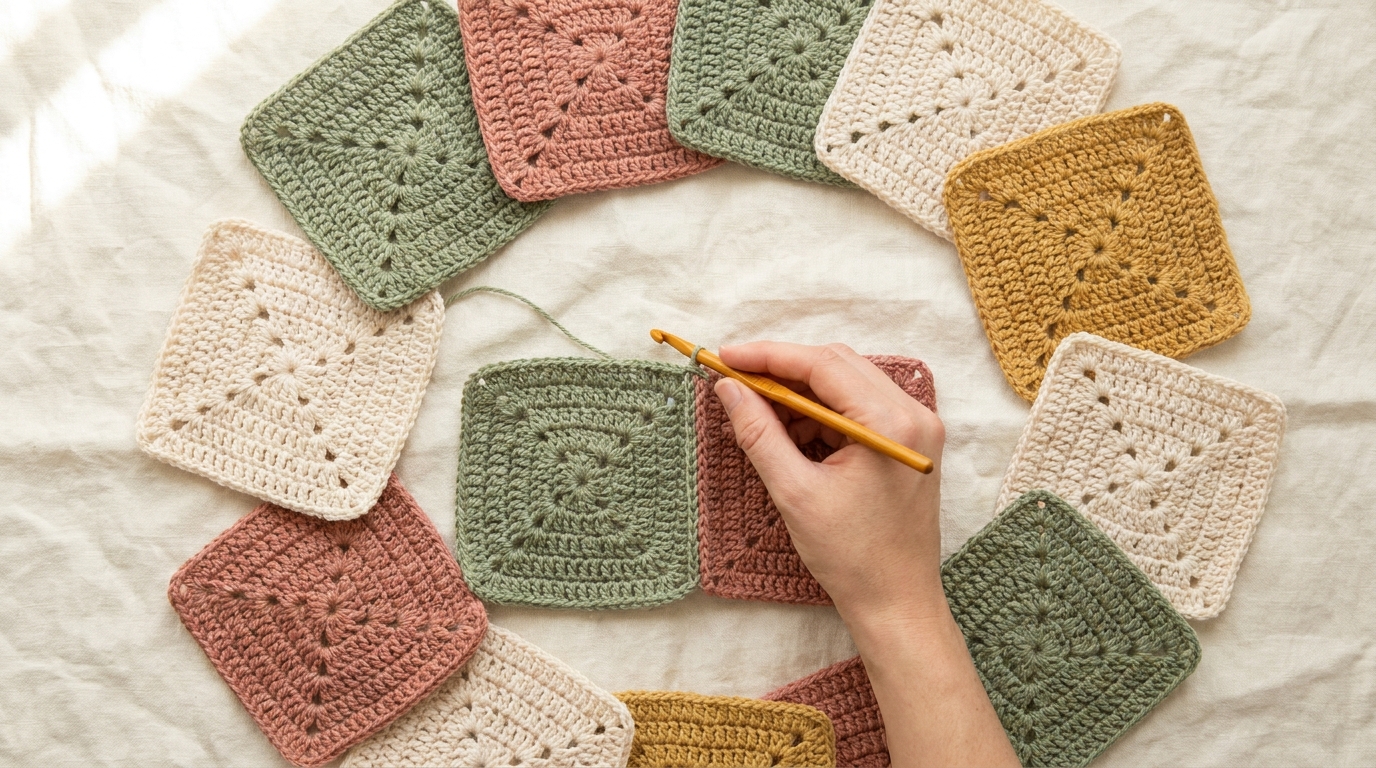
Why joining matters as much as making
You can crochet a hundred perfect granny squares and still end up with a blanket that buckles, pulls, or has seams that overshadow the squares themselves. The joining method is not an afterthought. It affects how the finished piece lies flat, how it drapes, how it wears, and how much of your joining work is visible from the front.
The good news is that a few reliable methods cover most situations. You do not need to know all of them. Knowing two or three well, and understanding when each one is the right choice, is enough to handle almost any granny square project.
This post covers five joining methods from fastest to most refined, with notes on when each one works best. At the end there is a section on layout planning, which is worth reading before you start joining anything.
Before you join: block your squares
Blocking before joining is one of the most useful things you can do. Granny squares often come off the hook slightly different sizes, with corners that curl or edges that ruffle. Blocking relaxes the fiber and sets the final shape.
Wet blocking is the most effective method for wool and cotton. Soak the squares in cool water, press out the water gently without wringing, then pin each square to a foam blocking board or folded towel. Use rust-proof pins to stretch the corners out to the correct size. Let them dry fully before removing the pins.
If all your squares end up the same size and shape after blocking, your seams will line up and your finished blanket will lie flat.
Method 1: Flat slip stitch join
The flat slip stitch join is the most common method for granny square blankets because it is fast, clean, and produces a nearly invisible seam on the right side.
How to do it:
- Hold two squares with right sides facing each other (wrong sides facing out).
- Insert your hook through the corner chain space of both squares at once.
- Join your yarn with a slip stitch.
- Chain 1. Insert hook through the next pair of stitches or chain spaces on both edges simultaneously.
- Slip stitch through both layers. Repeat across the entire edge.
- At the corner, slip stitch through both corner ch-2 spaces.
- Fasten off and weave in the end.
When you open the squares out flat, the seam sits on the back as a slightly raised ridge. From the front, the joining line is almost invisible if your yarn and tension are consistent.
Best for: blankets where you want a clean front face, any project where the seam should recede.
Drawback: working through two layers at once requires firm stitches that are not too tight. If your squares are worked tightly, this join can be fiddly.
Method 2: Flat single crochet join
The flat single crochet join creates a raised seam on the right side. This can be a design feature when worked in a contrasting color, giving the blanket a graphic grid. In the same color it is slightly more prominent than the slip stitch join but still tidy.
How to do it:
- Hold two squares with right sides facing each other.
- Insert your hook through both corner ch-2 spaces.
- Join yarn and sc through both layers.
- Continue sc across the full edge, working through corresponding stitches and chain spaces on both squares simultaneously.
- At the end, fasten off and weave in.
The sc creates a slightly thicker seam than the slip stitch. It also uses a little more yarn.
Best for: blankets where you want the joining line to be decorative, color-blocked granny projects with a contrasting grid.
Drawback: the raised ridge on the front is visible even in matching colors. If you want the seams to disappear, use the slip stitch join instead.
Method 3: Join-as-you-go (JAYG)
Join-as-you-go eliminates most of the seaming work by attaching each square to its neighbors during the final round of crocheting that square. You do not finish all your squares first. You add squares one at a time and attach them as you go.
How to do it:
Work the final round of your new square normally until you reach the edge that will be joined to an existing square.
Instead of working a ch-2 corner into free air, work a ch-1, slip stitch into the corresponding corner ch-2 space of the neighboring square, then ch-1 to complete the corner.
Along each joining edge, instead of ch-1 between dc clusters, work a sl st into the corresponding chain space of the neighboring square.
Continue the final round of your new square, attaching it to the neighbor at every corner and chain space along the shared edge.
For squares that share two sides with already-finished squares (inner positions in a grid), you handle two joins in the same final round.
Best for: large blankets where the prospect of seaming hundreds of squares after the fact is daunting. JAYG builds the layout as you go.
Drawback: requires you to commit to a layout before you start the second square. Changes mid-project are harder than with post-finishing methods.
Method 4: Whip stitch
The whip stitch is a hand-sewing technique done with a yarn needle rather than a hook. It creates a simple overcast seam on the back.
How to do it:
- Thread a yarn needle with a length of yarn in your joining color.
- Hold two squares with right sides facing.
- Push the needle through the back loops of corresponding stitches on both edges and pull the yarn through.
- Work over the top of the edge and through the next pair of stitches, continuing across.
- Fasten off and weave in the tail.
The whip stitch is flexible and relatively invisible when worked in matching yarn. It is slower than hook methods because you have to re-thread the needle for each seam, but it gives you precise control over tension.
Best for: joining a small number of squares, lacy squares with open corners where hook joins are awkward, or for people who prefer needle work to hook work.
Drawback: slower than hook-based methods for large projects.
Method 5: Mattress stitch
The mattress stitch is a hand-sewing seam that works from the right side, threading the needle through the edge posts of the stitches to create an invisible vertical seam.
How to do it:
- Lay two squares right side up, edges touching.
- Thread a yarn needle with a length of matching yarn.
- Insert the needle under the horizontal bar between the first and second dc post on the left square. Pull through.
- Insert the needle under the corresponding bar on the right square. Pull through.
- Continue alternating left and right, pulling gently every few stitches to close the seam.
- Fasten off when complete.
When the tension is right, the seam becomes almost invisible because the yarn sits inside the post structure rather than on the surface.
Best for: joining squares where the seam must be completely invisible, garments where the back is visible, high-effort projects where appearance is the priority.
Drawback: the most time-intensive method and requires some practice to get the tension consistent.
How to plan your layout before joining
Layout planning is the step most people skip and later regret. Before you join a single seam, spend time arranging your squares.
Lay them all out. Use the floor if you need to. Spread every square out in the planned grid formation. If your blanket is 6 squares wide and 8 squares tall, you need 48 squares laid flat in that grid.
Distribute colors and values. Look at the overall color distribution. If all the dark squares have ended up in one corner and all the light ones in another, shuffle them around until the colors feel balanced. Step back and squint; it is easier to see value balance from a distance.
Take a photo. Once you are happy with the layout, photograph it with your phone. This reference photo lets you pick up a row, work on it at the table, and still know where each square belongs in the finished grid.
Number the squares. Use small pieces of paper or masking tape labels. Write the row and column position on each square: R1C1, R1C2, R2C1, and so on. This makes joining in order much more reliable than working from a photo alone.
Join in rows. Work across all horizontal seams first to create long rows of joined squares. Then join the rows to each other along the horizontal seams between rows. This approach keeps the piece manageable and means you are always joining a straight flat length rather than a complex multi-directional assembly.
For more on making granny squares from scratch, see the how to crochet a granny square guide. For project inspiration and planning ideas, visit the granny square blanket post.
Joining is the last long step before a finished blanket, and choosing the right method for your project makes it go smoothly. Pick one method, work a test seam on two spare squares, and verify you like the look before committing to hundreds of seams.