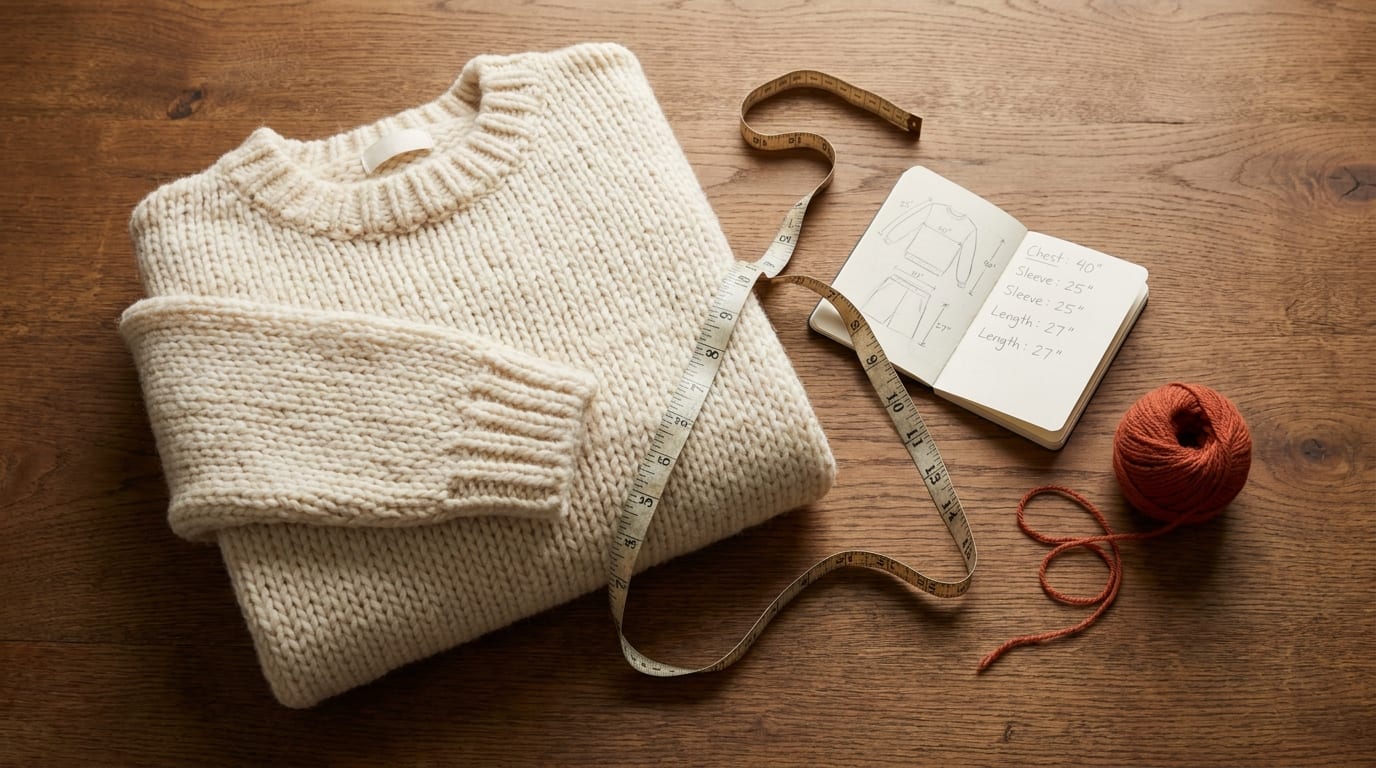
When a sweater fits everywhere except the front
You knit the size that matches your bust measurement, and the sweater still rides up at the front hem, pulls across the chest, or gapes at the neckline. This is one of the most common fit frustrations, and it is not your knitting. It is that a fuller bust needs more fabric over the front than a standard pattern grades in.
The full bust adjustment, or FBA, adds that fabric exactly where it is needed and nowhere else. Sewists have used it for decades, and the same idea works in knitting. This guide explains how to tell if you need one, the two main ways to do it in knitting, and how to estimate how much to add. It is a fitting concept more than a single stitch, so we will keep it plain and practical.
If you are still learning garment construction, our calm introduction to knitting covers the basics, and a make one increase (M1L and M1R) is the increase you will reach for when adding width. Always check your numbers against a gauge swatch first.
How to tell if you need one
A few signs point to an FBA:
- The front hem rides up higher than the back hem when you wear the sweater.
- There is horizontal pulling or strain lines across the bust.
- The neckline gapes or the armholes feel tight at the front while the shoulders fit.
- You normally need a larger size on top in ready-to-wear, or a cup size larger than a B.
A quick measurement helps. Compare your high bust (measured up under the arms, above the fullest part) with your full bust (around the fullest part). If the difference is more than about 2 inches (5 cm), a standard pattern graded to your full bust will likely be too big in the shoulders, and graded to your high bust will be too tight at the bust. The FBA lets you knit for the high bust, which fits the frame, and add room only where the bust needs it.
The two main methods in knitting
Knitting gives you two practical ways to add front fabric. Many garments use one, some use both together.
Method 1: short-row bust darts (adds length)
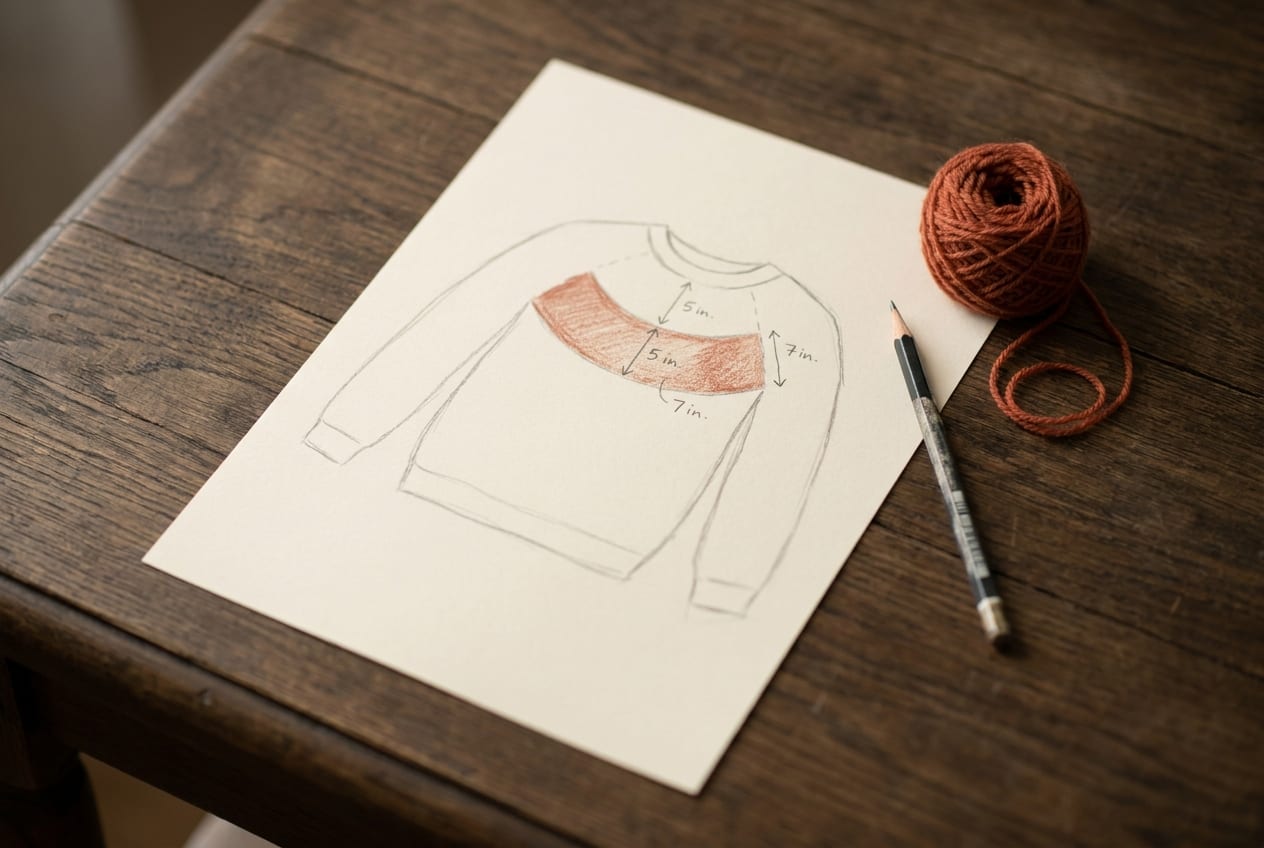
Short rows add extra rows across the front bust without adding rows to the side seams. You knit partway across, turn before the end, and work back, building up a wedge of extra fabric over the fullest part. This raises the front hem back to level and gives the bust somewhere to sit.
The basic idea:
- Knit the body to just below the fullest part of the bust.
- Work a set of short rows across the front bust stitches only, turning a few stitches in from each side so the extra fabric is centered.
- Stack two to four short-row pairs depending on how much length you need, each one a little shorter than the last so the wedge tapers.
- Resolve the turns cleanly (wrap and turn, or German short rows) so no holes show, then carry on with the body.
Short-row darts are invisible from the side and do not change your stitch count, which makes them the gentlest FBA for a top-down or seamless sweater.
Method 2: added width (adds stitches across the bust)
If the sweater also pulls sideways, you need more stitches across the front, not just more length. Here you increase a number of stitches across the bust on the front only, work the bust section at that wider count, then decrease back before the armholes so the shoulders stay the size that fits.
This is closer to the sewing FBA, where the dart adds both width and length. It takes more planning because you are changing the front stitch count independently of the back, so it suits patterns worked flat in pieces, or seamless patterns where you are comfortable tracking front and back separately.
How much to add
Start from that high bust to full bust difference. As a rough rule, every 1 inch (2.5 cm) of difference is about half an inch of extra length you want over the front bust, since the fabric drapes over a curve rather than a flat plane. So a 3 inch difference suggests roughly 1 to 1.5 inches of added front length, built from two or three short-row pairs at your row gauge.
For added width, convert the extra width you want into stitches using your gauge. If you knit at 5 stitches per inch and want 1 inch more across the front bust, that is about 5 stitches added and later removed. Always work from your own swatched gauge, not the pattern's stated gauge, because a small gauge difference changes the count.
These are starting points, not laws. Knit a generous swatch, do the math, and if you can, try the shaping on a cheap practice piece before committing to the real yarn.
Top-down versus bottom-up
The construction changes how you place the adjustment:
- Top-down seamless sweaters are the friendliest for short-row darts, because you reach the bust after the shoulders already fit and can add the wedge in place, then keep going.
- Bottom-up sweaters let you add width low and decrease it out before the armhole, which suits the added-width method.
- Pieced (seamed) patterns give you the most control, since the front is a separate piece you can fully reshape, but they ask for the most planning.
Common mistakes
- Sizing to the full bust and stopping there. That fits the bust but drowns the shoulders. Size to the high bust and adjust the bust instead.
- Adding width but not length. A fuller bust usually needs both. Width alone can still ride up at the front.
- Skipping the swatch. Every number here depends on gauge. A wrong gauge turns a careful FBA into a new fit problem.
- Forgetting to taper. Stacked short rows should each be slightly shorter so the wedge blends. A blocky dart shows.
Frequently asked questions
What is a full bust adjustment in knitting?
A full bust adjustment, or FBA, adds fabric to the front of a garment to fit a fuller bust without enlarging the shoulders or back. In knitting it is usually done with short-row bust darts that add length, added width across the bust, or a combination of both.
How do I know if I need an FBA?
Measure your high bust (under the arms) and your full bust (at the fullest point). If the difference is more than about 2 inches, standard sizing will not fit both your frame and your bust. Signs include a front hem that rides up, pulling across the chest, and a gaping neckline.
What are short-row bust darts?
Short-row bust darts add extra rows across the front bust only. You knit partway, turn before the end, and work back, building a centered wedge of fabric over the fullest part. This adds length without changing your stitch count and is invisible from the side.
How much length should an FBA add?
A rough starting point is about half an inch of extra front length for every inch of difference between your high bust and full bust, since the fabric curves over the bust. A 3 inch difference suggests roughly 1 to 1.5 inches, built from two or three short-row pairs at your row gauge.
Can I do an FBA on a top-down sweater?
Yes, and top-down seamless sweaters are among the easiest. Because you reach the bust after the shoulders already fit, you can add short-row darts in place over the fullest part and then continue down the body without reworking the upper sections.
Pinterest pin headlines (internal reference, strip before publish)
- A: "Full Bust Adjustment for Knitters, Made Plain"
- B: "Why Your Sweater Rides Up at the Front (and the Fix)"
- C: "Short-Row Bust Darts: Fit a Fuller Bust"