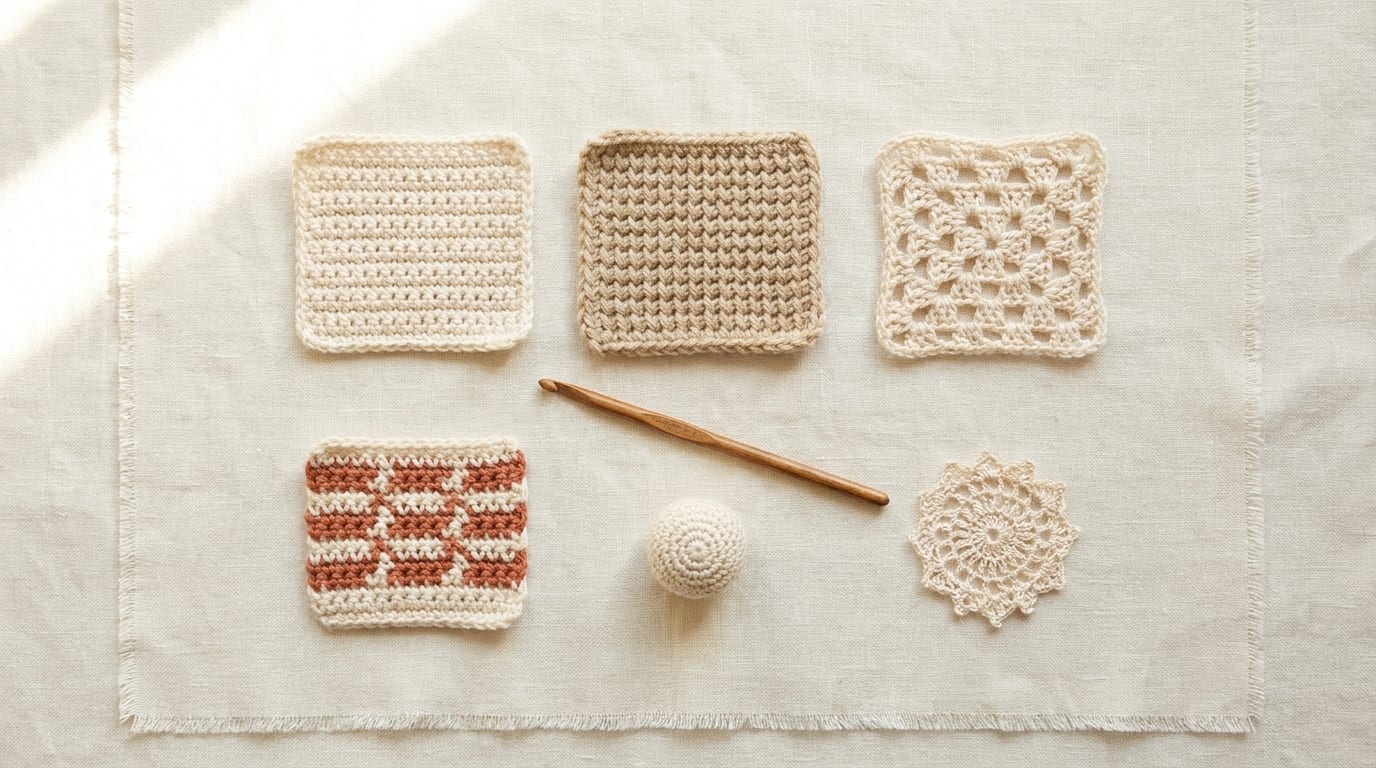
More variety than you might expect
When most people say "crochet," they mean the familiar single-hook craft with yarn. But crochet is actually a family of related techniques, each with its own tools, fabric qualities, and best-suited projects. Some look like knitting. Some look like weaving. Some look like nothing else.
You do not need to learn all of these. Knowing they exist helps you recognize what you are looking at when you browse patterns, and it opens up new directions when your current projects start to feel familiar. This guide covers eight main types, from the most beginner-friendly to the most specialized.
If you want background on where crochet comes from and how it fits into the wider craft world, our introduction to crochet is a good starting point.
1. Standard crochet
Standard crochet is what most people picture: a single short hook, a ball of yarn, and a series of looped stitches built one at a time. This is the foundation for every other type on this list.
The basic stitches, chain, slip stitch, single crochet, half double crochet, double crochet, and treble crochet, appear in almost every pattern and are the building blocks for more complex techniques. Projects range from dishcloths and scarves to blankets, garments, and home decor items.
Standard crochet is the right starting point for beginners. It uses a familiar-feeling tool, teaches muscle memory that transfers to every other crochet style, and produces satisfying results quickly. Once you can work a few basic stitches with consistent tension, you have access to thousands of patterns.
2. Tunisian crochet
Tunisian crochet uses a longer hook, either a single long hook with a stopper at the end or a hook attached to a flexible cable for wide pieces. Each row is worked in two passes: a forward pass (picking up loops from right to left until you have a row of loops on the hook) and a return pass (working those loops off from left to right).
The resulting fabric is dense, stable, and flat, with a texture that sits between woven fabric and knitting. It has a slight natural tendency to curl at the edges, which blocking corrects. Tunisian fabric is firmer than standard crochet and drapes differently.
Tunisian crochet is good for: bags, placemats, wall hangings, cozy blankets, and garments where you want a fabric that reads as more structured. It is a natural next step for someone who already knows standard crochet and wants a new challenge without learning an entirely different craft.
3. Broomstick lace
Broomstick lace, sometimes called jiffy lace, creates wide, decorative loops by pulling yarn over a large dowel or thick knitting needle before working the loops off in groups. The loops fan out in clusters that create an open, textured pattern with a distinctive petal or scallop shape.
The technique uses a standard crochet hook for working stitches and a large dowel for forming the oversized loops. Traditional patterns use a broomstick handle, which is where the name comes from. Modern crocheters typically use a large knitting needle or a thick dowel instead.
Broomstick lace is not a beginner project, but it is not complicated either. If you can single crochet and you are comfortable with the idea of working loops in groups rather than individually, you can learn it. It suits scarves, cowls, shawls, and decorative edgings well.
4. Hairpin lace
Hairpin lace is made using a U-shaped metal frame, called a hairpin loom or hairpin fork, and a standard crochet hook. You wind yarn around the two prongs of the frame while crocheting down the center, creating long strips of lacy loops joined by a central spine.
The individual strips are later joined together or edged with standard crochet to create the finished piece. The fabric is very light and open, with a delicate, almost woven appearance. It uses far less yarn than standard crochet for the same area.
Hairpin lace suits shawls, table runners, scarves, and anything where you want an airy, decorative fabric without the weight of solid crochet. It is a technique with a steep-seeming start because the loom looks unfamiliar, but the actual hand movements are simple once you understand the wrapping motion.
5. Filet crochet
Filet crochet builds pictures and text on a grid of open and filled squares, all worked in chains and double crochet stitches. An open square is a double crochet followed by two chain stitches. A filled square replaces those chain stitches with two additional double crochets. By plotting which squares are open and which are filled, you create images, borders, letters, and geometric repeats.
Traditional filet crochet uses very fine thread on a small steel hook and produces lacy curtain panels, table runners, and decorative edgings. Modern filet uses thicker yarn for a bolder, faster-working version. Both use the same two squares.
Filet crochet is accessible to anyone comfortable with double crochet. Reading the chart accurately is the main skill to develop. For a full guide with chart-reading instructions, see our filet crochet guide.
6. Tapestry crochet
Tapestry crochet works colorwork patterns by carrying multiple yarn colors simultaneously. While one color is being worked, the other colors are carried inside the stitches, crocheted over but not cut. This keeps the back of the fabric neat and avoids the yarn tails and weaving-in that comes with carrying colors across rows in other ways.
The technique works best with single crochet stitches because they have a compact structure that hides the carried yarn well. The finished fabric is dense and sturdy, with geometric patterns, motifs, or pictures visible on the front.
Tapestry crochet suits bags, baskets, pouches, cushion covers, and wall hangings where you want colorwork with a clean finish. It requires managing two or more yarn strands at once, which takes some getting used to. It is not recommended as a first project, but it is manageable for someone who already crochets regularly. For a step-by-step look at the technique, our tapestry crochet tutorial covers the basics.
7. Amigurumi
Amigurumi is the Japanese art of crocheting small three-dimensional stuffed figures: animals, characters, food items, and fantasy creatures. The name comes from two Japanese words meaning knitted stuffed toy.
The technique uses single crochet worked in a continuous spiral (without joining rounds) to build rounded shapes. A magic ring forms the base of each piece, allowing you to start a circle from the center without a hole. The tight single crochet fabric, worked with a hook slightly smaller than the yarn label suggests, creates a dense fabric that holds stuffing without gaps showing through.
Amigurumi is one of the friendliest advanced-beginner projects in crochet. Each individual piece (head, body, limb) is small, which means you see results quickly. Mistakes in one piece are easy to pull back and redo. And the projects are genuinely charming, which makes practicing tension feel worthwhile.
If you want to learn more, our guide to what amigurumi is covers the supplies, basic shapes, and first projects in detail.
8. Micro crochet
Micro crochet is standard crochet worked at an extremely small scale using fine crochet thread (often size 80, which is very thin) and tiny steel hooks (usually 0.4 mm to 0.75 mm). The stitches are the same as standard crochet; the difference is purely in scale.
The results are miniature: tiny flowers a centimeter across, lace edgings finer than fabric ribbon, earrings made from thread, and decorative motifs small enough to fit on a fingernail. The technique requires good eyesight or magnification, a steady hand, and patience for very slow progress.
Micro crochet is not for beginners. It demands precise tension control and the ability to see and count very small stitches. But it is accessible to any experienced crocheter who is willing to slow down and work with fine materials. The projects it produces are unlike anything achievable at standard scale.
Choosing where to start
If you have never crocheted before, start with standard crochet. Everything else on this list builds on the same foundation, and the skills you develop with a standard hook and worsted-weight yarn transfer directly to every other technique.
Once you are comfortable with the basics, the type you explore next should follow what interests you most. If you love the idea of making animals and characters, amigurumi is the natural next step. If you are drawn to colorwork patterns, tapestry crochet is where to go. If lace and delicate textures appeal to you, filet or hairpin lace are worth exploring.
There is no wrong direction. The hook motion is the same; only the tools and scale change.