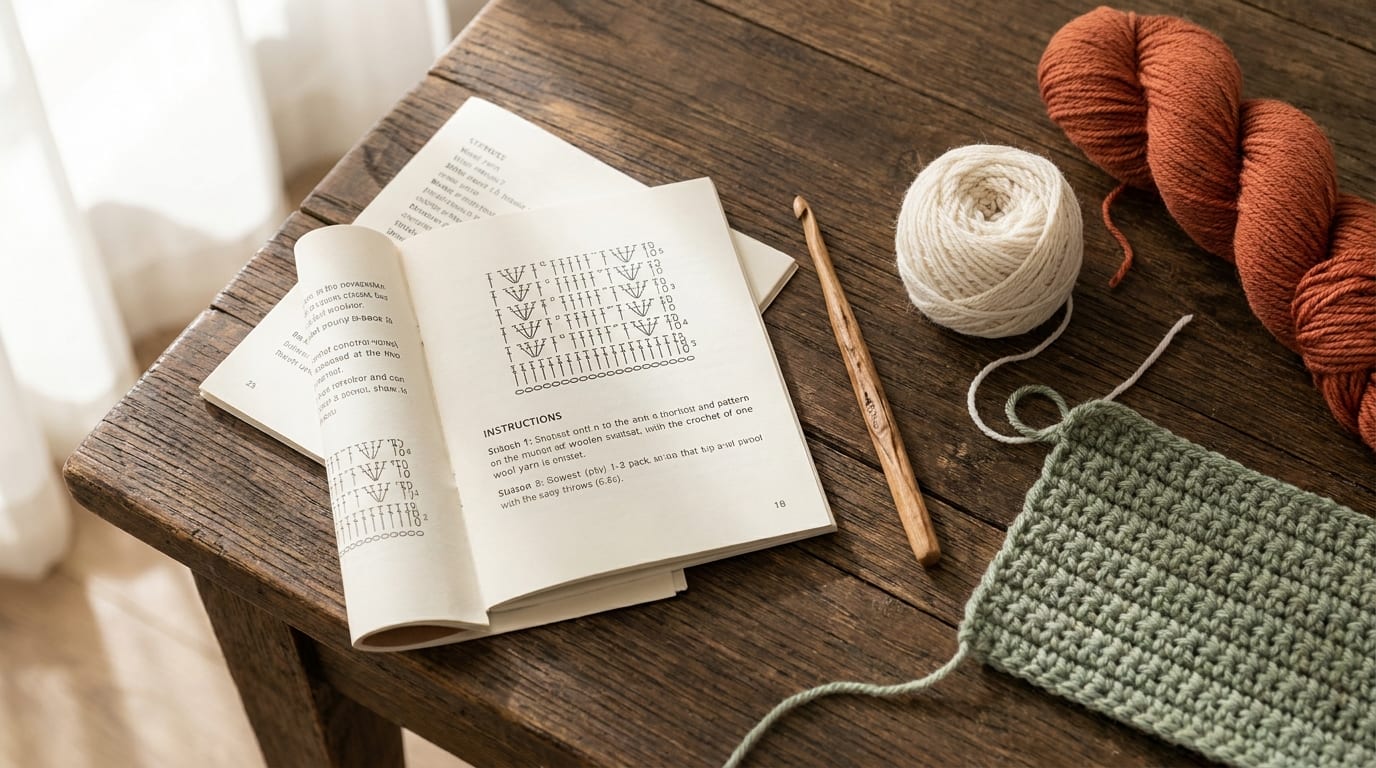
What a crochet pattern is, and the three formats
A crochet pattern is a set of instructions for turning yarn into a specific object. It tells you which yarn and hook to use, how many stitches to make, where to increase or decrease, and the order to work everything in. Crochet patterns come in three formats, and most of the confusion beginners feel comes from not knowing which format they are holding. Once you can recognize a written pattern, a charted pattern, and a video pattern on sight, the rest is just vocabulary.
This guide walks through all three. You will learn how to read a written pattern line by line, how stitch counts and the gauge section protect you from disaster, the difference between US and UK terms, how the four skill levels actually map to projects, and where to find clean patterns for free and for a fair price. If you are brand new to the craft, start with our introduction to crochet first, then come back here.
We will keep it calm. A pattern is a recipe, not a test.
Written patterns
A written pattern is the most common format and the one you will meet first. It spells out every row or round in abbreviations: ch for chain, sc for single crochet, dc for double crochet, and so on. The instructions read top to bottom, row by row, and a good one gives you a stitch count in parentheses at the end of each line so you can check your work as you go.
Written patterns work well when a project has a lot of shaping, color changes, or special stitches that would clutter a chart. Garments, amigurumi, and anything worked in a long sequence of different rows tend to come as written instructions. The format is compact and translates well to a phone screen, which matters when you are following along with a hook in your other hand.
Charted patterns
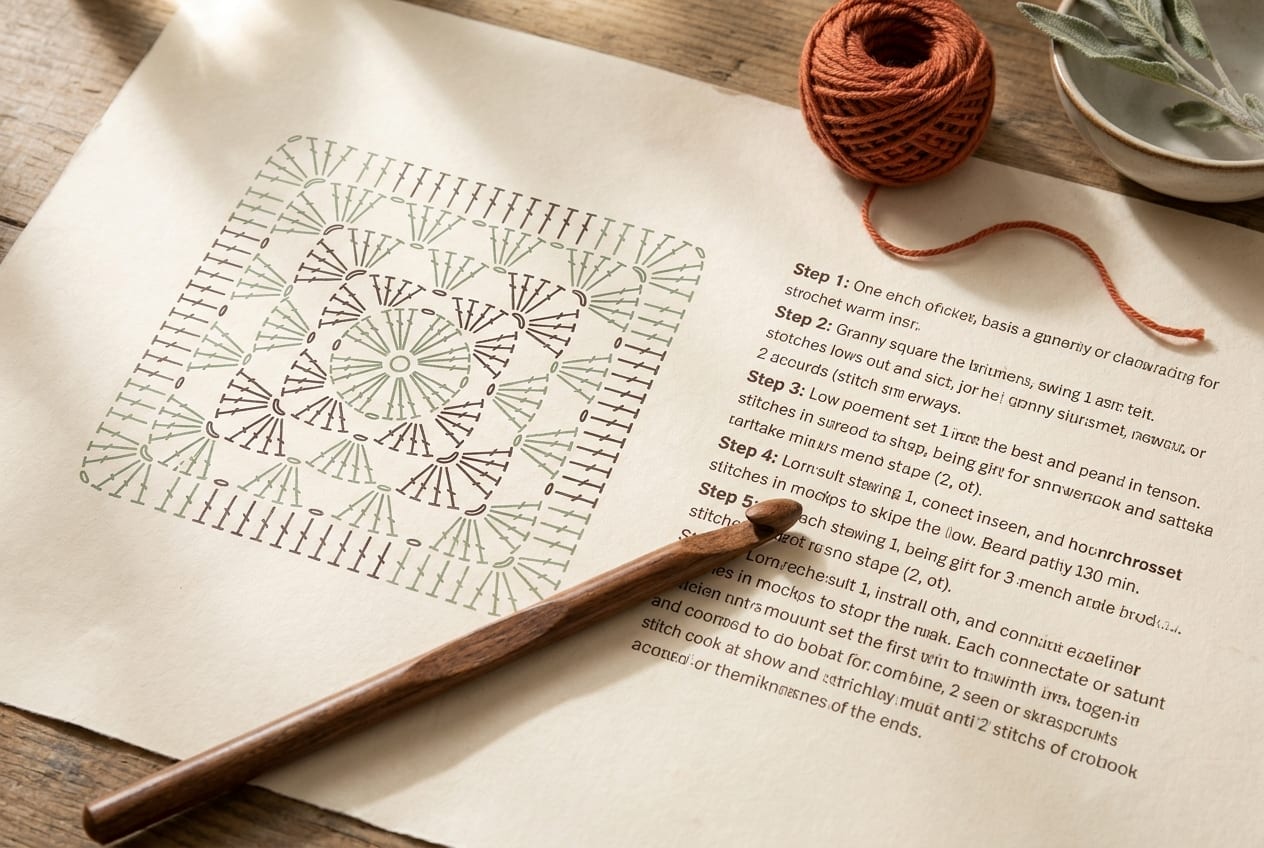
A charted pattern replaces words with symbols. A small open oval means a chain, a plus sign or short bar means a single crochet, a T with a slash means a double crochet, and so on. You read the chart visually, usually from the bottom up for rows and from the center out for rounds. The symbols sit roughly where the stitches go, so the chart looks a little like the finished fabric.
Charts shine for anything with a strong visual structure: granny squares, mandalas, lace, and colorwork. Once you learn the symbols, a chart is faster to scan than a paragraph, and it crosses language barriers because the symbols are largely standardized worldwide. Many patterns include both a chart and written instructions so you can use whichever your brain prefers.
Video patterns
A video pattern is someone demonstrating the project stitch by stitch, usually on YouTube. There is no reading involved. You watch, pause, and copy the hands on screen. For absolute beginners, or for one tricky technique buried in an otherwise simple project, video is the gentlest way in.
The trade-off is speed and reference. You cannot scan a video the way you scan a page, and finding the exact moment you need means scrubbing back and forth. Most experienced crocheters use video to learn a new stitch, then switch to a written or charted pattern to actually make the thing.
How to read a written crochet pattern
This is the part that makes people feel lost, and it should not. The language is small and consistent. Here is a typical row:
Row 4: ch 1, sc in next 3 sts, 2 sc in next st, *sc in next 2 sts, 2 sc in next st* rep from * to end. (16 sts)
In plain English: chain once to lift your yarn up to the height of the new row, single crochet into each of the next three stitches, work two single crochets into the next stitch (that is an increase), then repeat the part between the asterisks until you reach the end. The number in parentheses is how many stitches you should have when the row is done.
Two notations carry almost every pattern. Asterisks and brackets both mark a repeat. A pattern might write *dc, ch 1* 6 times, which means work that whole sequence six times in a row. Square brackets do the same job: [dc in next st, ch 1] 6 times reads identically. Designers pick one style and stick with it, so once you spot which one a pattern uses, you are set.
Stitch counts are your safety net
The little number in parentheses at the end of a row, like (16 sts), is the most useful thing in any pattern. It tells you exactly how many stitches that row should contain. Count yours against it every single row. If they match, the row is clean and you move on. If they do not, the mistake is in the row you just finished, not three rows back, so you can fix it before it compounds. Counting feels slow at first and saves hours later.
Why the gauge and materials sections matter
Beginners skim past the gauge and materials block to get to the rows. That block is the part that decides whether your finished object is the right size.
Gauge is how many stitches and rows fit into a measured square, usually 4 inches by 4 inches (10 cm by 10 cm). A pattern might say "16 dc and 9 rows = 4 inches." Before a fitted project, you work a small swatch and measure it against that number. If your swatch is bigger, your tension is loose and you go down a hook size. If it is smaller, you go up. For a scarf or a dishcloth, gauge barely matters. For a sweater, ignoring it is the single fastest way to make something that does not fit. Our gauge calculator does the arithmetic once you have a swatch in hand.
The materials section lists the exact yarn, the hook size, and any notions like a stitch marker or stuffing. The yarn named there may be discontinued or hard to find where you live, so match the weight and fiber rather than chasing the precise brand. A worsted weight wool behaves like another worsted weight wool. Our yarn weight converter lines up US, UK, and EU names so a substitution is a calm decision.
US versus UK terminology
Here is the trap that catches everyone at least once. American and British crochet use the same words for different stitches.
| US term | US abbreviation | UK equivalent | UK abbreviation | |---|---|---|---| | Single crochet | sc | Double crochet | dc | | Half double crochet | hdc | Half treble | htr | | Double crochet | dc | Treble | tr | | Treble crochet | tr | Double treble | dtr |
Read the table slowly. A US single crochet is the same physical stitch as a UK double crochet. A US double crochet is a UK treble. The names are shifted by one rung on the ladder. A pattern written in UK terms that says dc wants what an American calls single crochet, and if you work it as a US double crochet, every stitch will be the wrong height.
The fix is simple: every pattern should state which system it uses, usually right above the abbreviation key. If it does not, look at the materials and spelling for clues. British patterns often say "tension" instead of "gauge" and spell it "colour." When you are sure which system you are in, our full crochet stitches library and the searchable stitch dictionary at /stitches/ both show each stitch under both names. The Craft Yarn Council keeps the standard abbreviation and symbol charts the US industry follows, which is a useful reference to bookmark.
Crochet pattern skill levels
Most patterns carry a skill level, and matching it to your experience is the difference between a relaxing evening and a frustrated one. The labels are not official law, but the craft uses four levels consistently.
Beginner. Single stitches worked in straight rows or simple rounds, with minimal shaping and no finishing beyond weaving in ends. Dishcloths, scarves, and basic granny squares live here. If you know the chain, single crochet, and double crochet, you can make a beginner pattern.
Easy. Beginner stitches plus simple combinations, basic increases and decreases, and easy color changes. Beanies, simple shawls, and basket projects sit at this level. You are still using familiar stitches, just arranging them into shapes.
Intermediate. A mix of stitches, more involved shaping, working from a chart, lace, or colorwork that needs attention. Most garments, detailed amigurumi, and openwork patterns fall here. You are expected to read a pattern fluently and fix your own mistakes.
Advanced. Intricate construction, fine thread, complex stitch patterns, and shaping that demands close gauge control. Heirloom lace, fitted tailored garments, and elaborate motifs ask for advanced skills and patience.
The honest advice is to pick a project one notch below where your ego wants to be. A beginner who attempts an intermediate sweater usually stalls. The same beginner who makes three easy projects first walks into that sweater ready. There is no rush. The free crochet patterns roundup sorts 25 projects by exactly these levels so you can climb at your own pace.
Where to find crochet patterns
A project idea is half the job. Knowing where a clean, well written pattern actually lives is the other half. Here are the sources worth your time, free first.
Free sources
DROPS Design (Garnstudio). The largest fully free library on the web, with thousands of professionally graded patterns and photo tutorials for the techniques they use. Everything is downloadable as a printable. If you bookmark one free source, make it this one.
Ravelry, free filter. Ravelry holds the biggest pattern catalog anywhere, and a single checkbox filters it to free designs. The site had accessibility complaints after its 2020 redesign, so if it strains your eyes, keep sessions short, but the breadth and quality of the patterns are hard to match.
Yarn brand sites. Lion Brand and Yarnspirations (the home of Bernat, Caron, and Red Heart) both publish large free libraries formatted around their own yarns. Because the pattern and the yarn come from the same place, substitution math is easy, which makes these a friendly starting point.
Paid sources
Ravelry. Beyond the free filter, Ravelry is also a marketplace where independent designers sell their work, usually for a few dollars per pattern. Paid patterns more often include multiple sizes, tested gauge, and tidy printable PDFs.
Etsy. A huge selection of indie crochet patterns as instant PDF downloads. Quality varies more than on Ravelry, so read the reviews and check that the listing shows real finished-object photos, not only a styled mockup.
Indie designer sites. Many designers sell directly from their own site and release one free pattern a month to grow a newsletter. Buying direct often means the designer keeps more of the price, and you get access to their errata and support. Search the project name plus "crochet pattern" and click through to the designer rather than a roundup.
A quick word on Pinterest. It is wonderful for discovery and useless as a source. Always click through to the original site, because the pinned image frequently has nothing to do with the pattern it links to, and the real file lives with the designer. The same goes for the pattern hubs at /patterns/, which point you to vetted projects sorted by type.
How to read crochet charts
A chart looks intimidating until you learn that it is a small alphabet. Each symbol stands for one stitch, and the symbols are largely standardized across the craft. A chain is a small open oval. A slip stitch is a filled dot. A single crochet is a plus sign or a short vertical bar. A double crochet is a tall vertical line with one diagonal slash across it, and each extra slash adds one more height, so a treble carries two slashes.
You read a chart for flat rows from the bottom up, alternating direction with each row the way your hook actually travels: right to left on one row, left to right on the next. For projects worked in the round, like granny squares and mandalas, you start at the center and read outward in a spiral or in concentric rings. Because the symbols sit roughly where the stitches go, the chart ends up looking like a map of the finished fabric, which is exactly why charts feel natural once they click.
The fastest way to learn the symbols is to make them yourself. You can build a chart stitch by stitch, in your browser with no signup, using our free stitch chart maker. Drop in a few double crochets and chains, watch the symbols appear, and the alphabet stops being abstract. Designing even a small repeat teaches you to read charts faster than any amount of staring at someone else's.
How to organize and keep your crochet patterns
Once you have made a few things, a quiet problem appears. Your patterns are scattered. Some are PDFs in a downloads folder, some are bookmarked links that may break, some are screenshots, and one important one is on a printout with coffee rings. When you sit down to start a project, you spend ten minutes finding the file before you find your hook.
A little organization fixes this for good. Keep every pattern in one place rather than across a phone, a laptop, and a paper pile. Tag each one by project type and skill level so you can find "easy hat" in seconds. Note which yarn you actually used and what hook gave you gauge, because future-you will not remember. And keep your progress with the pattern itself, so a project you set down for three weeks does not become a guessing game about which row you were on.
This is the part of the craft CrochetZen was built for. It holds your pattern library in one tidy place, opens a PDF and tracks the exact row you are on, and remembers your notes per project, so picking a half-finished blanket back up is calm instead of confusing.
Frequently asked questions
What is a crochet pattern?
A crochet pattern is a set of instructions for making a specific object from yarn. It lists the yarn and hook to use, the gauge to aim for, and every row or round in order. Patterns come in three formats: written abbreviations, charted symbols, and video demonstrations.
How do I read a crochet pattern as a beginner?
Start by finding the skill level, the abbreviation key, and whether it uses US or UK terms. Then work one row at a time, treating asterisks and brackets as repeats. Count your stitches against the number in parentheses at the end of every row to catch mistakes early.
What is the difference between US and UK crochet patterns?
American and British notation use the same words for different stitches. A US single crochet equals a UK double crochet, and a US double crochet equals a UK treble. The names are shifted by one. Always check which system a pattern uses before you begin, usually stated near the abbreviation key.
Where can I find free crochet patterns?
DROPS Design offers thousands of free patterns as printable downloads. Ravelry filters its huge catalog to free designs with one checkbox. Yarn brand sites like Lion Brand and Yarnspirations publish large free libraries formatted around their own yarns, which makes substituting yarn simple.
Should I use a written pattern or a chart?
Use whichever your brain reads faster. Written patterns suit heavy shaping, color changes, and garments. Charts suit visual structures like granny squares, lace, and mandalas, and they cross language barriers. Many patterns include both, so try each and keep the one that feels clearer to you.
How do I know which skill level pattern to choose?
Match the label to your experience and pick one notch below your ambition. Beginner means simple stitches in rows. Easy adds basic shaping. Intermediate involves charts, lace, or garments. Advanced means fine thread and intricate construction. Making a few easier projects first makes harder ones go smoothly.
Pinterest pin headlines (internal reference, strip before publish)
- A: "How to Read Any Crochet Pattern, Calmly"
- B: "Crochet Patterns Explained: Written, Charted, Video"
- C: "Where to Find Free Crochet Patterns That Actually Work"