Start with what you will actually finish
The best first crochet project is one you finish. An ambitious blanket started in week one often becomes the pile-of-yarn-in-a-bag at the back of a closet, because large projects require sustained tension consistency and patience before those things have had a chance to develop.
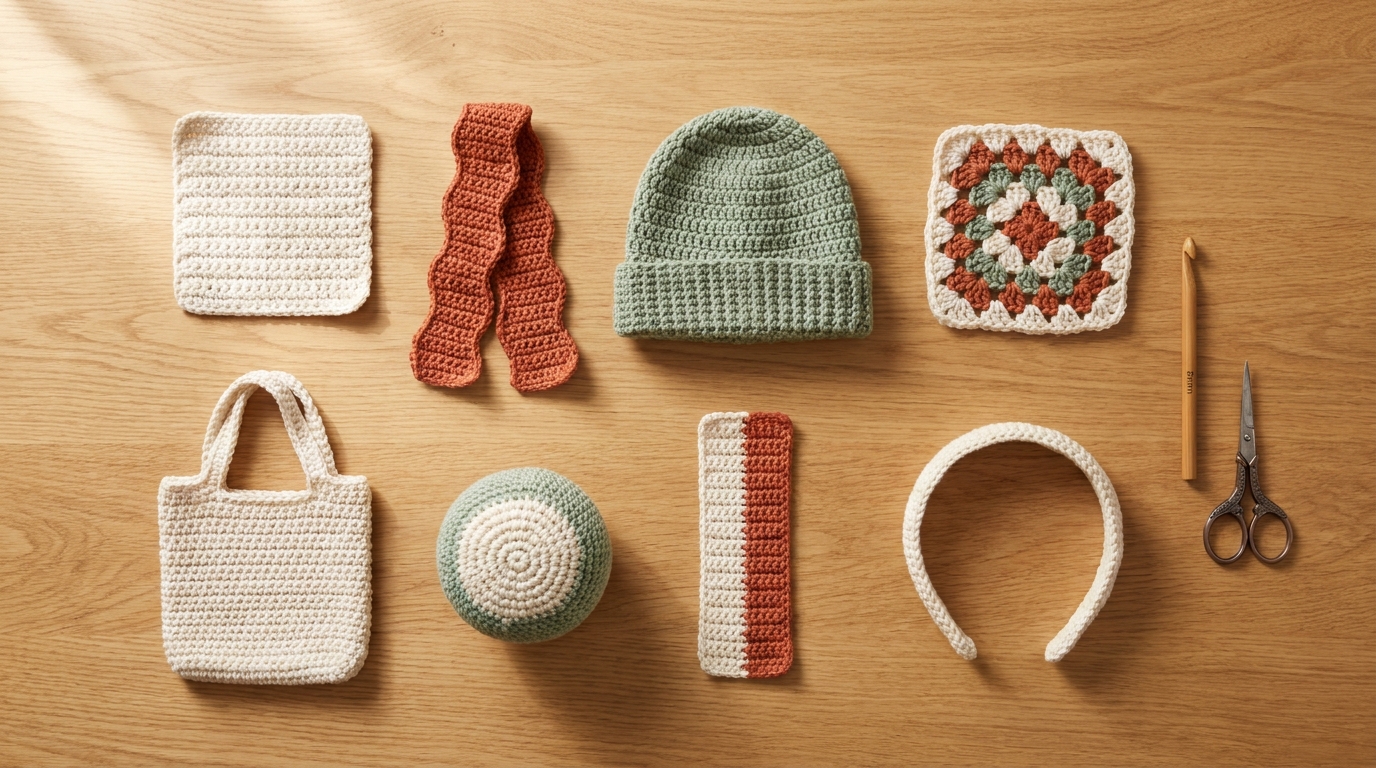
The eight projects below are sequenced from simplest to slightly more involved. Each one teaches something new without requiring you to learn multiple new skills at once. If you are brand new to crochet, start with the first one on the list before skipping ahead. The crochet for beginners guide covers the foundational stitches you will need for any of these projects.
For free patterns to try across several of these projects, the free crochet patterns 2026 collection has options for each skill level.
1. Dishcloth
Skill level: Absolute beginner Time estimate: 1 to 2 hours Stitches needed: Chain, single crochet
A dishcloth is the perfect first project because it is a flat rectangle with no shaping, no joining, and no counting beyond keeping your rows even. You make a foundation chain of around 25 to 30 stitches, work single crochet rows back and forth until the piece is roughly square, and fasten off. Done.
What makes it beginner-friendly is that getting it exactly right does not matter much. A dishcloth that is 8 inches instead of 7 inches is still a dishcloth. This low-stakes quality makes it ideal for learning tension without the pressure of producing a precise finished size. Cotton yarn works best for actual kitchen use, though any worsted-weight yarn works fine for practice.
What you will learn: the slip knot, the foundation chain, single crochet rows, turning your work, and fastening off.
2. Simple scarf
Skill level: Beginner Time estimate: 3 to 8 hours (depending on yarn weight and scarf length) Stitches needed: Chain, single crochet or double crochet
A scarf is a dishcloth made longer, so if you can finish the dishcloth you can finish a scarf. The main addition is choosing a stitch that works up at a pace you enjoy. Single crochet gives a dense, warm fabric but takes longer. Double crochet works up much faster and gives a softer drape, making it a very common beginner scarf choice.
Choose a bulky or super-bulky yarn with a 6 mm or larger hook for the fastest results. Your first scarf in chunky yarn can be done in a few hours across one or two sessions. This keeps motivation high and gives you a wearable finished piece quickly.
What you will learn: maintaining even width over many rows, finishing a longer project, and optionally, your first double crochet rows.
3. Bookmark
Skill level: Beginner Time estimate: 15 to 30 minutes Stitches needed: Chain, single crochet
A bookmark is one of the fastest finished crochet objects you can make. It is a narrow rectangle, typically 1 to 2 inches wide and 6 to 8 inches long, sometimes with a simple tassel or loop at the end. The small size means tension inconsistencies in the early rows are quickly left behind and forgotten as you work the rest.
Bookmarks are also ideal practice pieces between larger projects. When you want to try a new stitch or a new yarn without committing to a big project, casting on a bookmark takes nothing away from your main work.
What you will learn: working a narrow piece with consistent edges, and optionally adding a simple tassel or slip-stitched chain loop embellishment.
4. Headband
Skill level: Beginner Time estimate: 45 minutes to 1.5 hours Stitches needed: Chain, single or half double crochet, seaming
A simple crochet headband is a rectangle that gets seamed end to end. The only new skill beyond the scarf and dishcloth is sewing that seam closed with a yarn needle. The finished piece is a stretchy band that goes around the head, so it needs to be the right width (typically 3 to 4 inches) and the right length (typically 18 to 20 inches before seaming, to allow stretch over the widest part of the head).
Half double crochet is a great choice for headbands because it creates a slightly taller, more cushioned fabric than single crochet and works up quickly. The seam at the back of the band is straightforward: hold the two short ends together and whipstitch or mattress stitch through both layers.
What you will learn: simple seaming, working to a measurement instead of an arbitrary stopping point, and the half double crochet stitch.
5. Beanie hat
Skill level: Beginner (with patience) Time estimate: 3 to 5 hours Stitches needed: Chain, single or double crochet in rounds, slip stitch joins, basic decreases
A beanie hat is a significant step up from flat rectangles, but it is genuinely accessible for beginners who have finished at least one flat project. The main new skills are working in joined rounds, maintaining a consistent stitch count as you build the cylindrical body, and working simple decreases at the crown to close the top.
The construction is straightforward: start from the top with a magic ring and increase each round until the circle reaches head size, then work even rounds for the body, and decrease at the end if you are working crown-down. Alternatively, many beginner patterns work brim-up, which means you can try on the hat as you go to check the fit.
Choose a simple single-color pattern for your first hat. Leave colorwork and textured stitches for attempt two or three.
What you will learn: the magic ring, working in joined rounds, slip stitch joins at round ends, and basic single crochet decreases.
6. Granny square
Skill level: Beginner to intermediate Time estimate: 30 to 45 minutes per square Stitches needed: Chain, double crochet, slip stitch joins in rounds
A granny square is a small crocheted square built outward from a center ring in concentric rounds. It looks impressive but is made from just chains and double crochets arranged in a simple sequence. Once you know the pattern, you can make granny squares while watching TV, because the sequence becomes automatic quickly.
The single square is a satisfying object on its own, but granny squares also become building blocks for larger projects. Join a few together and you have a pot holder. Join many and you have a blanket or a tote bag. The how to crochet a granny square guide walks through the full sequence step by step with photographs.
What you will learn: starting from a center ring, working cluster stitches, turning corners in circular crochet, and the chain-space technique that defines the square's corners.
7. Simple amigurumi ball
Skill level: Beginner Time estimate: 45 minutes to 1.5 hours Stitches needed: Single crochet in continuous rounds, increases, decreases, stuffing
Amigurumi are crocheted stuffed figures, and while full animals and characters require some planning, a simple sphere is an excellent entry point. A crochet ball is just a circle that expands outward with evenly spaced increases and then closes in with matching decreases. It is the basis of every amigurumi figure's head and body, so making one standalone ball teaches you the core skill at the center of the whole genre.
The key difference from other beginner projects is working in continuous rounds without joining. You use a stitch marker to track where each round begins and work without stopping to join until the piece is done. Stuffing the ball as you decrease at the top is the only multi-step moment, and it is straightforward.
What you will learn: continuous rounds, evenly spaced increases and decreases, stuffing and closing amigurumi shapes, and the magic ring as a center starting point.
8. Granny square tote bag
Skill level: Beginner to intermediate Time estimate: 6 to 12 hours total Stitches needed: Double crochet, chain, joining rounds, single crochet border, seaming
A simple tote bag made from joined granny squares is a natural step up after you have made a few individual squares. The construction is: make a set of squares, join them into two flat panels, seam the panels together at the sides and bottom, add a simple single crochet or slip stitch border around the top opening, and attach handles (either crocheted or purchased bag handles).
The project reinforces granny square construction, introduces panel joining at scale, and produces a genuinely useful everyday object. Cotton yarn makes a tote that is durable and washable. Jute twine gives a stiffer, more structured finish.
Handles are the most flexible element. Crocheting long chains or rows of single crochet for handles is simple but produces something a little floppy. Bamboo bag handles or metal rings threaded with a single crochet trim give a cleaner, more polished result.
What you will learn: working to a consistent square size across many pieces, joining squares into panels, reading a simple assembly diagram, and adding functional finishing elements.
Choosing your next project
Once you have worked through two or three of these, you have a solid foundation of skills. Most beginner-to-intermediate patterns become accessible at that point. The skill tree branches quickly: a beanie leads naturally to colorwork and cables, granny squares lead to motif blankets and garments, and amigurumi skills transfer to any kind of stuffed figure.
If you want more structured options, the free crochet patterns 2026 guide includes recommended patterns across several skill levels with notes on what each one teaches. Pick the one that matches where your skills are now, not where you hope to be in six months.
Work at the level in front of you. The more complex projects become easy when you have genuinely internalized the simpler ones.