Why crochet patterns use symbols
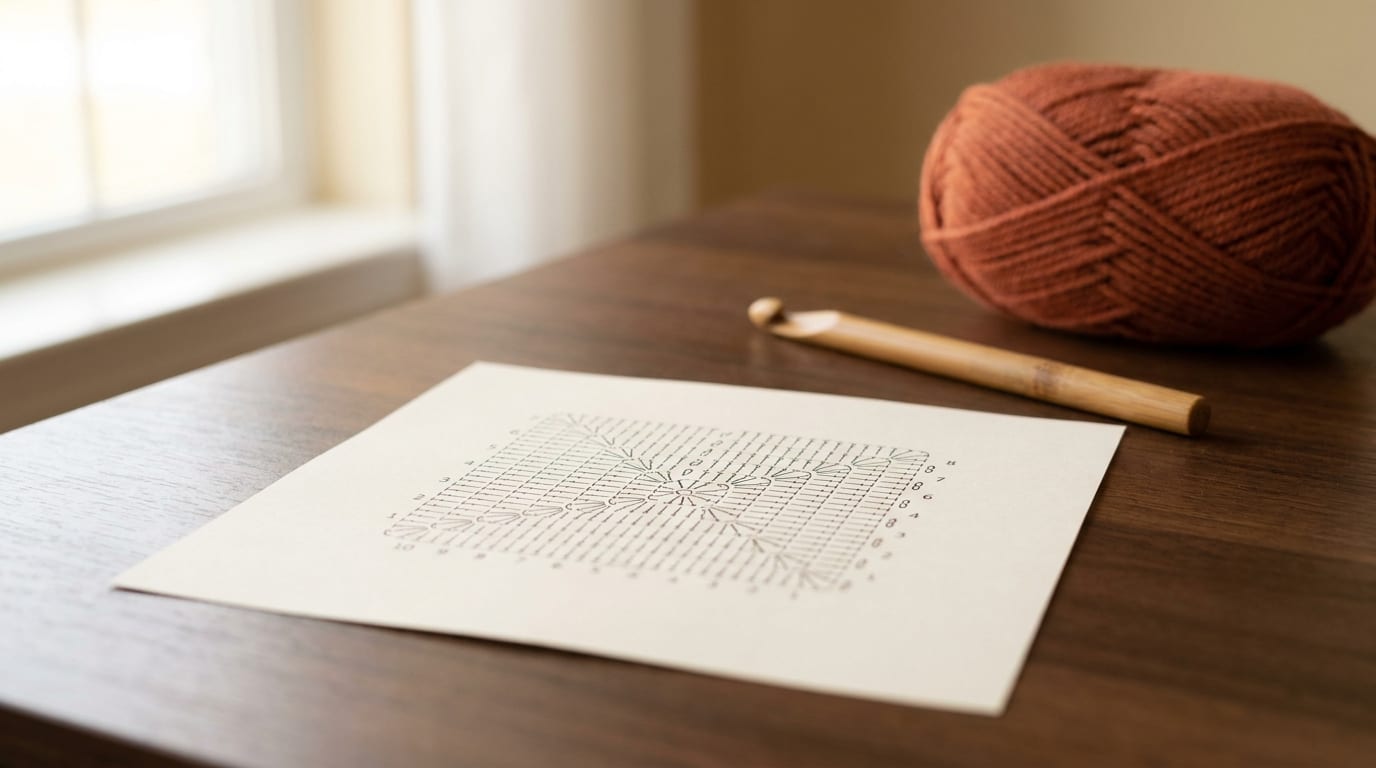
A written crochet pattern tells you exactly what to do in words: "ch 3, dc in 4th ch from hook, dc in next 5 sts." A chart does the same thing visually, replacing each instruction with a small icon placed in the position where you will actually work that stitch. When you look at a chart, you see the shape of the pattern before you crochet it.
That visual preview is the main reason crochet symbols exist. Complex lace patterns, granny squares, and intricate motifs are genuinely easier to follow as charts than as rows of text abbreviations. The chart shows you the whole structure at once -- where the increases are, where the clusters gather, how the motif repeats.
There is also a practical international reason. Because crochet symbols are standardized images rather than words, a chart published in Japanese, German, or Spanish is readable by any crocheter who knows what the symbols mean. Learning them once opens up a much wider pool of patterns.
The 12 essential symbols
Publishers do use slight variations in some symbols, but these 12 icons appear consistently across the majority of crochet charts in print and online.
Chain (ch) -- an oval or small ellipse. The most basic symbol, representing a single chain stitch. A row of ovals drawn in a line shows a foundation chain. When you see a small oval between other symbols, it represents a chain space.
Slip stitch (sl st) -- a filled oval or small solid dot. A slip stitch is the shortest crochet stitch, used to join rounds or move across stitches without adding height. The filled or darkened oval distinguishes it from the open chain oval at a glance.
Single crochet (sc) -- an X or plus sign. Single crochet is the shortest building stitch and the most common choice for dense, firm fabric. Different publishers use either an X or a plus sign for this stitch. Both mean exactly the same thing.
Half double crochet (hdc) -- a T with one short horizontal bar. The half double crochet is taller than a single crochet and shorter than a double. The T shape in the symbol represents the vertical post of the stitch, and the bar represents the extra yarn-over that makes it slightly taller.
Double crochet (dc) -- a T with two short horizontal bars. The standard tall stitch used in most blanket and garment patterns. The two bars on the T symbol indicate the two yarn-overs that form this stitch.
Treble crochet (tr) -- a T with three short horizontal bars. A treble is taller than a double crochet and is used in lace, tall motifs, and fan stitches. The three bars indicate three yarn-overs.
Magic ring -- a circle with an arrow. The magic ring (also called a magic loop) is the starting point for anything worked in continuous rounds, including granny squares and amigurumi. The circle with an arrow shows you the adjustable starting loop.
Turning chain -- a small curved chain or labeled oval. The turning chain is the set of chains you work at the start of a row to bring your hook to the right height for the next stitch. Charts often show it as a small chain with a directional arrow indicating the turn.
Increase -- two symbols sharing a base point. When a chart shows two stitch symbols converging at the same base point, it means you work both stitches into a single stitch below. This is how you add stitches and create shaping.
Decrease -- two symbols converging at the top. The mirror image of an increase: two symbols sharing a top point means you work them together as one, leaving only one loop on the hook at the end. This removes one stitch and creates the same effect as sc2tog or dc2tog in text.
Front post and back post -- stitches with arrows or curved bases. Post stitches wrap around the post of the stitch below rather than inserting through the top loops. Charts show these with a small arrow or a curved base on the T symbol indicating the direction of the wrap.
Bobble, cluster, or puff -- a filled teardrop or fan shape. Three-dimensional raised stitches are shown as a filled teardrop or rounded fan shape. The exact shape varies by pattern, but these symbols always indicate a stitch that gathers multiple loops before closing.
US vs. international symbol differences
The symbols themselves are largely consistent across countries, but what they are called differs between US and UK terminology. This matters because a chart uses the same T-with-two-bars symbol regardless of whether the pattern is written in US or UK terms, but the stitch that symbol represents has different names.
In US terminology, a double crochet is a tall stitch worked with two yarn-overs. In UK terminology, the same stitch is called a treble crochet. Meanwhile, what UK crocheters call a double crochet is what US crocheters call a single crochet.
The practical rule: always check the first page of any pattern for a note that says "US terms" or "UK terms." If the pattern uses a T-with-two-bars and calls it a double crochet, it is US terminology. If it calls the same symbol a treble, it is UK. Getting this wrong shifts every stitch height in the pattern by one level.
How to read a flat-row chart
A chart for a flat piece like a scarf or blanket panel is read from the bottom upward, mirroring how you build the fabric from the foundation chain.
Row 1 is at the bottom of the chart and reads from right to left (the same direction you crochet). Row 2 reads from left to right, because after turning the work, you now crochet in the opposite direction. Odd rows read right to left; even rows read left to right.
Repeat brackets are shown as a section of the chart enclosed in a box or marked with asterisks in the written notes beside the chart. The bracketed section is the unit you repeat across the row as many times as directed.
How to read a round chart
Charts for motifs, granny squares, and pieces worked in the round start at the center and grow outward. Round 1 is the innermost ring -- usually a magic ring with a few stitches worked into it. Round 2 is the next ring out, and so on.
Read each round counterclockwise as it appears on the chart, which mirrors the counterclockwise direction of most rounds when the right side faces you. Some charts number each round with a small numeral near the start of that round to help you keep track.
Join rounds are shown as a small filled dot (slip stitch) at the point where the round closes, and the turning chain for the next round often appears immediately after it.
Why charts are useful even if you prefer written patterns
You do not have to choose between charts and written patterns -- most good pattern books include both, and switching between them is useful depending on where you are in the project. Charts help you understand the overall structure and catch mistakes early because you can see the shape of the stitch pattern. Written instructions are easier to follow stitch by stitch when you are deep in a long repeat.
Using both together is the most efficient approach. Read the chart to understand the pattern before you start. Follow the written instructions row by row as you work. Cross-check against the chart when something does not look right.
The crochet abbreviations guide covers the text side of pattern reading, which pairs directly with chart reading. If you want to practice reading a complete written pattern from start to finish, the how to read a crochet pattern guide walks through every section of a typical pattern in order. The stitch chart maker tool lets you build your own visual charts for original designs.