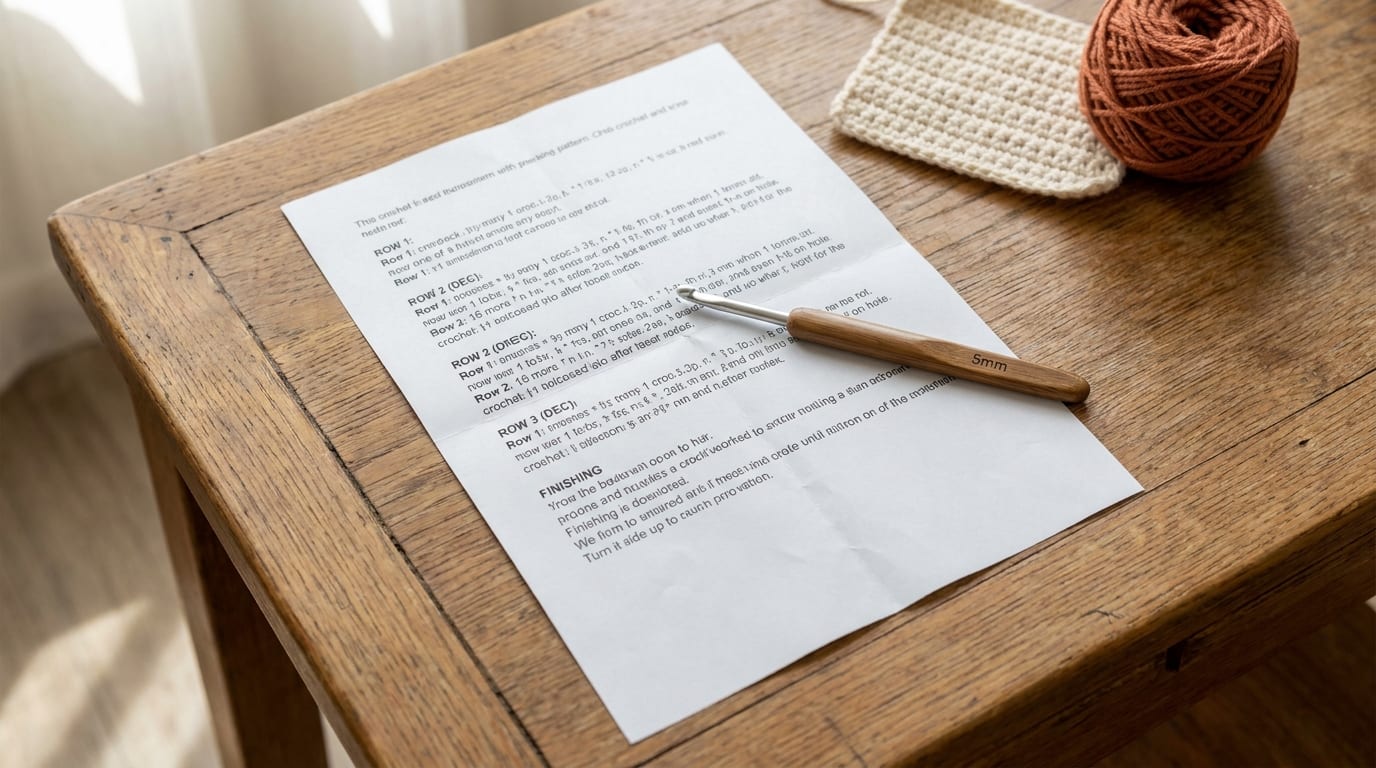
A pattern is just a recipe
A crochet pattern is a set of instructions written in a compressed shorthand. It tells you what materials to use, how to set up, and then walks you through every row or round in order. Once you understand the structure and the abbreviations, reading a pattern is no different from following a recipe: you assemble your ingredients, then follow the steps in order.
The difficulty for beginners is not that patterns are complicated. It is that they use abbreviations, symbols, and notation conventions that are unfamiliar at first. This guide walks through each section of a typical pattern, explains what you will find there, and shows you how to read the instruction lines without getting lost.
For a quick reference on what each abbreviation means, keep the crochet abbreviations guide open alongside this one as you read your first few patterns.
The five sections of a crochet pattern
Most patterns follow a consistent structure. Learning to recognize the sections lets you find what you need quickly and gives you a mental map before you start crocheting.
1. Materials list
The materials section tells you everything you need to gather before you start. It typically includes:
- Yarn: the specific yarn used in the pattern (name, colorway, weight), plus the total yardage or weight needed. If you are substituting yarn, match the weight and check gauge.
- Hook size: the recommended hook, usually in millimeters and the US letter equivalent, like "5 mm (US H-8)." This is a starting recommendation, not a fixed rule. Your gauge check will confirm whether to use this size or adjust.
- Notions: anything else needed, such as stitch markers, yarn needles, scissors, buttons, or a tape measure.
- Finished measurements: the size of the completed piece. For a blanket that might be "48 × 60 inches." For a hat it might be "fits head circumference 20–22 inches."
Read through the materials list completely before you start. Discovering halfway through that you need locking stitch markers and you only have ring markers is an avoidable interruption.
2. Gauge
Gauge tells you how many stitches and rows should fit into 4 inches (10 cm) of fabric using the pattern yarn and hook. A typical line looks like: Gauge: 14 dc and 8 rows = 4 inches in double crochet.
For items with a fit requirement, you need to make a gauge swatch and confirm your numbers match before starting. For decorative items and things where exact dimensions are flexible, gauge is a useful reference but not always mandatory.
3. Abbreviations and special stitches
Good patterns include an abbreviations key, either a full list or a selection of abbreviations used in that specific pattern. Read through this section before you begin the instructions.
Some patterns also include a "special stitches" section before the main instructions, where they explain any non-standard techniques used in the pattern. If a designer uses a custom stitch they have named, like "crossed dc" or "puff st (their version)," they will define it here with step-by-step instructions. Do not skip this section. If the pattern uses a special stitch in row 4 and you have not read how to make it, you will be stopping mid-row to figure it out.
4. Pattern instructions
The main instructions section is the core of the pattern. It is written either row by row (for flat pieces) or round by round (for circular pieces). Each line covers one row or round and tells you every stitch to make.
5. Finishing
After the last row or round, most patterns include finishing notes. This might be instructions for seaming pieces together, adding a border, weaving in ends, blocking, or attaching buttons or embellishments. Do not skip to this section early. Finishing often references specific edges or seam allowances that only make sense after you have completed the main construction.
Reading row-by-row instructions
For flat pieces like scarves, dishcloths, and blankets, the pattern works in rows. You crochet across a row, reach the end, turn your work, and come back in the opposite direction.
A typical row instruction looks like this:
Row 1: Ch 1 (does not count as st), sc in each st across, turn. (30 sts)
Reading this left to right:
Row 1:This is the first row of actual stitches after the foundation chain.Ch 1 (does not count as st)You chain 1 to bring the hook to the right height for single crochet, but this chain is not counted as a stitch when you come back to work across this row on the next pass.sc in each st acrossWork one single crochet into every stitch all the way to the end of the row.turnRotate your work so the other side faces you, ready for the next row.(30 sts)Your row should contain exactly 30 stitches when complete.
A more complex row instruction might look like this:
Row 4: Ch 3 (counts as dc), dc in next 2 sts, * sk 2 sts, (dc, ch 2, dc) in next st; rep from * to last 3 sts, dc in last 3 sts, turn. (38 sts)
Here:
Ch 3 (counts as dc)The turning chain counts as your first double crochet, so you do not work a dc into the first stitch below it.dc in next 2 stsTwo double crochets into the next two stitches.* sk 2 sts, (dc, ch 2, dc) in next st; rep from * to last 3 stsThe asterisks mark a repeat. Skip 2 stitches, then work a dc, ch 2, and another dc all into the same stitch. Repeat this sequence until 3 stitches remain.dc in last 3 stsWork a double crochet in each of the final 3 stitches.
Reading round-by-round instructions
Circular patterns use rounds instead of rows. Common examples include hats, granny squares, amigurumi, and circular dishcloths.
Rounds often begin from a center starting point. Many patterns use a magic ring for this, which creates an adjustable loop that closes tight once you work stitches around it. Some patterns substitute a short chain joined into a ring.
A typical round instruction:
Rnd 1: Work 6 sc in magic ring, join with sl st to first sc. (6 sts)
After the first round, subsequent rounds increase in stitch count to spread the circle outward, or maintain the same stitch count to build straight walls (as in a hat).
Rnd 2: Ch 1, 2 sc in each st around, join with sl st to first sc. (12 sts)
Rnd 3: Ch 1, * sc in next st, 2 sc in next st; rep from * around, join with sl st to first sc. (18 sts)
Each asterisk repeat here covers 2 stitches, one regular single crochet and one increase, and the sequence repeats around the full round.
Joined vs. continuous rounds. Some circular patterns, particularly amigurumi, work in continuous rounds without joining. The instructions will say "work in continuous rounds" or "do not join." You use a stitch marker at the start of each round to track where one round ends and the next begins.
Understanding repeats
Repeats appear in almost every pattern. They compress what would otherwise be very long instruction lines.
Asterisk repeats use * and * (or sometimes **) to mark the beginning and end of a repeated section:
* sc in next 2 sts, ch 2, sk 2 sts; rep from * across
You work sc in next 2 sts, ch 2, sk 2 sts once, then you repeat that exact sequence across the full row or for the number of times specified.
Bracket repeats use [ ] to group stitches that belong together. Sometimes a pattern uses both asterisks for the main repeat and brackets for a grouped cluster within it:
* [dc, ch 1, dc] in next ch-sp, sk 1 st; rep from * to end
The brackets tell you that the dc, ch 1, and dc all go into the same chain space. Read the brackets as a unit.
Repeats a specific number of times. When a pattern says rep from * 4 times, that means you work the section four more times after the first pass. You work it five times total.
Stitch counts at the end of rows
The number in parentheses at the end of each row or round, like (24 sts), is the pattern author's expected stitch count at that point. Count your stitches after every row, especially while you are learning.
If your count does not match, you made an error somewhere in that row. Do not continue to the next row. Instead, count backwards through the row to find where the count went wrong. Common causes are accidentally adding a stitch by working into the turning chain when you should not, missing a stitch at the row end, or misreading a repeat and working one extra or one fewer repeat than intended.
Catching errors at the stitch-count check saves you from ripping back many rows later.
Following patterns for multiple sizes
Garment patterns often cover several sizes at once. The notation lists all sizes together, smallest first, with larger sizes in parentheses:
Foundation chain: ch 41 (45, 49, 53)
Before you start any multi-size pattern, decide your size and mark that number throughout the pattern. If you are making size 2 (the second number in the parentheses), circle every second number in the entire pattern. This takes a few minutes but prevents you from accidentally switching to the wrong size partway through when you are focused on your stitches rather than your notes.
How to handle a pattern you do not understand
You will encounter pattern instructions that do not make sense on first reading. This is normal. When it happens:
- Re-read the special stitches section to see if the term is defined there.
- Check the abbreviations key.
- Look at the stitch count at the end of the row and work backwards: how many stitches do you need to have made to arrive at that count?
- Try working the instruction with scrap yarn so you can experiment without risk.
Patterns in the crochet patterns library include full stitch explanations and are written with first-time pattern readers in mind. They are a good place to practice reading instructions before tackling more complex designs.
A solid grasp of abbreviations makes every pattern easier. The crochet abbreviations guide covers the full US term list and the US vs UK terminology difference in one place.
Reading patterns gets faster quickly
The first time you read a full crochet pattern, it can feel like decoding a foreign language. The second time is noticeably easier. By your third or fourth pattern, the structure is familiar and you are spending your attention on the actual craft rather than the notation.
Work through a simple pattern once with this guide beside you, checking each section as you reach it. After one complete project, the anatomy of a pattern becomes second nature and the shorthand starts to read as naturally as ordinary text.