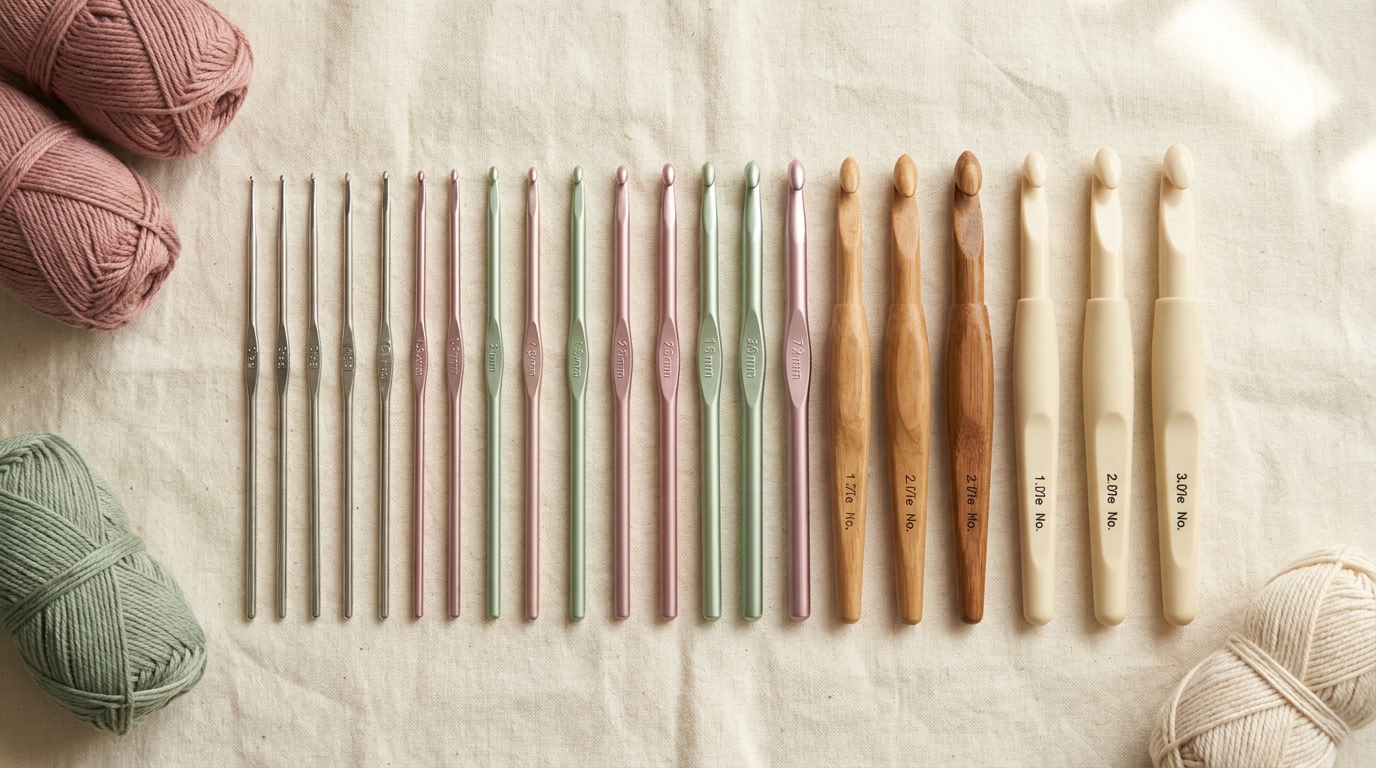
Why hook sizes can be confusing
Crochet hook sizes are labelled in at least two systems — US letter/number and metric millimetres — and the two do not always line up neatly. A pattern might call for a US H/8 hook, a 5 mm hook, or simply an 8, and all three can mean slightly different things depending on the brand. Understanding how the systems work, and knowing that the millimetre measurement is always the reliable one, clears up most of the confusion.
This guide covers every common hook size in one place, explains when to go up or down a size, and helps you choose between hook materials.
The complete crochet hook size chart
The table below lists the most common crochet hook sizes with US letter, US number, metric (mm), and UK sizes. The mm column is the most universal — when in doubt, match this.
| US Letter | US Number | Metric (mm) | UK Size | Common Use | |-----------|-----------|-------------|---------|------------| | B | 1 | 2.25 mm | 13 | Thread crochet, lace | | C | 2 | 2.75 mm | 12 | Thread, fine cotton | | D | 3 | 3.25 mm | 10 | Light fingering yarn | | E | 4 | 3.50 mm | 9 | Fingering to sport weight | | F | 5 | 3.75 mm | 9 | Sport weight | | G | 6 | 4.00 mm | 8 | DK weight | | — | 7 | 4.50 mm | 7 | DK to worsted | | H | 8 | 5.00 mm | 6 | Worsted weight | | I | 9 | 5.50 mm | 5 | Worsted to aran | | J | 10 | 6.00 mm | 4 | Aran to bulky | | K | 10.5 | 6.50 mm | 3 | Bulky | | L | 11 | 8.00 mm | 0 | Bulky to super bulky | | M/N | 13 | 9.00 mm | 00 | Super bulky | | N/P | 15 | 10.00 mm | 000 | Super bulky | | P/Q | — | 15.00 mm | — | Jumbo | | S | 35 | 19.00 mm | — | Jumbo / arm crochet |
Note on steel hooks: Steel hooks for thread crochet run on their own numbering scale that goes in reverse — a steel size 1 is larger than a steel size 14. They are listed separately from aluminium hooks at the shop. For thread crochet and doilies you will specifically want steel hooks in sizes 0–14.
If you want a quick interactive version, the free crochet hook converter lets you type in any size and see the equivalent in other systems.
How to match hook size to yarn weight
Each yarn weight has a recommended hook size range. You will find the suggested hook size on the yarn label's ball band — it is usually printed alongside a crochet hook symbol and given in both mm and US size.
The standard recommendations are:
| Yarn Weight | Recommended Hook | |-------------|-----------------| | Lace / Thread | Steel 4–14 (0.75–1.75 mm) | | Fingering | B–E (2.25–3.50 mm) | | Sport | C–F (2.75–3.75 mm) | | DK | G–7 (4.00–4.50 mm) | | Worsted | H–I (5.00–5.50 mm) | | Aran | I–K (5.50–6.50 mm) | | Bulky | K–L (6.50–8.00 mm) | | Super Bulky | M–P (9.00–15.00 mm) | | Jumbo | P and above (15 mm+) |
These are ranges, not fixed rules. Your actual gauge — how many stitches and rows fit in four inches — determines whether the recommended size works for your tension. See the gauge swatch note below.
If you are working with worsted weight yarn, a US H/8 (5 mm) or I/9 (5.5 mm) is the most common starting point.
How hook size affects your fabric
Changing hook size changes more than just gauge. It changes the feel and drape of the finished fabric.
Smaller hook than recommended: tighter fabric, firmer texture, less drape. Better for amigurumi (stuffed toys) where you want a dense fabric that does not let stuffing show through. Can feel stiff for garments.
Larger hook than recommended: looser fabric, more drape, airier texture. Better for shawls, wraps, and lightweight garments where you want movement. Stitches are more visible and open.
Matching the recommended size: produces a fabric in the middle — structured but not stiff, with the weight and drape the yarn was designed to show off.
There is no single right answer. Many crocheters deliberately go up a hook size from the yarn label recommendation when making garments, because a slightly looser fabric drapes more naturally. Others go down a size for bags or baskets to get a firmer structure.
The importance of a gauge swatch
A gauge swatch is a small sample you crochet before starting a project, counted to check that your stitch size matches what the pattern expects. It sounds like extra work, but it saves the frustration of a finished item that is the wrong size.
To check your gauge:
- Chain enough to make about a 15 cm (6 inch) square.
- Work in the pattern stitch for several rows until the piece is roughly square.
- Flatten it without stretching it and measure the middle — not the edges, which can pull.
- Count how many stitches and rows fit in 10 cm (4 inches).
- Compare to the pattern's stated gauge.
If you have too many stitches in 10 cm, your tension is tight — go up a hook size. If you have too few, your tension is loose — go down a hook size. Then swatch again with the new size.
Hook materials: what to know
The hook diameter and shape are what matters most, but the material of the handle affects how working feels over a long session.
Aluminium
The most common material. Smooth, slightly cool to the touch, and very affordable. Yarn glides easily over aluminium, which makes it a fast, comfortable choice for most yarn types. Aluminium hooks are the standard recommendation for beginners because they are widely available, work with all yarn weights, and are inexpensive enough to buy a full set without much outlay.
Steel
Used exclusively for thread crochet (lace, doilies, fine cotton work). Steel hooks are smaller and narrower than aluminium hooks, and they are strong enough not to bend under the tension that thread crochet requires. If you are working from a thread crochet pattern, you need steel hooks — aluminium ones are not made small enough.
Wood and bamboo
Warm to hold, slightly grippy, and lighter than metal. The friction slows yarn down a little, which helps when working with slippery yarns like silk, bamboo fibre, or smooth cotton. Some crocheters find wood more comfortable than metal for long sessions. The trade-off is that wood hooks are less durable — they can splinter or warp if left in damp conditions, and they are more vulnerable to breakage in very small sizes.
Plastic and resin
Lightweight and smooth, most often found in larger sizes (K and above) where a metal hook would be heavy. Transparent or colourful resin hooks have become popular as an aesthetic choice. They work well and are comfortable to hold in larger sizes.
Ergonomic handles
Ergonomic hooks are not a separate material — they are usually aluminium or steel hooks with a wide, cushioned or contoured handle moulded around the shaft. The wider grip distributes pressure across the palm rather than concentrating it on the fingers, which reduces hand fatigue during long crochet sessions.
If you find your hand cramping or aching after an hour of crochet, an ergonomic hook is worth trying. The hook tip works identically to a standard hook — the only difference is the handle.
Choosing your first set
If you are buying your first hooks and want a practical set that covers most patterns, here is a straightforward approach:
- For a single starter hook: US H/8 (5 mm). Works with worsted weight yarn, the most common beginner yarn weight.
- For a small beginner set: sizes G/6 (4 mm), H/8 (5 mm), I/9 (5.5 mm), and J/10 (6 mm) cover the most common patterns.
- For a complete set: a boxed aluminium set from any craft shop will include B through K or similar and give you a hook for almost any standard pattern.
Avoid buying a full interchangeable set until you know which sizes you use most. A simple set of individual hooks is more useful when you are starting out.
For quick size conversions when you are mid-project and unsure, the crochet hook converter at CrochetZen handles US, metric, and UK sizes in one place.
Storing your hooks
Hooks get lost easily. A rolled fabric case or a zipper pencil case keeps them together and protects the tips. Avoid leaving them loose at the bottom of a project bag where tips can bend or where you spend five minutes rummaging every time you want a specific size.
Label any hook that does not have a size stamped on the shaft. A small sticky label on the handle saves a lot of guesswork.